
Blog
Governance Reimaginings (or, There’s Got To Be A Better Way)
Brendan McMurtry-Howlett on the challenges of navigating a board of directors as a young artistic director, and the project Generator has undertaken with Shakespeare in the Ruff and Toronto Dance Community Love-in to look at alternative governance models.
This is the first post in Generator’s ‘Governance Reimaginings’ blog series. You can find all posts in the series here, and everything we’ve published related to boards here. In this post, Generator Strategic Advisors Co-Chair and Board Member Brendan McMurtry-Howlett introduces the project.

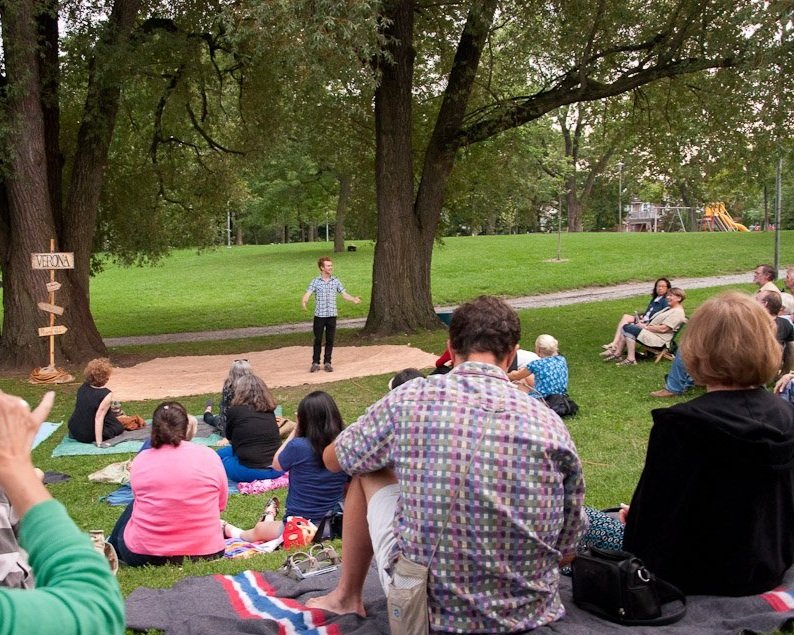
Kaitlyn Riordan, Brendan McMurty-Howlett, and AJ Richardson (left to right) in Withrow Park, Shakespeare in the Ruff’s home base, in 2012 (perhaps contemplating the nature of governance, who’s to say?) — photo by Daniel Daley
So, my friends, we’ve had a couple blog posts about boards and governance already, primarily highlighting the shortcomings and challenges of the legislated model (i.e. systemic patriarchy and white supremacy). You can do a quick little recap here and here. You can also basically ask anyone who has ever sat on a board or worked with a board and they’ll likely give you a litany of issues…as well as a handful of positives.
Despite the widely acknowledged flaws of the non-profit board governance system that a company becomes beholden to as soon as it incorporates, “to incorporate or not to incorporate” is a question Generator hears routinely.
This, of course, is never as simple a conversation as the independent companies asking hope it will be (although we did write an ArtistProducerResource.com page about it to cover the basics). There’s pressure on indie companies who are looking to grow to pursue incorporation, either for regular non-profit status, or the coveted, yet misunderstood “charitable status” (Cue the pots of gold dancing in artists’ eyes.)
We’ve been having this discussion on repeat for years, emphasizing the systemic white supremacy and patriarchy that plagues the non-profit board of directors model—but we haven’t really had a clear alternative to point to. So, we thought we’d try to do something about it. We teamed up with Shakespeare in the Ruff and the Toronto Dance Community Love-in, two companies we’ve worked with closely over the past few years through our Company Collaborator program, to propose a project exploring alternative governance models—and lo and behold, the funding came through!
But first, how did I get here?
I’ve been peripherally connected to Generator (and even the former version: STAF) for a number of years. I helped found Shakespeare in the Ruff and served as the Artistic Director for the first five years, before passing the torch to Kaitlyn Riordan and Eva Barrie, who have now completed their tenures as well. More recently, I joined Generator’s board, curious to experience the board structure from the other side. See, as a young artist producer launching Shakespeare in the Ruff, I myself was lured by the promise of incorporation and charitable status. Well, to be perfectly honest, we were forced to incorporate in order to obtain a permit to perform in a city park. But, it seemed like a reasonable step to take since we wanted to grow the company and increase our access to resources.
I flew headlong into incorporation, and the accompanying “corporate” requirements and mandated board of directors, without much thought to what it actually meant.
I soon found myself trying to quickly learn the language of a corporation: Robert’s Rules, by-laws, minute-taking and motions. I filled our board with non-artists, as per the advice of the day: lawyers, accountants, corporate marketing experts, and the like.
I soon found I was living a double life: an artist in the rehearsal hall, actively embracing uncertainty with a robust creative process and vocabulary to navigate it; and a corporate executive in the board meetings, faking my way through meetings, discussing corporate decision-making procedures —steering clear of uncertainty at all costs lest the board of non-artists get scared and panic in a way that might undermine the organization. I found I was frequently undermining my own expert knowledge of the arts industry to defer to a corporate lawyer who waved around their “fiduciary duty” like a beating-stick.
I couldn’t provide leadership within the vocabulary and processes of a corporation, and the corporate directors couldn’t provide leadership for an arts industry they knew nothing about.
At the lowest point, our board imploded over disagreements of corporate procedure, and the company very nearly folded. No joke: Shakespeare in the Ruff, now celebrating its tenth anniversary and welcoming a third generation of leadership, almost went belly-up in year three.
I don’t believe there was malicious intent from any party. We were all simply pushed into a system of operating that did not arise from the values or ways-of-knowing of the artistic company itself. None of us had clarity on the actual functions of governance, beyond fulfilling the legal structure insisted upon by the Incorporation Act.
There were also many great experiences with Ruff’s board, where I was genuinely supported by a community of artists and non-artists alike to achieve more than I ever could have on my own. These polar oppositional experiences piqued my curiosity, and ever since leaving Shakespeare in the Ruff, I have sought to learn more about the spirit of governance and the legal structures we have in place. (I even went and did a Master’s degree looking at some of this stuff, but that’s a different story.) When the opportunity arose to join this project (and help write the grant), I jumped at it.

Brendan with Wayne Burns (right) in a production photo from Romeo and Juliet in 2016 — photo by Cylla von Tiedemann
Brendan welcoming Ruff audiences before a performance of Two Gents in 2012
So what is the project?
From the outset, the core of this project has been the desire to tackle the seemingly overwhelming topic of ‘governance’ within the context of a community of artist producers thinking about similar questions, but each through the lens of slightly different operating structures.
The Toronto Dance Community Love-in is an incorporated non-profit, and has operated with a collective leadership model since their inception. Shakespeare in the Ruff is a theatre company that has been operating under a co-leadership model, but is now undergoing a leadership transition towards a collective model, as well as a moment of transition with their board. Ruff is an incorporated charity which means they’ve got an extra layer of regulations and reporting requirements on their “corporate” structure.
We wanted to achieve a few things through this project. First, we wanted to learn. What are the other possibilities for governance models and structures? What are the exact legal requirements, and are there any loopholes in fulfilling them? What does “governance” actually mean separate from the non-profit board-of-directors model? Second, we wanted an opportunity within each of our three organizations, to try things out, do things differently, and experiment with governance and organizational structures based on our learning. Third, we wanted to share our learnings with the broader community…hence this blog post. And there will be more blog posts coming.
Throughout the past six months, we’ve structured our project as a series of (mostly Zoom) learning sessions, inviting in various knowledgeable folks who each bring a different perspective to the concept of governance and non-profit structures. These have been incredibly enlightening and exhilarating sessions, filling my head and heart with so many ideas, and allowing for an intimate discussion about the issues. We’ve been meeting with folks such as Jane Marsland, Yvette Nolan, Zainab Amadahy, Elder Whabagoon, Cynthia Lickers-Sage, and others.
What has struck me so far in these sessions is that governance is no one thing for any one person. It is about a practice of decision making that is undertaken in community. There is no magic wand, or perfect structure that will solve all the problems. Anything we create must be engaged with, nourished, and sustained by those impacted by and connected to the organization.
We’ve also had sessions where we’ve all shared our current thinking and questions, as well as how each of our uniquely structured organizations are wrestling with the shared issues. These sessions have been just as enlightening as those with invited guests, as I’ve been exposed to the innovative thinking and practical adjustments that my fellow participants have been doing within their own organizational contexts.
Over the next couple of months, we will be publishing a series of blog posts written by various people participating in this project. Some of them will be engaging with the learnings offered to us by our guest speakers. Some of them will be personal reflections on an evolving understanding of governance. We hope they will all be wildly entertaining. Or, at the very least, we hope to contribute to a growing community of folks in the arts (as well as other sectors) who are taking a good hard look at governance and the ways we make decisions together. We are all starting to recognize that in order to address systemic racism and patriarchy, we need to address our systems, and be bold in dreaming up something different.
These times of upheaval are an opportunity, if we can find the energy. As Yvette Nolan said to us, "I don't know how long this window is going to be open for." This is urgent work, and the more we share our growing knowledge on the subject of organizational transformation, the better our chance of enacting change that will reverberate through our sector…and honestly, hopefully the world too.
Governance Reimaginings asks how we can deconstruct inherited governance structures to create systems of accountability and community care that support, and are aligned with, the values of the organizations and individuals they serve. Structured as a knowledge exchange between Generator, Shakespeare in the Ruff, and the Toronto Dance Community Love-in, Governance Reimaginings took place between April-December 2021 and featured a series of instigations by invited guest speakers. We gratefully acknowledge the support of the Chalmers Family Fund, administered by the Ontario Arts Council, for this project.


Board Governance: What is it? What is possible?
Reflections on a discussion about what power boards have, what is possible when we look at alternative ways of operating, and what we mean we talk about accountability.
A conversation with Generator Generations
What power do boards have? Generator’s Lead Producer Kristina Lemieux used this prompt to launch a conversation around what we know (and what we think we know) about boards of directors, and what is possible when we look at alternative ways of operating.
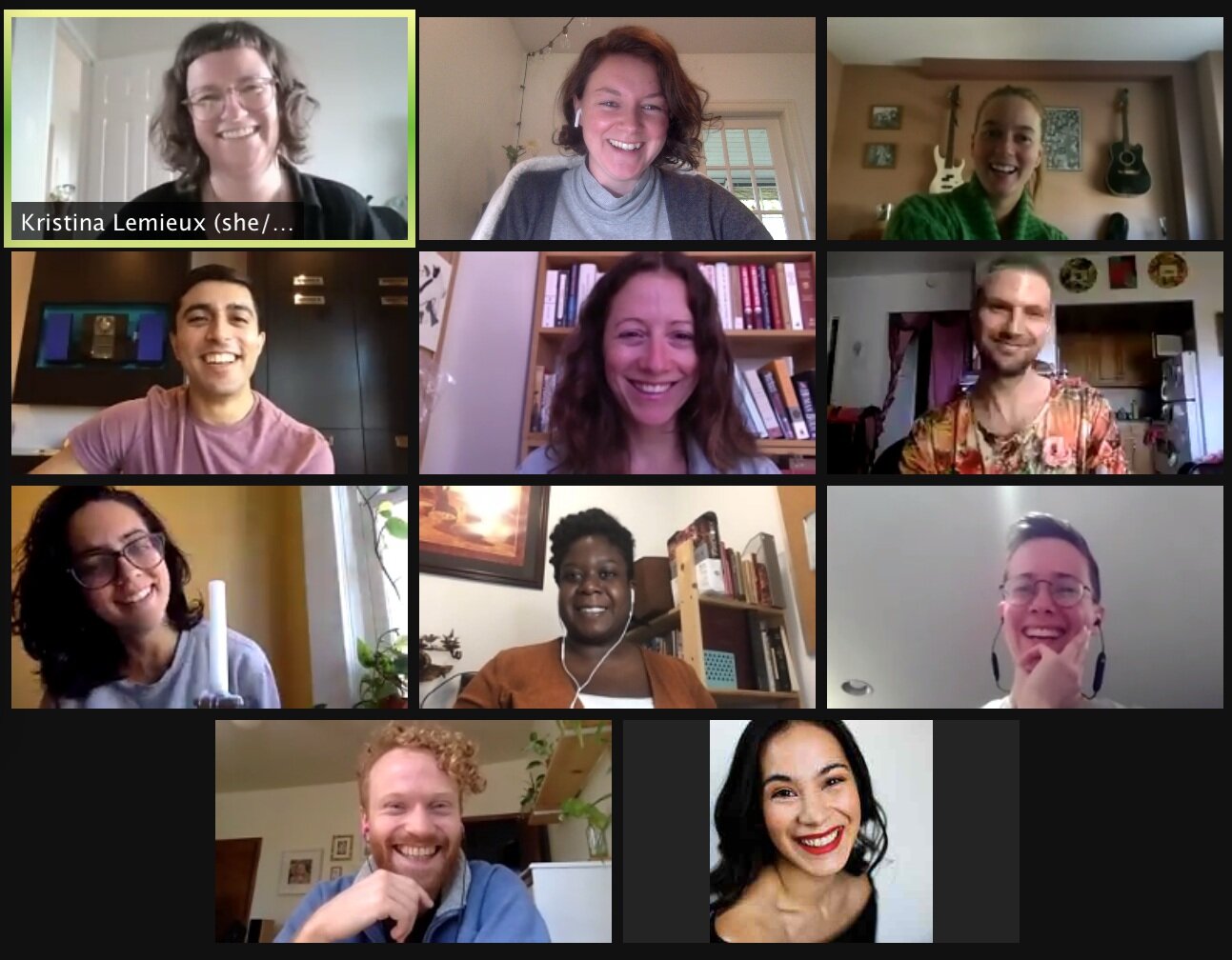
Present at the Zoom discussion this blog post was based on: seven community members (Eva Barrie, Robyn Breen, Jacqueline Costa, Rohan Dhupar, Brock Hessel, Brendan Howlett, and Kaitlyn Riordan) and Generator’s staff team (Annie Clarke, Sedina Fiati, Kristina Lemieux, and Keshia Palm).
Over the past few months we’ve been inviting our community of program alumni to ‘Food for Thought’ conversations, exploring topics related to transformation, opportunity, and growth—much like we’re doing right here on our Learnings + Explorations blog. One of the big topics we’ve been exploring is boards of directors (Kristina got us started on the blog in October with We’re going to talk about boards a lot—here are some introductory frameworks to get us started). This post is based on a discussion that took place over Zoom in October that we called ‘Board Governance: What is it? What is possible?’
Why boards?
Boards of directors of non-profit organizations in Canada have a fiduciary duty, tasking them with the responsibility to act in the best interests of the organization by overseeing the resources of the organization in line with its stated mandate. There may be additional external oversight if the organization has charitable status and/or is operating beyond the financial threshold at which public funding bodies require an annual external audit.
It’s important to note that many of the reasons why our boards are the way they are stem from the requirements of public funders.
The relevant acts for organizations incorporated in Ontario, BC, and at the federal level, all say that compensating board members is permitted for non-profits (this is not the case for registered charities); the funders, however, expressly forbid it. As a result, one of the givens we work with in the non-profit sector is that individual board members are volunteers—a fact that inevitably dictates the amount of work and engagement it is reasonable to expect from them.
Boards are often held up as forces for accountability. But what kind of accountability are we talking about exactly? Financial accountability is achieved by an audit—having boards as additional oversight is arguably redundant. Accountability to the funders is provided through reporting—if you’re awarded money for programming, you need to provide evidence of that programming being carried out. You probably do similar forms of reporting to donors, sponsors, even audience members. But what about the more nebulous form of accountability that many of us crave so deeply: accountability to community?
Towards community accountability
“The more involved artists are in an organization, the easier it is to support them,” says Sedina Fiati, Generator’s Training Consultant. She offers the example of the outbreak of Covid-19: institutions were too cut off from artists to understand how to best support them in a crisis. Artists are often intentionally held at arm’s length from an organization’s governance: an artist who sits on your board is an artist who’s no longer easy for you to hire for a project—that would constitute a legal conflict of interest. Sedina challenges this premise: if artists are both engaged by an organization and involved in the decision-making that goes into it, “why is that a bad thing?”
We want organizations in our community to be accountable to their mandate, to their values, and to their community—but we don’t feel like that’s happening. So if boards are failing to achieve that accountability, what happens if we take it out of their job description? Kristina asked the group:
“How do you want to create systems that hold organizations and leaders accountable?”
She asked folks to reflect both as leaders and as community members, and emphasized the importance of identifying the community they want to be held accountable by.
Brendan Howlett adds that an accountability structure would optimally include people who are inside the organization’s operations and those who are not. “So in the case of Generator, if you want to be accountable to the people who have gone through your programs [Generator Generations], you also need to ask: who are the people who are not participating in Generator Generations, and why?”
Dreaming of alternatives
Seeing an organization’s programming is not the same thing as seeing their mandate. Accountability to the community you’re working in would mean moving beyond quantitative measures—Did this program happen? How many programs did you run? How many people participated? What was your box office revenue?—to investigate the qualitative.
What would it be like to centre the people who are working on the projects, and their experiences with your organization?
“The people who are the most engaged are artists,” Sedina says, “partly out of love, partly out of desperation.” (And this can extend to all those who work on your projects—the production team may or may not identify as artists, but you better believe they’re just as engaged as those who do!)
So how do we make space for those voices to impact the way your organization works, and integrate feedback into production processes? Sedina suggests sending out a pre-rehearsal questionnaire so that you can begin a process with access needs in mind. Kaitlyn Riordan wonders about sending out a survey at different points throughout the process as a way of actively checking on how you’re doing on your values. Whether you’re managing a staff team, production team, creative team, or some combination, you can allocate time and money for feedback in your contracts, and identify what folks will be evaluating from the outset.
One of the models that was suggested to support community accountability was membership. If you have a membership, you can consult with them! Kristina references the long-standing model of the artist-run centre, which is prevalent among independent galleries in the visual arts sector. The first step? Defining who your membership is, or could be.
“Clear terms of engagement and incentive,” Brendan emphasizes, are key to any governance model. If you’re looking at taking accountability off the board’s plate, and/or redefining what accountability can mean for your organization, clarity and intentionality will serve you well. The questions we kept coming back to in this discussion were Who do you want to be accountable to? and How do you create systems that support community accountability? The ideas above are just a beginning!

One of the areas non-profits tend to lean on boards for? Fundraising! The Generator board put a ton of work into our summer fundraising party, Wrecked, in June 2019. Left to right: Sedina Fiati (staff), board members Elenna Mosoff, Claire Burns, and Quinn Harris, with Kristina Lemieux (staff) and Mikaela Demers (seated).
What do we want to keep?
In the current/dominant model, there are certainly ways in which the institution of the board of directors provides value to the organizations it serves, and to the individuals who serve as directors. Brendan talks about how rewarding he’s found some of his work with boards; he sees them as a potential avenue for meaningful involvement from non-artists. They can “help us make sure we’re not exclusively making art for other artists,” he says.
Kristina has found that boards can, at times, be a useful place for organizational leadership to go for emotional and professional support; for better or worse, they’re the closest thing the non-profit sector has to the clinical supervisor model (whereby social workers have access to someone with context for their profession, who can offer some support and function as a sounding board).
Boards may also operate as a place for leaders to consult as they make decisions. But the question then becomes who should leaders be consulting before making decisions? Is it the board? Their peers? The staff team? The broader community? All of the above?
Where do we go from here?
It feels as though there’s great interest in moving away from positioning boards as the arbiter of organizational accountability, towards a model that emphasizes accountability to community. In one sense, there’s already room to play around with different models—when you start to unpack it, the intrinsic power that boards have is actually pretty limited—but in another, there are very real obstacles that prevent us from subverting the systems and norms that are already in place. Funders are certainly the source of many of these norms, and it stands to reason that we would see a much greater diversity of governance (and accountability) models if certain requirements were changed. Advocating to policy-makers for the removal of the compensation prohibition for boards (and, while you’re at it, the requirement to have a board in the first place) is a great start. Other obstacles come from a place of scarcity, or at least perceived scarcity: limited time and resources to experiment and make change happen.
And yet, if nothing else, 2020 taught us that there’s room to dream bigger, to demand better, and to move with intention. Questions about governance and accountability aren’t so different from the bigger questions we’re asking each other right now: what does it mean to be in community? What is the role of an artist? And how can there be space for those who want different things, and for institutions that support different ways of working? No one on this Zoom call had all the answers—but if you do, we’d love to hear them: info@generatorto.com.
Further Reading
We will never stop recommending this fantastic piece by Yvette Nolan, published on MassCulture’s website in September 2020: ‘Governance structures by theatres, for theatres—what I wish existed.’
For a really comprehensive report on reimagining governance in the non-profit sector in Canada: ‘Peering into the Future’ by Lisa Lalande, published in August 2020.
If you’re looking for some basic context about how boards currently function in the sector, and what that means for artist producers and non-profit workers, visit the Board of Directors page on ArtistProducerResource.com.
Generator will be continuing to write about boards as part of this Learnings + Explorations blog throughout the year to come. If you have any questions or anything you’d like us to explore, please contact Kristina Lemieux, Lead Producer, at kristina@generatorto.com.


A Values-Based Approach to Hiring
Generator in conversation with Shakespeare in the Ruff and the Toronto Dance Community Love-In, two companies in residence with us who have both undergone hiring processes this fall.
Generator in conversation with Shakespeare in the Ruff + the Toronto Dance Community Love-In
“It’s a transitional year,” Eva Barrie says of Shakespeare in the Ruff, the company she leads with Kaitlyn Riordan—but she may as well be speaking for the entire arts sector. From small organizations to large institutions, and every CERB-supported artist in between, we are being asked to confront, create, and navigate massive change this year. Announcements of departures, job postings, and review processes signal major shifts happening at all levels of our sector—and they just keep coming.
This fall, the Toronto Dance Community Love-in and Shakespeare in the Ruff have both undergone hiring processes. The Love-in welcomed applications for a new ‘Lover’ to join their existing team of co-Artistic Directors; Ruff sought new artistic leadership to replace current co-Artistic Directors Eva Barrie and Kaitlyn Riordan. (Applications to both are now closed). The two companies are in long-term residence with Generator through our Company Collaborator program.
“I think these companies are at similar but different points in their development,” says Kristina Lemieux, Lead Producer at Generator.
“Because of their agility, Ruff and the Love-in can both teach larger institutions about a values-based approach to hiring.”
Their respective approaches offer insight for companies currently undergoing transition, as well as companies seeking to clarify values to support long-term transition processes and work culture.
Ruff and the Love-in also represent something more specific: the point in an organization’s life cycle in which processes become more formalized and ‘operationalized.’ Kristina offers the analogy of a tech start-up, where you receive outside investment for years before you become profitable; similarly, what we tend to see in the arts is people volunteering their time for years before they get paid commensurate to the hours they contribute. Both Ruff and the Love-in started to move towards more operational, less project-based funding a couple years ago; as a result, they’re now able to offer more stable income to leadership. At both companies, all leadership positions remain part-time, and the staff continue to be engaged as contractors, not as employees.
We brought them together over Zoom in October to discuss the ways they’re carrying out their hiring processes in this, 2020: the year that looks like no other.

Shakespeare in the Ruff's co-Artistic Directors Eva Barrie (left) and Kaitlyn Riordan in Withrow Park in 2018 (photo by Dahlia Katz).

The Love-in's (left to right) Robyn Breen, Shelby Wright, Ann Trépanier, and Oriana Pagnotta at a winter 2019 company retreat.
An atypical year
A typical year for The Toronto Dance Community Love-in would feature monthly in-person dance/movement workshops from October-June. There would be a two-week intensive period of workshops and performances in July, plus other discussions and productions from time to time. Ruff does one mainstage production of a Shakespeare adaptation—“we use the word adaptation very loosely,” Eva says— in Withrow Park each August. They also run a Young Ruffian education program for youth, and a Guerilla Ruffian mentorship program for Emerging Artists. Needless to say, programming at both organizations has shifted in the time of covid-19. Both companies have relied on a combination of shifting programming online and experimenting with carefully controlled, distanced in-person offerings in Toronto.
Why now?
Hiring processes take work—usually enormous amounts of time, energy, and care. “We have the resources to do that now,” says Shelby Wright, a Lover since 2018, “but in the past it wasn’t possible for us.” The Love-in has always had a collective leadership model, with the number of Lovers in co-leadership fluctuating between two and seven over the years. Historically, new people have joined organically, through some form of interaction with the organization. “We've been curious about what would happen if we put out a call for this role,” Shelby explains. “Who would apply and what could they bring to the team?”
“We firmly believe that the health of an organization depends on new perspectives and fresh ideas,” Eva says.
“Ruff, because of its size, is a great place to experiment. And it has a great community backing it, of audiences who are excited to see something different.” Earlier this year, Ruff hired Associate Artistic Director Desiree Leverenz after putting out an open call for submissions. Their current process will mark the first open call for artistic directorship in their history. Previous transitions have arisen from informal conversations and internal decision-making. Eva and Kaitlyn have been co-Artistic Directors since 2018, replacing the previous model of a single Artistic Director. With that transition in 2018, Eva explains, “what we wanted to put forth was an offer of how to work collaboratively, and within a flattened hierarchy.” For their call for applicants this fall, they were intentionally open to different forms of leadership models. “People assume there's a status quo that you have to maintain. And we're saying, you bring your own—you can change it!”
What’s changed?
At the Love-in, the approach to hiring for a new ‘Lover’ has been informed by some shifts in thinking that have emerged this year. They’re moving away from the language of “teaching” (workshops are now called Practice Labs), re-assessing engagements with artists to deepen them and make them less “transactional,” and changing how they find artists to engage with. “In the past, most or all of our engagement with artists was based on a list of artists that the Lovers would contribute to based on people that they knew about, or were referred to,” Shelby explains. “A big shift for the end of this season and into the next year is that we're meeting artists that perhaps we've never heard of, which is exciting. And specifically artists who are local—Toronto or GTA-based.”
Ruff had been working towards leadership transition for a while, and the past few months have pushed them to make the hiring process as thoughtful and considered as it can be. “We landed on this one,” Eva says “because we wanted to ensure the process connects to our values.”
The application process
Eva explains that a lot of her and Kaitlyn’s time went into contacting individuals who they saw as capable—even before the job posting went live.
“Some of the best leaders I’ve seen in the arts community didn’t know they were leaders.”
This process also included reaching out to other Artistic Directors and asking who they needed to know about. It also meant following up with folks who said they weren’t interested in applying, and investigating why that was. “We were heavily looking into how we could create an anti-oppressive, anti-racist job posting. So we're looking at how, specifically, what factors and what barriers stop people from applying.” One of the issues Eva identifies is one of transparency: people can be discouraged by simply not knowing what they’re getting into. With that in mind, Ruff prepared an Applicant Guide to accompany their job posting, the aim of which was transparency about things like salaries, workload, and what the application process would look like. They also identified their Hiring Committee (which does not include any staff), so folks would know who would be making the decisions. “We're very clear that our values are anti-racism. As a company that presents Shakespeare, I think it's very important to say: we do not worship Shakespeare; we use that text as a playground. We don't use it as a way to push forth colonial values.”
Perhaps the biggest takeaway for Ruff? “Build in time.” Allow people time to not only complete the application, but to consider applying in the first place—and then allow for enough training time once they’re hired. Another thing Eva found valuable was a Facebook Live Q&A event that she and Kaitlyn facilitated, helping them engage with potential applicants and see how they were reaching people halfway through the process.
Part of outreach for the Love-in has been not only reaching out to specific organizations to share the call with their communities, but also making a point of getting on the phone or on a video chat with those organizations. “Just so they know about the changes we’re going through,” explains Robyn Breen, a Lover since 2014. “Our organization has changed, and continues to change all the time.” They’re working hard to make sure applications aren’t just coming from people they already know. “The contemporary dance community is small,” Shelby says, “but we don’t want it to continue to be small.”
A priority for the Love-in has been taking a CV/resume out of the application process.
“We're less interested in what someone has done and more interested in what they want to do,” Robyn says.
“So much of our collective leadership is that we teach each other really valuable skills,” adds Camille Rojas, a Lover since 2020. “With other hiring practices, there’s maybe a checklist of this and that, but what we're really interested in is seeing how we can help nurture each other and our community in different, less institutionalized ways.”
Kristina points out that the way the Love-in has built their call “reflects the way in which the Lovers are constantly shifting and changing how they hold roles and responsibilities within the collective.” Shelby explains that’s an important facet of the Love-in being artist-run: “by collectively working, it means that if someone needs to step away, or take some time to pursue their own artistic project, there isn't a big gap that's left—we all carry the work together.”

The Love-In’s Ann, Oriana, and Shelby (left to right) working at the Generator office in 2019

Eva performing in Withrow Park in 2017 (photo by Dahlia Katz)
The interview process
Eva shares that her own experiences as an artist have helped emphasize the importance of respecting artists’ time. “Kaitlyn and I are both freelance artists, and we recognize that hustling for jobs is like 80% of your job—so people need to be compensated.” Ruff has been clear that anyone engaged in an interview process will be paid for their time. “This also allows people to prepare more for the interview, and to feel more valued when they come into the interview. We stole that from AMY Project I think!”
Shelby agrees—the aim is for the “interview process” to be a ten-minute phone call; if it goes beyond that, people will be paid. For both the applicants and the Lovers doing the interview, Shelby wants it “to feel like they’re participating in a Love-in event—joyful, loving, respectful.”
“We are constantly trying to push against hierarchical structures, which is why we've organized ourselves the way we do.”
Even though it will be still an interview, “we want to find a way for it to be a little bit horizontal,” Shelby says.
How they got here
There is an openness inherent to both Ruff and the Love-in’s calls for applicants—they know they’re going to be faced with radically different proposals, visions, and offers. But they’re not worried. “For me,” Eva says, “it's about clarity in values.” She is fully supportive of future leadership going in their own direction. “My only thing would be, we've worked very hard to ensure that this is a place where that does not perpetuate harmful stereotypes and practices of white-centered organizations. Ultimately, Ruff is a playground, and however people want to play with it, go for it. And those sorts of values, I hope, are ingrained in the company already.”
Reading through the applications that have come in, Shelby says, “it’s really nice to be able to either see Love-in values there, or not.” The company has gone through the process of identifying their values, even (and especially) as those values change. Ruff has done the same, and they’ve shared their ‘5 Key Values’ as part of their job posting.
“None of this work was born this year,” Kristina says. This kind of clarity in values comes from years of sustained effort by these leaders, and a commitment to running organizations that put values at the forefront.
Eva emphasizes that the work of building the culture of an organization has an important bearing on who gets hired, and how they navigate that role. “If you’re looking to hire from Black, Indigenous, or people of colour communities, the culture of the organization already needs to be moving in that direction. Otherwise, if it's a white centered space, it's likely it will stay a white-centered space—unless you actively, actively dismantle that. When we were talking about what’s stopping people applying to Ruff? The question became do they see themselves in classical work? Eva sees this deep groundwork and space-making as central to her and Kaitlyn’s jobs as Artistic Directors:
“We need to prepare people and set people up to come into these work cultures, and to thrive.”
Ruff and the Love-in are both examples of organizations that have transformed their values and work cultures over the past couple of years. They have managed to grow in scale and stabilize their funding while remaining agile; this has been accomplished by a commitment to self-examination, continued learning, and accountability. We believe their collective insights speak to the importance of companies putting time and care into identifying their values (especially when they are at inflection points in their growth), and infusing hiring practices with those same values and priorities. We hope their insights will inspire those in similar situations, and lay bare some of the work and thinking that goes into these processes.
Generator will be undergoing its own leadership transition over the next year (you can find the announcement about Lead Producer Kristina Lemieux’s coming departure in our 20/21 Season Update here). We’ll be documenting more about the thinking and processes that are going into it, right here on our Learning + Explorations blog. If you have any questions for us about anything discussed above, or any questions you’d like us to explore around leadership transition, send us an email at info@generatorto.com.
This blog post is based on an October 23, 2020 Zoom conversation between Generator, the Love-in, and Shakespeare in the Ruff. Present at that meeting—from Generator: Kristina Lemieux and Annie Clarke; from the Love-in: Camille Rojas, Robyn Breen and Shelby Wright; from Ruff: Eva Barrie.
About Shakespeare in the Ruff
Shakespeare In The Ruff is a Toronto-based theatre company dedicated to exploring the possibilities of outdoor, site-specific theatre, re-imagining classical works, and fostering the next generation of theatre artists. Ruff strives to create accessible work in Toronto's Withrow Park, and welcome those who may not have connected with classical works in the past. The company has multiple training programs for emerging artists, and prides itself on deep connections with the Riverdale community. Shakespeareintheruff.com
About The Toronto Dance Community Love-in
The Toronto Dance Community Love-In is a not-for-profit artist-run dance organization based in Tkaronto, with a mandate to uphold generosity, respect and LOVE. The organization is nomadic, hosting an array of programming including workshops, performances, facilitated talks, collective practices and a summer festival in various spaces across the city. By connecting, supporting and welcoming artists locally and abroad, the Love-In provides a responsive platform for sharing experimental approaches in dance education and creative practice. tolovein.com
#UrgentExchange Stop Abuse & Exploitation in Toronto Dance
We partnered with Company Collaborator the Toronto Dance Community Love-In and Daniels Spectrum for our first-ever #UrgentExchange devoted to dance: how do we dismantle harmful power structures and create safer spaces?

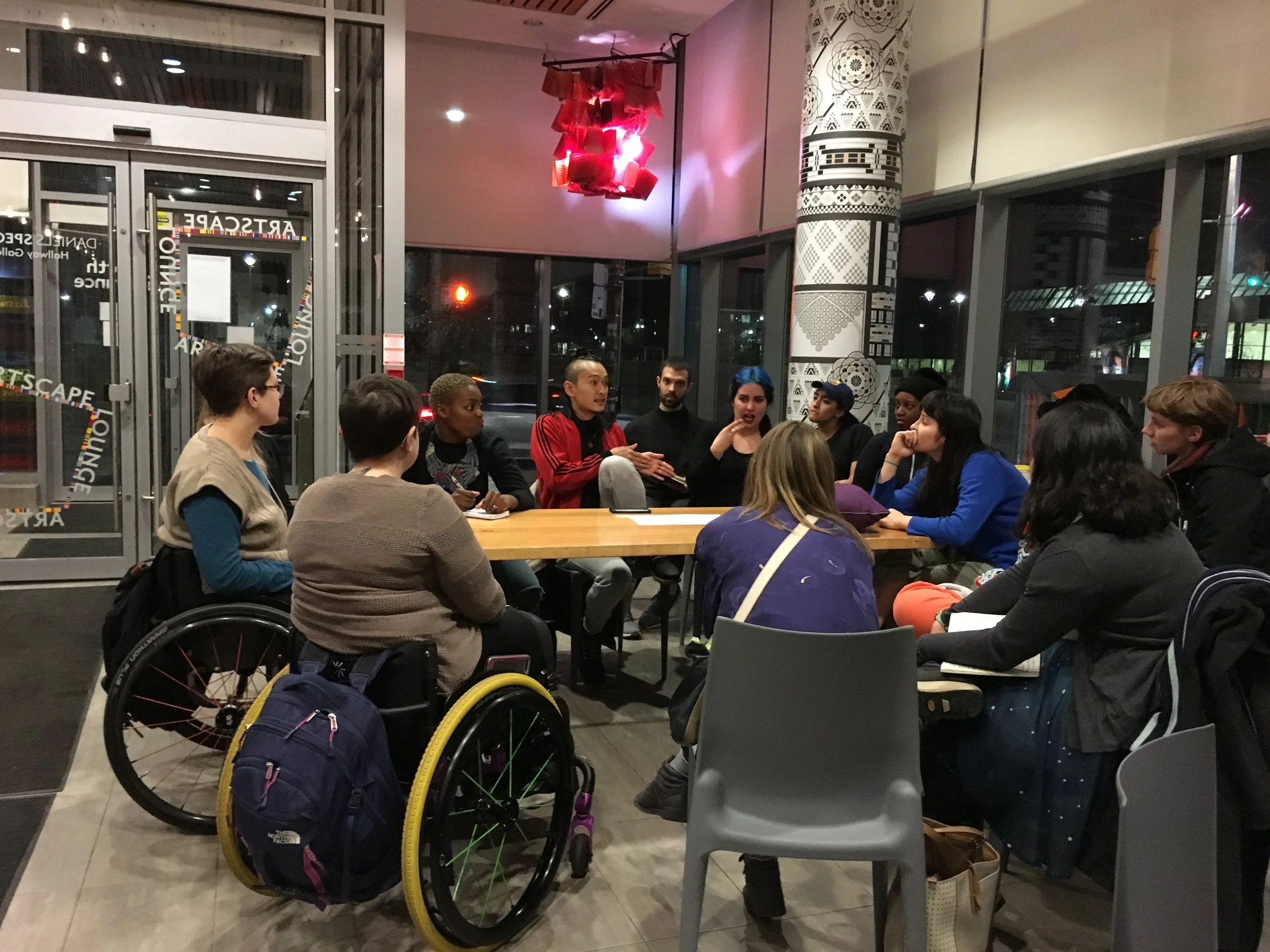
Left to right: Kate Nankervis, Tina Fushell, and Robyn Breen of the Love-In, Kristina Lemieux and Sedina Fiati of Generator, and Oriana Pagnotta of the Love-In.
In December, we partnered with the Toronto Dance Community Love-In (now a Resident Company at Generator) and Daniels Spectrum for our first ever #UrgentExchange devoted to dance. Together with the Love-In, we asked community members to vote in Twitter and Instagram polls choosing between the topics “Accessible Process Now” and “Stop Abuse and Exploitation.” The results were 50/50 on Twitter, so the deciding votes were on Instagram, where 74% told us that what was most urgent in dance was stopping abuse and exploitation: how do we dismantle harmful power structures and create safer spaces?
On December 17, we gathered at Daniels Spectrum. ASL interpretation was provided by Rogue Benjamin. After introductions from Generator and the Love-In, we invited participants to rotate through each of the following four topics, in 25-minute sessions:
Social Location facilitated by Jiv Parasram: understanding the ways in which we ALL hold power and privilege
Race facilitated by Rodney Diverlus: examining the race problem in dance, and what we can do about it
Gender facilitated by Sze-Yang Ade-Lam: from understanding how gender plays a role in conversations about power, to asking everyone’s pronouns
Community Agreements, facilitated by Sedina Fiati: what they are, what goes into building them, and how to incorporate them into your process
We also had an open table available for folks who had other topics they wanted to discuss. Before we started, a participant proposed that this be a space to discuss Accessibility. Unlike many other #UrgentExchange conversations (like #MeToo One Year Later on December 9), there was no recorded or live-streamed component to this event - this was to encourage open and frank dialogue. Instead, we invited “witnesses” to observe each of the four topics, as well as the open table, and write down their thoughts and learnings. What follows are the responses of our five witnesses, along with resources we suggest for further learning. To find out more about each of the witnesses, scroll down to the bottom of the page.
→ General Resource for Talking about Power and Privilege Diversity Toolkit: A Guide to Discussing Identity, Power and Privilege

Molly Johnson responds to RACE, facilitated by Rodney Diverlus
First up, this discussion was COMPLEX - beyond a summary listing of what we got into, I don't have the means with which to fully share it. The following is one distillation of my experience and what it sparked for me - I could offer many others.
I'm a witness at the race table and as a white person talking about race, my cheeks are pretty fucking red as soon as I speak. I don't want to fuck up, you don't want to fuck up - there are different measures of what that means at this table. Discomfort is necessary. Discomfort is something I have spent a lot of my life avoiding. Discomfort is a thing some of us get to avoid and some of us are thrust into, and that becomes real apparent real fast.

The speed dating vibes are almost useful in that there's no time to waste and we get to it as quickly as we can but it feels a little too emblematic of [my experience of] the dance community - and the white capitalist hetero-patriarchal society from which it takes its cues - AKA as a place where good intentions and conversation starters abound but very rarely result in meaningful change. The system is in full effect even in environments like this where the intention, I believe, is wholehearted.
One of the prompts Rodney gives us is to answer what is missing in the conversation on race in dance. I look around the room and think not so much about what topic is missing but about who is missing: 99% of the white men in the dance community are missing, dance artists over the age of 45 are missing, the power holders in the dance community are missing - the two previous categories and the educators, presenters, funders, and artists who are on operating are missing. These people are not in the room. These people need to be in the room. I take my sharpie marker and write this down on my little post it note. But then what? I write it here and maybe somebody reads it and feels called out but then gets over it and pays attention. Or...business as usual.
It's weird and informative and enlightening and troubling to see Rodney run the same drill for each session. All I can think about it is how many times he's had this conversation. He's civil and articulate and kind. I recognize these things and how I appreciate them and then recognize the scary mental space of appreciating racialized people conducting conversations about something that is actually pretty fucking abhorrent in a civil, articulate, kind way so that white people can feel okay inside the conversation about the thing they created and continue to perpetuate but mostly avoid discussing. None of that is exactly what it is but it's also not not that.
What is missing in the conversation on race in dance? White people are missing. Urgency on behalf of white people is missing. The point is very often missing. We are still getting confused between having enough and having privilege. We are still crying meritocracy at the same time as knowing full well that meritocracies are a fallacy when each of us begins with very different resources, very different access points, and that this dance world is still being built for a certain kind of person to thrive.
→ Resources “White Privilege: Unpacking the Invisible Knapsack” by Peggy McIntosh, Jonathan Osler on Moving from Actor to Ally to Accomplice
Mikaela Demers responds to SOCIAL LOCATION, facilitated by Jiv Parasram
On Monday, December 17th, #UrgentExchange Stop Abuse and Exploitation in Toronto Dance was co-hosted by Generator TO and The Dance Community Love-in at Daniels Spectrum. All who attended rotated between four tables every 25 minutes, set up with stationary facilitators focused on different topics. I had the fortune to sit with Jivesh Parasram who was facilitating conversation around the topic of social location or position.
After quick introductions, Jiv led our table in a fairly common exercise:


The Power Flower, with all of its flaws, is designed to demonstrate where you fall in the societal power structure of a chosen community. The idea is, that through completing the Power Flower, as a group, conversations between table members will surface. Jiv explained the Power Flower with transparency and facilitated each group with a personalized sense of care. As a witness of three different groups of people who came to the table, it was hard not to notice the radical differences between groups as a whole during their experience of the Power Flower.
Group 1 selected a community of focus and flew through completing the Power Flower. When Jiv asked, for example, “Sexual orientation? Which group has the most power in community X?” answers from the group came with immediacy, confidence and often from multiple people. Some categories did give some group members pause, but it seemed that even lack of knowledge was admitted with certainty and in the spirit of learning. ‘Human/Non-human’ is an example of a category that resulted in an exchange between an artist who admitted to not understanding what the category meant. A fellow artist reciprocated, with care, on a perspective to consider for this category (SUCH A BEAUTIFUL MOMENT). But in general, the group went around the Power Flower and the categories were filled in with small clarifying conversations by different folks in the group.
When Group 2 was asked the same questions by Jiv, responses were more frequently returned with whole minutes of silence. Answers came as offerings; suggestions or guesses in quiet voices and a questioning tone. The group was preoccupied with the semantics of the exercise as opposed to the goals, spending the majority of their time dissecting the Power Flower as opposed to generating productive and critical discourse. By the end of the 25 minutes, a third of the Power Flower had been completed.
In reflection, there were a number of takeaways from the evening:
The varying responses in groups as a whole and the productivity or level of understanding surrounding the topic of social position is a reminder that it is important to recognize and call out power structures around us.
The Power Flower requires the active participation of its participants. Much like creating change, active conversation in a safe space provides more learning opportunities and overall productivity.
Members of the Toronto Dance Community are at varying levels of understanding or comfort with conversations that focus on critical observation and reflection on the community.
Upon reflection, group 2 brought to light blind spots or areas to be considered in future conversations for the Toronto Dance Community. Seeing gaps in understanding or an inability to participate is essential to continuing conversations of this nature with goals of critical discourse and affecting change in a community as a whole.
→ Resource “Express Yourself: Crafting Social Location Maps and Identity Monologues,” The New York Times

Kallee Lins responds to COMMUNITY AGREEMENTS, facilitated by Sedina Fiati
Efficiency. Legacies of colonialism. The way things have always been done. Inequalities and hierarchies in the creative process. These were some of the responses cited as reasons why community agreements have historically not been used in the studio.
Implicit in hierarchical processes of dance creation is that the product is prioritized above the people involved. As a collaboratively built document, community agreements have the ability to flip this equation and fundamentally shift the distribution of power. Creating an agreement allows a group to explicitly – and contractually – answer the question, “How do we want to operate in this space?” Its strength comes from everyone involved agreeing to what is included and seeing their needs reflected.
During our #UrgentExchange conversation on the topic, facilitator Sedina Fiati outlined three key questions to scaffold a community agreement:
How do we want to be treated?
How will we deal with conflict?
What accessibility needs do we have?
The second question is crucial – it builds in an accountability structure. Who can performers go to if someone causes them harm, particularly if it’s the choreographer/director at fault? Should a “mediator” be named to resolve intractable conflicts? While a safer, more joyful creative space may be the goal, ensuring the rules of that environment are enforced is vital to its sustainability.
Participants were urged to consider accessibility in a broad way, and to ask themselves what would allow all participants to not only function, but to thrive. This approach considers physical barriers like venue accessibility, and less visible obstacles like access to childcare, knowing when performers will be paid, or the use of video and other memory aids in rehearsal.
Specificity in detailing how a group wants to be treated is crucial, yet what became clear in responding to question one is how rarely we’re asked to articulate our needs in a work setting. Common responses expressed a desire to be treated “with respect” and “with dignity”. The next level of conversation prompted us to describe exactly what those conditions look like. For some, it meant that “the physical and emotional health of each person is valued,” that “there’s permission to fail, slow down, and divert,” and that “my opinions will be listened to”.
While community agreements are a practical tool to create a safer work environment, perhaps their greatest strength is in providing the space to question our needs and envision what a fairer, more equitable process of creation looks like. The possibility of better creative spaces exists; we can start by rewriting the terms of engaging with one another.
→ Resource Nikki Shaffeeullah discusses Container Building at #UrgentExchange in January 2018

Nickeshia Garrick responds to GENDER, facilitated by Sze-Yang Ade-Lam
I'd like to preface this by saying that #UrgentExchange organized by Generator is a necessary start to the thoughts and conversations needed to inform change within the Dance and Arts community. If we are fighting for equity, accessibility and fair representation for those on varying spectrums (QTBIPOC, BIPOC, NB, People with Disabilities etc...) within the Toronto Arts Community, it starts with these discussions in hopes of bringing about action.
The topics being discussed for the event were Gender, Race, Social Location, Community Agreements and Accessibility, all being facilitated/witnessed on separate tables. Those attending had approximately 20-25 minutes at each table before they had to move on to the next one. I personally would have preferred us all being able to sit together and openly discuss the topics as a large group, as what was being said wasn't mutually exclusive. The set up for me resembled speed dating, being pressed to quickly get your points in before the timer went out, which can be increasingly difficult when delving into these topics, especially for individuals on varying points of the intellectual spectrum.
Being a witness for the event also allowed me access to the thoughts and suggestions of those who participated. The topics discussed were necessary, but folx were looking for more prevalent and urgent topics such as the #metoo movement, intersectionality, meritocracy, ableism etc... Other main points were, how do we get these conversations in the dominant arts institutions within Toronto? If we're fighting for institutions to update their methods of hiring, teaching/training and offering programs that are more accessible, how do we get them to change? How often will #UrgentExchange be held, and will we discuss what actions to take?
With the advent of revolutionary movements such as #BLM and #timesup, action has been made to change the mentality of corporations. The arts community in Toronto should be under the same scrutiny to change their ways as well.
Ultimately, #UrgentExchange was a night to stir things up and get people thinking about the major issues. Hopefully these talks will continue, in hopes of reaching the dominant Arts companies in Toronto so that our thoughts and concerns do not fall on deaf ears.
→ Resources Working with Trans, GNB and GNC Artists, on ArtistProducerResource.com, “Finding Our Way in a World of Gender Fluidity” on Howlround

Fabien Maltais-Bayda on THE PROCESS & OPEN TABLE
The topic of December 17th’s #UrgentExchange was abuse in our dance communities, and more specifically, how to stop it. It’s a subject both pressing and challenging, not only because systemic abuse is a complicated matter rooted in longstanding power dynamics, but also because stopping it remains a hefty task requiring no small feat of endurance.
It was interesting to note that quite little of what I witnessed at #Urgent Exchange addressed abuse directly. This may be due to the evening’s structure, with participants rotating through sub-categorized tables: community agreements, gender, race, social location, and an open table that convened a conversation on abilities during one of the event’s multiple sessions. Significant topics in themselves, these themes tended to become the focus of discussion at the tables I observed. Yet beyond mere logistics, the event’s tendency to coalesce around topics alternate to the tagline may have had much to do with the main issue at hand. Abuse and exploitation are rarely simple questions of bad or inconsiderate behaviour. Rather, they are inherently tied to power – its imbalances and hierarchies – and are always circumscribed by factors like ability, gender, and race. To work at stopping abuse requires, almost as a prerequisite, active engagement with these social formations. It is perhaps unsurprising that, in the context of a single evening, this is about as far as things got.
Each of the conversations I observed held many important moments, but since I was tasked with witnessing the open table, it seems useful to note just a few of the ideas generated around it here. Of course, it’s important to remember just how inaccessible Toronto’s dance infrastructure is. One participant noted that engagement with the city’s contact improvisation community remains nearly impossible for many since events tend to be held at Dovercourt House – a building with many stairs and no good options for getting around them. Another significant point raised in the discussion was that accessibility is never one-size-fits-all – doorways and halls meant to provide access, for example, might be wide enough for some wheelchairs, but not others. The conversation foregrounded that accessibility requires us to consider the diverse needs of individual bodies, and asserted the importance of centering folks with lived experience.
Returning to #UrgentExchange more broadly: without a coherent plan of action generated, without the “stop” of its title put in motion, the evening and its goals might be considered unfulfilled; indeed, some of the community feedback I’ve heard suggests this. But such a feeling is also hardly surprising. Thinking back, I cannot recall even one event meant to tackle an important issue facing our community that did so comprehensively. (And this certainly includes those I’ve organized or coordinated myself.) Issues of systemic abuse, of equity, of access, are immensely complex, and a gathering of two, three, or even four hours will always be unequal to the task of making change. This isn’t to excuse or justify our many shortcomings as organizers and community members – rather, I want to re-assert the constant collective effort that tackling oppressive structures requires. If #UrgentExchange served, primarily, to begin unseaming the sturdy social fabrics of the status quo that allow abuse to continue, it succeeded in something important. Now, I think, it rests on all of us – organizers, participants, witnesses – to pull the threads further, and to build actions out from these moments of reflection.
→ Resources on Accessibility ArtistProducerResource.com: Audience Accessibility, Artist Accessibility, Writing an accessibility statement for your event or website; HowlRound.com: Article Round-Up
About the Witnesses

Molly Johnson
Born and raised on Cape Breton Island, Molly Johnson makes body-based texts and performance projects exploring alternative ways of being in a capitalist patriarchal society. A Dora Award-winning dance artist, Molly has danced for and with many brilliant humans including Nova Bhattacharya, Susie Burpee, Sabina Perry, Julia Sasso, Riley Sims, and Heidi Strauss. She has spent a decade performing in public spaces with Dusk Dances, toured internationally with Montréal’s Danièle Desnoyers/Le Carré des Lombes, and was a key collaborator with Marie France Forcier from 2007 to 2016. Her collective and individual work has been presented at PS: We Are All Here, SummerWorks, Kinetic Studio, Dancemakers, Mile Zero Dance, and the Halifax Fringe Festival. Based in Toronto, Molly is co-artistic director of hub14 art + performance works and a freelance writer in the space between. thisismollyjohnson.com
Molly was a member of Generator’s 2018 Performance Criticism Training Program.

Mikaela Demers
Mikaela Demers is an emerging artist and producer originally from Northern Ontario. She has been a member of earthdancers, Lila Ensemble, Parahumans, the Garage, and worked as a performer for Vanessa Jane Kimmons, Allen Kaeja, Love Letters Cabaret, Brian Solomon, Megan English and Fernando Troya. Demers has been a part of numerous collaborative choreographic performances including Celestial Play (2013), checkbox (2015) and most recently maelstrom (2017), a co-choreographed work that toured to Toronto and Thunder Bay. Her current independent creative process is based on the physical study of eye focus and awareness. Demers hosted her first independently produced show the pack: creature in May 2018. She is a member of Branch Collective, and the producer of Branch Intensive, a week-long dance intensive hosted in Sudbury, Ontario. Demers has hosted three rural residencies to date in Sudbury and on Manitoulin Island. Mikaela is part of Generator’s 2018/19 Artist Producer Training Program cohort.

Kallee Lins
Kallee moved to Toronto in 2012 to meld her love of the performing arts, research, and writing. After completing an MA in Theatre and Performance Studies at York University, and spending a number of years in the PhD in Dance Studies program, she worked as the Marketing and Communications Manager for the Dancer Transition Resource Centre. Today, Kallee is the Manager of Membership & Community at Imagine Canada, an organization working to build a strong, resilient future for all charities and nonprofits. She sits on the Board of Directors of Dusk Dances and Dance Umbrella of Ontario.

Nickeshia Garrick
Nickeshia Garrick was born in Toronto, Ontario and has been performing since the tender age of six. She received her dance training at the NYIDE (New York Institution of Dance and Education), National Ballet School of Canada, Toronto Dance Theatre and Simon Fraser University.
Nickeshia holds a BFA from Simon Fraser University (Vancouver), is currently working toward the 2019 Premiere of No Woman’s Land with Roshanak Jaberi and Karen Kaeja, and has recently become a 2018 Dora Mavor Moore Award winner for Outstanding Ensemble in Pool (no water).

Fabien Maltais-Bayda
Fabien Maltais-Bayda is a writer, researcher, and arts administrator based in Toronto. He was a Dancemakers Writer-in-Residence in 2016/17, and was shortlisted for the Ontario Association of Art Galleries art writing award in 2017. He writes for Canadian Art, Canadian Theatre Review, The Dance Current, esse, and Momus, and recently published an essay on curation and the dance retrospective, co-written with Joseph P. Henry, in the Berghahn Books volume Curating Live Arts. Fabien currently works as the Administrative Director for the Canadian Alliance of Dance Artists - Ontario Chapter.

#UrgentExchange #MeToo One Year Later
One year later, how has #MeToo has impacted the performance community? From triggers in the rehearsal process, to the changing role of the stage manager, to nudity and violence on stage, to the biases and blind spots that hold back change.

Last January, #UrgentExchange asked “Who is A Monster? What Makes A Monster? Am I Monster? #MeToo What Next?” - three days after the news broke about Soulpepper.
One year later, we partnered with PARADIGM productions and Daniels Spectrum to investigate how #MeToo has impacted the performance community: from triggers in the rehearsal process, to the changing role of the stage manager, to nudity and violence on stage, to the biases and blind spots that hold back change.
On December 9, 2018, we gathered at Daniels Spectrum following a performance of The Philosopher’s Wife, written by APT grad Susanna Fournier and produced by Resident Company PARADIGM productions. (Pictured: Generator’s Kristina Lemieux and PARADIGM’s Susanna Fournier and Alison Wong.)
Part One: Watch the Videos
We began with presentations exploring three perspectives across disciplines: Meghan Speakman on Stage Managing with #MeToo, Matthew Eldridge on Intimacy and Touch from the Perspective of Health Practice, and Andrea Zanin on Consent and Power: Lessons from Kink. Watch the videos below!
Inspired in part by this #UrgentExchange, the Toronto Star’s Karen Fricker wrote “One year after Soulpepper, what stage have we reached?” including reflections from both Meghan Speakman and Sedina Fiati. Read her article here.
Part Two: Read the Highlights
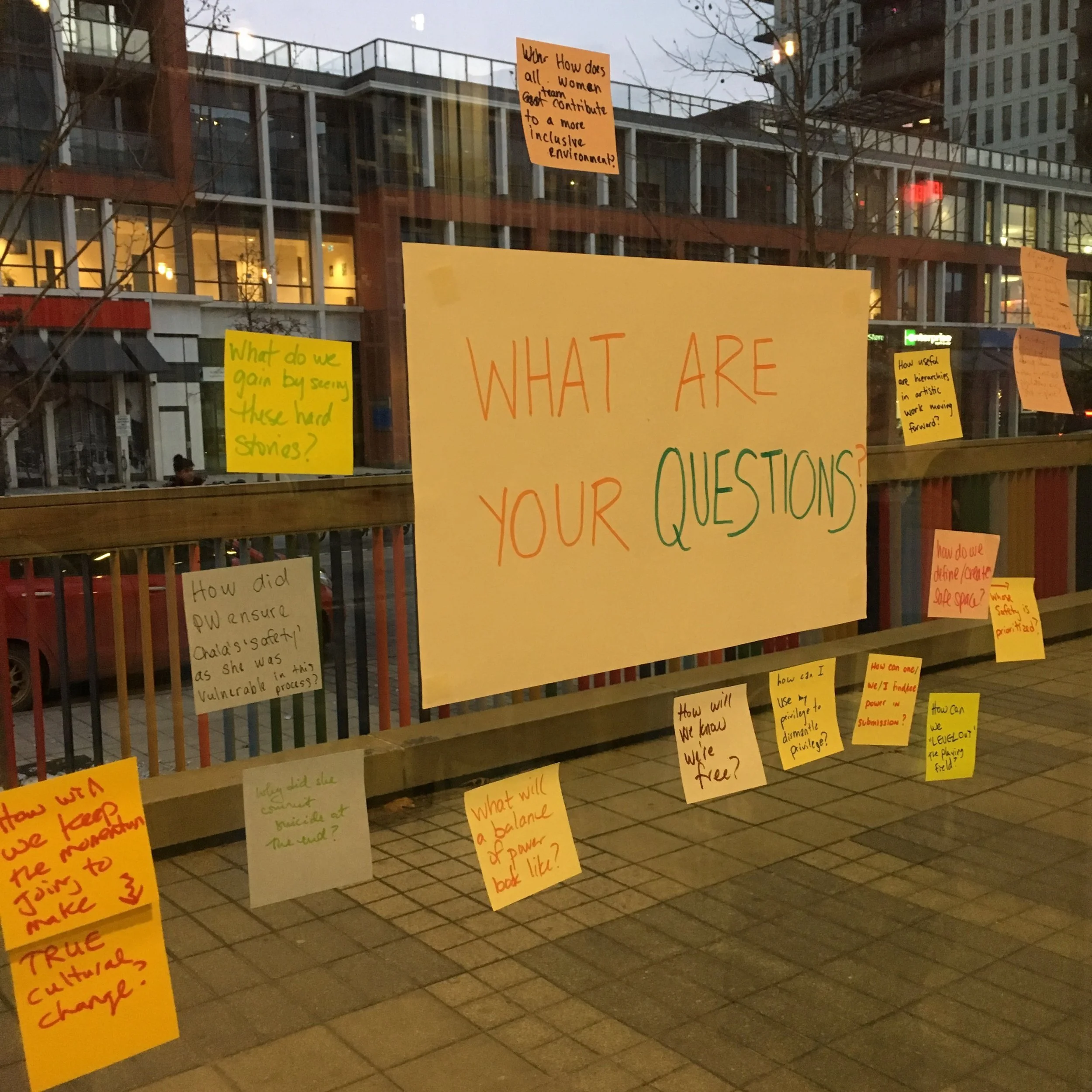
For the second half of the event, Generator’s APT Facilitator Sedina Fiati (pictured below) sat down with The Philosopher’s Wife team to talk about how they tackled these issues in the production. We heard from playwright, producer and actor Susanna Fournier, producer Alison Wong, and actor Chala Hunter. As a jumping-off point, we asked participants to share what they noticed about the production, and what their questions were (responses pictured below). You can watch the whole conversation on Periscope, or read some highlights below:
“It took me a long time to become the proud feminist killjoy that I now am.” -Susanna


On the Relationship with the Audience
Susanna “I think in terms of getting to a point in my practice as a playwright where I am now starting to really meet and develop audiences, for me I think the theatre contract is a stand in for a kind of social contract. So, I've invited you all to come into a space, and I’ve made something and brought other people in and I’m going to offer something, but I need you to come, and so, now we are in relationship with each other. I’ve asked you to come into relationship with me. And so I need to be aware of what my desire is, why have I asked you here, what do I think I have to offer you, what do I hope you might receive, and what am I hoping you might bring to this relationship that now we are in together.”
Alison “Introducing this work to an audience involved setting the stage, so to speak, for conversation. And really working with the intention that these plays are not meant to be let loose into the world and have them, necessarily, speak for themselves; the intention that we want to work in a way that allows the audience to come back to us, whether it is through conversation on the internet, whether it is through events like #UrgentExchange. Even the fact that it’s a trilogy, so knowing that we are building a relationship; the idea is that we want to build a relationship with our audience so that these ideas and the themes that are in the play continue to evolve and we continue to contemplate them each time we meet each other. And trying to, as much as we can with the resources we have available, to create avenues for that.”
On Theatre and Trauma
Susanna “I deal with a lot of difficult topics in my work, and I know that I am looking to create a kind of ritualized space; that potentially we can come together and grapple with some of these traumas in a way that creates even just a moment with which we can feel through them. Because I think if we are not willing to feel through them, they won’t pass through us. And so that is a really delicate thing, to go: I know I am purposely asking folks to come experience a wound, and I think if we can experience that together there is a possibility for changing a narrative around it, or allowing it to maybe leave our bodies, work through our body. I think theatre is a place for and of the body and I feel that I live in a very disembodied culture. And even sometimes in the act of theoretical talking about, of analysis around trauma, analysis around power, it’s like yes: in my head, and my body is not included. And what I find in theatre is when I am moved it’s because I am allowed to feel my way through the things I experience, not just intellectually, but in my heart, and my gut, and I guess that is the power of catharsis.”
On Power in Process
Susanna “I am learning a lot as a playwright and a producer. There is a huge amount of power you have as a playwright, in that I’m choosing content and I’m choosing whose story we are looking at and where should we look in a story in the same way the director can tell us where and who to look at. As a producer I feel that it is the most crucial realm of putting a different kind of politic in action, because I wield our culture’s powerful symbol, which is where does the money go. And you can create a process that reflects where you want to put that money. But you also choose who is on the team, how the team is going to gather, what are we going to talk about, what are we going to prioritize.”


Above: production photos from The Philosopher’s Wife. Cast: Chala Hunter, Aviva Armour-Ostroff, Susanna Fournier and Danny Ghantous. Photography: Haley Garnett and Bernie Fournier.
Chala “A question I have been asking myself in many rooms, as a performer, certainly, but just as a person on the street, or in my home, or in any community or room that I happen to be in, is about how I can embody a kind of equality or community or togetherness or how I can embody the way that I hope or wish power could function in our communities, in our society. And that’s a question; I don’t have the answer to that, but I’m asking it of myself in many different circumstances, and as I ask it, trying to catch myself when I am behaving in ways that I feel I have been conditioned to, out of fear, or learned power structures, or all sorts of things. And so I would say that within the rehearsal hall, especially having been a fairly involved part of the conversation around #MeToo or Not in Our Space, or many of these conversations around harassment and consent in the performing arts and in the world, I’ve been looking to embody in rooms, to be an ally. To show in my behaviour that I will ask questions, ask for consent, be respectful, but also kind of demand it for myself. And that means doing things that make me uncomfortable, like saying no, like asking questions when I don’t understand something but feel embarrassed to ask the question. Even standing next to someone that I feel might be vulnerable in a moment, and that’s an assumption, certainly sometimes, but I’m trying to trust my intuition in those moments and err on the side of being caring and hopeful, rather than this kind of silent ‘I’m going to stay away from a situation or moment that seems like it might be dangerous, or someone might be feeling a bit vulnerable, or they maybe they need some help. And I don’t mean that specifically in this process: I’m talking about in the last year of my life, and I operate in the same way in grocery stores now as well, which I find is necessary sometimes; crazy things happen everywhere.”
Sedina “Now I’m asking myself what kinds of spaces I want to create, and who do we need to be in the space for it to be affirmative and joyful, what do we need to say. …We really have to cultivate character in ourselves, as theatre artists, black performance artists. We are always like ‘In the room, in the room’ but if you are not that outside of the room, how will you be it, how will you suddenly summon up the courage, how will you suddenly summon up knowledge that you don’t have? It behooves us to keep having conversations like these.”
On Safety in Process
Susanna “We do need to always be taking the temperature in the room and go: How are we doing? Is this enthusiastically working? Or are we all like ‘Oh, knives in the air, elephants all over the place?’ And if that happens let’s talk then, before one of the elephants pierces another elephant. If we feel the temperature rising, we can always go ‘Are we ok? Is there something we need to discuss? Has something happened?’ Cause that might have happened two days ago. People’s reactions to things - I was chronically: something bad happens and three days later I’m upset. But I’ve learned to just kind of deal with it. We can’t expect everyone in the moment to react like, ‘Hi, I have the language and tools with which to do this.’ They may react three days later by having a small meltdown in a corner. I think it’s another reason why having producers in the room - or having outside eyes who are watching the process, just there for feedback - is really important. Because I’m still learning, and I still miss moments. There are still moments where I go, ‘I should have said something.’”
Chala “Asking questions is so important, just checking in with people, like kind of maybe more than seems reasonable, is important… There is so much talking that has to go down to make people feel safe.”


Photos: Speakers Meghan Speakman (left) and Andrea Zanin (right); PARADIGM productions in conversation with Sedina.
On Yes and No
Chala “I had an experience of realizing that I think of no as a rejection, or as like, ultimately negative; as a creative rejection, as a personal rejection, when really what I discovered through this process was that yes and no are both just pieces of information towards greater understanding and more complicity, and that is very fundamental for me.”
Sedina “Our theatre training has trained us out of ‘no.’ Yes and… but the spirit behind yes and is let’s collaborate - it isn’t do what you want. It isn’t yes to anything. It means a spirit of collaboration and that’s what we should be entering into. ‘No’ means, close this door but open a different door. Because that means we have to be creative in the way we do things…‘No’ can be so generous because you are helping the other person navigate, instead of letting them walk into a minefield.

Trailer Project by UnSpun Theatre and Ahuri Theatre
As indie theatre companies and creators, both UnSpun Theatre and Ahuri Theatre have made trailers for our own work in the past – whether for potential audiences or for potential producing partners. We also watch a lot of trailers, or scroll by them as they pop up on our social media feeds. We wondered: is there any magical formula that makes trailers effective? How much do audiences rely on trailers to determine what they’re going to see? What about potential partners?
As indie theatre companies and creators, both UnSpun Theatre and Ahuri Theatre have made trailers for our own work in the past – whether for potential audiences or for potential producing partners. We also watch a lot of trailers, or scroll by them as they pop up on our social media feeds. We wondered: is there any magical formula that makes trailers effective? How much do audiences rely on trailers to determine what they’re going to see? What about potential partners?
We decided to watch a ton of trailers from different performance practices (theatre, live art, dance, performance art) to see if we could come up with ‘rules’ for what works and what doesn’t. We then chose a number of trailers that employed a variety of techniques and held a screening night at the Generator offices. We then put out an online survey to garner feedback on a few trailers that had sparked interesting conversations from our screening night. We also spoke to some producers and producing companies about what they look for in a trailer or short video. We compiled the responses and looked for patterns. We’ve included the emergent patterns below.
Media moves quickly and these responses reflect a moment in time, and particular dominant styles of making trailers. Many respondents noted that we need to keep up with filmmaking trends if we’re going to use film as a marketing tool, and not rely on aesthetics or approaches that have worked so far.
Trailers for General Audiences
About our respondents:
100% of respondents attend live performance (generally at least 4x/year)
70% of respondents are art-practitioners
35% of respondents have made trailers in the past (mostly for the general public, some for potential partners)
Thoughts about making trailers:
“It’s our most effective marketing tool”
“It’s challenging to translate stage acting to film”
“The lack of resources is daunting”
A number of respondents noted that a show trailer they made helped secure a partner:
“Trailers raise the perceived value of a show and increase social media discussion”
Many respondents also noted the challenge in the timing of making a trailer: if you make a trailer early enough to share with potential audiences, you likely won’t have your design elements in place to film. But if you wait for the elements, you’ll miss the window of sharing the video with potential audiences.
68% of respondents watch trailers to determine if they will see a particular show (although, by the end of the survey, many later realized that they rely on trailers more than they had thought)
“I’m more influenced by graphic design and marketing”
“I’ll watch them if they happen to come up on social media”
“Trailers help me learn more about a company more than about a particular show”
67% of respondents said that a particular trailer had prompted them to see a show.
“If a trailer is everywhere I may get sucked in”
57% of respondents said that a particular trailer had made them avoid a show.
Respondents were turned off by: aesthetic, lack of diversity, preciousness, and quality of video
Creating for specific platforms:
Respondents noted that they often watch trailers differently across different platforms. Many do not watch Facebook videos with sound, so using sound as a main source of information or mood is not always useful on Facebook or other social media.
Respondents will usually seek out information about a company or show on their website or YouTube/Vimeo page. They expressed a willingness to watch longer videos on these sites, as opposed to social media sites.
There is a real line between sharing a trailer enough to illicit ‘buzz’ and overexposure.
We divided the trailers into two categories: Representational Trailers and Essence Trailers.
Representational trailers usually use footage and/or audio from the show and give a sense of what the show might be about. The features of Representational Trailers that respondents liked were that they get a sense of what the performance will actually look like and a sense of the aesthetic of the piece. It was agreed that these trailers have more of a chance to be done with poor quality footage and audio and often don’t translate well to film.
Example: UnSpun Theatre, All The Things I've Lost
Essence trailers might use footage that is completely separate from the show itself, and in some cases might be just a series of images and sound. They express a mood or try to pique curiosity. Respondents liked that these trailers don’t give too much away, communicate a feeling, and can be intriguing. These trailers can also alienate audience members or come off as dull, opaque or pretentious.
Audiences use these trailers in different ways: they go to representational trailers to get more details about a show, its style, the company, etc. They go to essence trailers to get excited about a show when they might have already heard about it.
Trailers for Presenters and Partners
We had just as much variety in the responses from presenters as we did from general audience viewers. Overall, it seems that presenters would really rather just watch your work live, but they mostly agreed that trailers can be a very good way for them to learn more about artists and companies whose work they don’t know well. They might also serve to get a presenter interested in work that they can then see live or learn more about from an archival video.
We spoke to presenters who produce touring work on large and small scales, as well as presenters who produce large national festivals.
Here is some of the range of responses we received:
One presenter said, “They’re useless.” They prefer to find new work “on the advice of a very trusted colleague who has seen the production and will vouch for it, by seeing the FULL live performance themselves, if not the full LIVE performance then a full length archival video.” They felt that “trailers are a possible marketing tool for public but they are not what presenters use at all.”
Another felt differently, responding “theatre trailers are very useful for presenters. When done well they provide compelling visuals, context and (hopefully) a few good reviews. (The) problem with trailers and all video is that if they aren't good, they could kill interest in the work (which may indeed be very good). Not all video production is created equal.”
One presenter and curator admitted that they hated having to watch trailers, but that it was a part of their work, and useful for learning about new companies to keep on their radar. They added that the trailer really has to accurately represent the piece if they aren’t able to see the actual show. The presenter said that they often use trailers when putting a season or festival together, as a way or presenting the work to the larger team and as a way of getting a sense of how different work might feel together.
One agent responded “I would say 120% you need a good 2-3 minute video, to sell your show to presenters (who then in turn use it to sell to their audiences) and to get pitch and showcase spots at conferences. I’m ALL for a good (and relatively short) sizzle reel!!”
The results – What to (maybe) do and what to (maybe) not do.
One caveat: there was no trailer that every respondent loved. Responses were extremely divergent. There was more of a consensus during the screening night and we suspect that the group dynamic and conversation helped shape responses. Some respondents loved trailers filled with artsy shots of fields and animals; others thought they were dull and hollow. As with anything, know your audience.
Keep it short. Especially if you’re sharing it on social media. And especially if your content is at all repetitive – in this case, most people won’t watch past 20 seconds of material that features repetitive content.
Tell a story (if you can). It doesn’t have to be a full narrative, and in fact, you’ll do best to focus on one or two elements of your show. It can also be an abstract narrative. But build to some sort of emotional peak.
Interviews must have content. Audiences are leery of interview snippets that feature artists talking about how good or important a show is. They are interested in hearing an interview if there is an interesting story, process, concept about the show.
Consider watching habits. Don’t rely on sound or music if you’re primarily sharing this content on Facebook. It needs to be compelling without sound. Consider subtitles.
High quality footage and audio is everything. You can have a great trailer, but poor quality footage turns people off and it results in your audience assuming that the lack of expertise they’ve seen might translate to the stage. If the sound is bad, they often think the sound in the show will be bad. Consider using mics for an archival run-through to get better sound. If there’s an audience not audibly laughing at a joke, it seems like the jokes aren’t hitting. On the other hand, audiences are forgiving when they see a dull trailer with really high production values.
The same goes for editing. Bad cuts can really stand out in a 45-second trailer.
Give us something, but don’t give everything away. Most viewers like to get some information about a show: Is this a dance piece or a theatre piece? What is the company making this piece? If your trailer is more abstract, audiences don’t mind as long as they’re not left feeling completely confused by the material. Give them something to hold on to.
Define yourself. Audiences responded to new, intriguing terms to define your work. Describing work as “a live film” or “an art party” piqued our respondents’ interests. Don’t be afraid to prominently feature your logo or a strong tagline.
Be graphic. Really cool graphic design elements wowed audiences.
Start strong. If your opening isn’t effective, much of your audience won’t keep watching.
Use choice pull quotes if you have them. Most respondents liked pull quotes and were influenced by them, as long as they came from a variety of sources. Trailers using quotes that came only from Twitter, for example, were frowned upon. Many people noticed this and responded negatively to it. It seemed like it was better to not include quotes than to only include quotes from social media.
Learn about film. Live performance generally doesn’t translate well to film, and the trailers that garnered the most positive feedback recognized this and used the features of film to their advantage. Some chose a representational style, but shot the performers at an interesting location or using close ups. Some were very clever about editing and sound, or using different camera angles.
“ Stage picture and screen picture are different – so just using stage blocking is not the best option.”
“Theatre is experienced live in one long “wide shot.” And I think what’s exciting to me about trailers is it’s a chance for us to get up close and intimate.”
Don’t make me feel like I’m watching a commercial. Even though you’re using this trailer to sell an experience, allow the trailer to stand on its own as a creative storytelling tool.
Do something different. Viewers were almost always interested in unusual approaches to sharing performance on film. Strange short films intrigued audiences and even though these films weren’t as connected to the performances themselves, respondents said they were interested in learning more about an artist or company based on the inventiveness of the material.
Examples
These are examples of trailers provided by UnSpun Theatre and Ahuri Theatre. Enjoy!
Some Specifics of Site Specific Theatre: A Generator Resident Company Community Project
A five part video series using case studies from Generator's Resident Companies Shakespeare in the Ruff, Outside the March and Litmus Theatre. This project was part is a Community Project as part of their residency.
Some Specifics of Site-Specific Theatre is a Video Series featuring case studies from Litmus Theatre, Outside the March and Shakespeare in the Ruff. This is a Community Project made collaboratively by Resident Companies during their 1st year at Generator.
About this series: Organized into 5 videos to represent a different phase of the creative production process, each company reflects on how they create theatre outside of traditional theatre venues, sharing their inspiration right through to lessons learned.
Part 1: INSPIRATION
Part 2: LOGISTICS
Part 3: THE SHOW
Part 4: AFTERMATH
Part 5: LESSONS LEARNED
Generator and ArtistProducerResource.com are supported by Canada Council for the Arts, Ontario Arts Council, Toronto Arts Council, Government of Canada and Business for the Arts. Videos edited by Dhulfiqar Gshayyish.