
Blog

Kaitlyn Riordan on the Family Dynamics of Governance
In the sixth and final post in our ‘Governance Reimaginings’ series, theatre artist, playwright and former Artistic Director for Shakespeare in the Ruff, Kaitlyn Riordan offers a personal response to a session led by Erin Kang.
This is the sixth and final post in Generator’s ‘Governance Reimaginings’ blog series. You can find all posts in the series here, and everything we’ve published related to boards here. In this post, theatre performer, playwright and former Artistic Director of Shakespeare in the Ruff, Kaitlyn Riordan, offers a personal response to a Governance Reimaginings session and follow up conversation with Erin Kang, Manager of Networks at the Ontario Nonprofit Network and project co-lead of their Reimagining Governance initiative.
Warning, this is an imperfect metaphor.
Last summer, I had the pleasure of participating in and witnessing my dear friend have a baby. She’s a single parent who, like many, has created a non-nuclear family model. I was her birthing partner and her sperm donor was her primary care-giver for the first seven weeks of the baby’s life. His husband came by for visits (they are uncles to the baby) and my friend invited their family to come by and meet the new nibling/grandchild. Oh wait… were we calling the donor’s parents ‘grandparents' if the donor wasn’t ‘dad’? A precocious five year old nibling asked; but if you aren’t married, is she really my cousin? And would my friend and her baby now be included in family portraits?

Alt-family royalty free clip art
Well, sure, yeah, and we don’t know yet. But what was perfectly clear, is that this baby would be loved by a large and extended family because my friend and her donor had chosen this path. They had been intentional, they had to be, because the traditional model (hetero couple gets married and has a kid) did not fit their needs. And rather than court that model, my friend identified her desires and did the work to create a model that would fit those. Yes, she's a badass. It took time, research, lots of conversation, informed consent and eventually, a document that both parties signed.
What my (badass) friend’s situation revealed to me is that I so often default in life; into roles, into timelines, into structures without giving them a second thought. Much like many nonprofits when it comes to governance.

Photo of Erin Kang
This is where my metaphor really falls apart - apologies to anyone who has given birth. Now, if we imagine the physical act of birthing a child (something that simply has to happen for a human to exist), like say, an AGM, appointing directors, getting an annual audit, etc (things that simply have to happen for nonprofits to exist) does that really encompass all that it means to “have a child”? I put that in quotes as I transition my metaphor over to Erin Kang’s area of expertise; governance in the nonprofit world.
The Ontario Nonprofit Network (ONN) and Kang, in collaboration with Ignite NPS, have co-created a virtual hub for governance innovation, full of tools and resources that enable nonprofits to explore all the other parts of governance and figure out what their company needs in a DIY/choose-your-own-adventure kind of way. Like bottle feeding vs breast feeding, disposable vs reusable diapers - every parent needs to figure out what they and their baby need and build a system to support that. So why do we only talk about the technical (birthing/AGM) part of it? Again, apologies for the AGM/birthing parallels…
Partly, it’s because we’re all overworked & under-paid and governance feels like the least of our priorities. Partly it’s because we’ve only been exposed to one model. The top down Board of Directors model that feels daunting and cumbersome and can sometimes feel like the adults (business people) making sure the kids (artists) don’t land the company with a deficit. Most literature and training around governance is based on Board performance, efficiency, and engagement, that’s it. No wonder we associate all things governance with Boards. When in fact, the work of governance can play such an important role in the health and development of an organization.
So the ONN asked: what is governance? Who is doing it? Who should be doing it? And how? One of the big realizations they made was that organizations were being forced to squish their values and practices into the existing model. There are 58,000 nonprofits in ON, how can one or two models work for such a diversity of organizations?! A bit like my friend navigating a system that expects a family to look a certain way.
The initiative decided that instead of creating a different model, they wanted to develop a process that would empower orgs to create their own models, one day hopefully flooding the nonprofit sector with an abundance of working models to be inspired and not shackled by. They collaborated with nine nonprofits over a period of several months to co-create the materials, and supported them in experimenting and working with new ideas.
First, they identified that the ultimate goal of governance is to “enable positive impact on the community”. Initially, I didn’t think this would resonate with my baby metaphor, but the more I think about it… They then identified the high level functions of governance: developing strategy, setting and upholding org culture, tracking finances, etc. Turns out, fundraising is not a governance function, but can be a board function if that choice is made. Whoa… Then, once all of those factors were identified, the orgs moved to the design playground: Processes, People, Structures, Culture. Get an in-depth look at that here
For 10 months, these nine organizations tested the tools and resources they, along with ONN and individuals in the sector, helped to co-create. The Reimagining Governance Lab will contain multiple access points, not a set process, so organizations can choose how deep to dive in based on their current capacities. In early conceptions of the project, the goal was to create a process for organizations to follow. However, it became clear that a set process would still be too limiting. This evolution moved the thinking from a circular model to more of a 3-D governance ecosystem, responding to the various needs from the different organizations.
The ONN has just launched their public Reimagining Governance Lab online. It includes stories and examples from the nine organizations they worked with and will have updates as the nonprofits continue to evolve their governance models, each experimenting with specific elements and needs. The Lab will continue to be animated by convening communities of practice, inviting other organizations to join in and try things, all of which will be documented and included in the Lab as the experimentation/implementation evolves.
This work is an experiential process and requires organizations to name, identify, and reflect on how they do governance. What are the external/internal influences? It requires space & time to put intentionality into how a governance system is designed. Kang clarified that these questions almost never get asked and requires those in power to reflect on why they have power, and then often to relinquish it for deep and lasting change to manifest. Anti-oppression work needs to be woven into the fabric of governance, particularly because the nonprofit model is based in white supremacy .
Kang identified the concept of intentional vs implied ways of functioning, and how so much of what we do is implied, based on “how it has always been done”, sometimes for over 100 years. One of the surprising things Kang shared with us was that documenting comes later in the process. By-laws, documents, policies etc. should reflect the decisions being made about your governance system, not vice versa. Much in the same way the contract between my friend and her donor came after they had done all of their homework and discussed all the foreseeable possibilities. At that point, making a contract was easy because they were coming from a place of understanding each other’s goals, desires, and values.
And just so you don’t think that I’m the only one who sees these parallels, Kang herself reflected that:
“I liken [challenging governance models] a lot to family dynamics. We often think about the birth parents of a child; that they are responsible for the whole development of this child. Whereas, in fact, there are all these environmental, societal factors - also chosen family, friends, educators etc. So imagine if we only focus on a child’s parents, and then we’re like, yep, that’s it. The idea of co-parenting, for a lot of people, and the idea of challenging the dominant norm of what those relationships look like, is hard to imagine.”

Yes, hard to imagine, but the work that Kang, the ONN, and their invested partners are doing (not to mention my badass friend) is making it easier for nonprofits to imagine other models and develop ones that work for them. ‘One size fits all’ worked when there was only one nonprofit in Ontario. 'One size fits one’ will be far more responsive and effective with 58,000 in this province alone.
Governance Reimaginings asks how we can deconstruct inherited governance structures to create systems of accountability and community care that support, and are aligned with, the values of the organizations and individuals they serve. Structured as a knowledge exchange between Generator, Shakespeare in the Ruff, and the Toronto Dance Community Love-in, Governance Reimaginings took place between April-December 2021 and featured a series of instigations by invited guest speakers. We gratefully acknowledge the support of the Chalmers Family Fund, administered by the Ontario Arts Council, for this project.


Kaitlyn Riordan is a settler of Irish and French descent. She lives in Tkaronto and is a four-time Dora nominated actress and a playwright. She was part of the leadership team at Shakespeare in the Ruff from 2012-2021, including Artistic Director from 2017-2021, where her 'feminized’ Shakespearean play; Portia’s Julius Caesar, premiered in 2018. It was later produced at Hart House Theatre and is being produced at the University of Waterloo this spring. 1939, which she co-wrote with Jani Lauzon, premiered at The Stratford Festival in 2022. Plays in development include Gertrude's Hamlet, I Sit Content – a story of Emily Carr, and The Naked Nun. As an actor, she has worked across the country with Punctuate! Theatre, The Stratford Festival, Tarragon, The Grand, The Segal Centre and many in between. She has performed Linda Griffith’s one-person show; Maggie & Pierre multiple times and done Shakespeare on a national tour of England, in Colorado for two summers, and repeatedly in Withrow Park between two majestic willow trees.

Shelby Wright on the shape of governance
In the fifth post in our ‘Governance Reimaginings’ series, dance artist and former Co-Artistic Director for Toronto Dance Love-In, Shelby Wright, offers a personal response to a session led by Cynthia Lickers-Sage.
This is the fifth post in Generator’s ‘Governance Reimaginings’ blog series. You can find all posts in the series here, and everything we’ve published related to boards here. In this post, dance artist and former Co-Artistic Director of Toronto Dance Love-In, Shelby Wright, offers a personal response to a Governance Reimaginings session led by Cynthia Lickers-Sage, Executive Director of the Indigenous Performing Arts Alliance (IPAA). This post was co-written by Brendan McMurtry-Howlett, artist and board member with Generator.
What did I picture Board Governance to be when I first joined the Governance Reimaginings project with Generator? I think I imagined turning our attention to a rule book covered in dust, but a rule book nonetheless; information that I didn’t have experience with, and therefore couldn’t yet have an opinion on. I was without an entry point. But, as I have learned through this project, board governance is in fact just what you make it, and what it needs to be. Governance is, in many ways, a record of the relationships formed and intentions created within a group of individuals who share a common goal: to manage and maintain the health of an organization.
Cynthia Lickers-Sage joined the folks participating in the Governance Reimaginings project to talk about her extensive and invaluable experience in the field, particularly in her role as the Executive Director with the Indigenous Performing Arts Alliance (IPAA). It was wintertime, and we were meeting on Zoom.
In our session with Cynthia, she talked with us about the ways that she, and IPAA before she arrived, are reclaiming board governance through a linguistic and cultural grounding in Indigenous practice and ways of working. At IPAA they name the individuals who fulfill the function of a board, The Grand Council. Cynthia described a way of organizing that is holistic in structure, a way of interacting that is unwritten and collaborative; a beautiful contrast to the image of a dusty rule book.

Photo provided by Shelby Wright
One of the first things she talked about was that she didn’t practice a hierarchy, “but rather, a…” she searched for a word, and then, laughing she said, “linearchy!”. Sharing this in-the-moment creative languaging was a perfect exercise in governance reimagining. Linearchy captured my imagination: is she describing lineage? Or a line drawing? I sat there thinking of the various possible sketches and line drawings I came up with when, in a previous Governance session, we were asked to draw what we thought board governance looked like. What emerged from my page were lines that continued to the outer reaches of the page in all directions. A depiction of constant growth but connected to some centrifugal force, a cycle or a spiral, a flowering center. Or possibly the shape of an ear. Could it be that board governance is actually the traces of our work together, the various sketches, ideas drawn up, a series of images from dialogue and collective thoughts?
“We do have a structure but it’s more in a circle format,” Cynthia said in describing the governance practice at IPAA. For them, the circle is both philosophy and function. The shape of a circle provides endless continuity, one thing turning into another, motion. An open and dynamic shape that generates many iterations from the place of beginning; there’s no distinct starting place, and infinite entry points. Everyone joining an IPAA Grand Council circle is considered equal to others, and has the opportunity to contribute and voice their ideas. It also guides procedure: when an idea or issue is brought forward to the Grand Council, discussion always goes around the circle with each member of the circle given space to speak if they are moved to. In fact, at the bottom of all their meeting minutes, they have a diagram of the circle, and the names of who sat where. When everyone has spoken on the matter, a collective decision is made in an interconnected way. Cynthia shrugs her shoulders and says it’s a way of working that “was comfortable with my DNA, I don’t know any other way to put that.”
This comment gave me pause. What are the ways of working that are compatible with my own life experience? Most boards use the colonial standard structure of “Robert’s Rules of Order”, where a director leads the meeting, motions are made, and decisions are made by majority rule voting. Before having any board experience, I didn’t know who Robert was and what his rules were, and upon review I can definitely say it is nothing to inspire what is needed in my own practice of meeting, gathering, discussing. What is my grounding within dance, within creative exploration in rehearsal halls, that can point me to a way of working with governance? I am familiar with coming to complex decisions in collaborative group dynamics - that is my whole world as a dance artist.
So why have I been undermining my own experience and competence as soon as I step into the context of board governance?

Moments for the Neighbouring Room, photo provided by Shelby Wright
Cynthia went on to describe their AGM which uses open space facilitation to gather ideas and collect talking points; a space to share stories, to paddle down the river, spontaneously dancing, feasting together, eating words, eating thoughts, visioning the future. A space to become family. Space is made for organizational conversations to take place in many forms, and that arise, free form, in the moment. “Why not,” she said. She reminded us that we are adults, we are not in school, we can show up and be receptive to our own thoughts and share them with others and organize accordingly. Language and terminology are important and sometimes need to be insisted upon, as Cynthia continues to do with IPAA. If the funders and stakeholders do not understand, it is our responsibility to teach them, to lead them. “I’ve got a lot of strength in my shoulders now to push back”, Cynthia said. To make her point, she tells us that granting agencies didn’t always give the option to apply for funding as an artist collective. That was something artists had to advocate for. To do something different, one must simply do something different.
This was a refreshing reminder, and for me, it allowed me to visualize throwing that dusty imagined rulebook, those stale “Rules”, right into the garbage.
“Respect what is needed,” Cynthia pointedly stated. Start at the beginning, which could be anywhere, and keep in mind that every journey starts with a step. This will be a work in progress, but that’s a good thing. Board Governance should be a living document, absorbing the knowledge brought forward with new members, quivering with ongoing dialogue, rippling outward when the dial finally moves forward. The performing arts sector is at the beginning of possibility, a paradigm shift, of shaping the foundations of support. That is what Governance is meant to do.

Shelby Wright at Toronto Biennial, photo by Nick Rose
Since our session, I have continued to ask myself: what do I know in my life as an artist that can shape the way I practice Governance? What are the words, shapes, and ways of collaborating that I can use to reimagine Governance? As artists we practice being courageous enough to trust ourselves, our own ways-of-knowing, in knowing what is needed. The way forward is written in our own bodies.
Governance Reimaginings asks how we can deconstruct inherited governance structures to create systems of accountability and community care that support, and are aligned with, the values of the organizations and individuals they serve. Structured as a knowledge exchange between Generator, Shakespeare in the Ruff, and the Toronto Dance Community Love-in, Governance Reimaginings took place between April-December 2021 and featured a series of instigations by invited guest speakers. We gratefully acknowledge the support of the Chalmers Family Fund, administered by the Ontario Arts Council, for this project.

Shelby Wright is a Toronto-based dance artist, choreographer and producer. In her work, Wright celebrates the unique genre of dance as a means of relationship building through collaboration, and critical experimentation in scene and score building. Wright has received training from Canada’s National Ballet School (Toronto), École de danse contemporaine de Montréal, The Limón Institute (New York), and holds a BA from the University of Toronto in Cinema Studies and History. She has performed professionally in New York, Toronto, Montréal, Halifax, Winnipeg and Vancouver, with artists Kahtryn Alter, Susan Wolf, Jamee Valin, Robert Kingsbury and Lauren Runions. Since 2015, Wright has worked with Toronto visual artist Katie Lyle on a collaborative performance practice combining their artistic backgrounds in dance and visual art. Selected presentations of their co-authored work include: the Toronto Biennale (2019), SummerWorks Festival (2018), and the Canadian Art Foundation (2017).

Sophie Dow on Values, Feasting, and other Board Business
In the fourth post in our ‘Governance Reimaginings’ series, dance/music artist and board member for Toronto Dance Love-In, Sophie Dow, offers a personal response to a session led by Yvette Nolan.
This is the fourth post in Generator’s ‘Governance Reimaginings’ blog series. You can find all posts in the series here, and everything we’ve published related to boards here. In this post, dance/music artist and board member for Toronto Dance Love-In, Sophie Dow, offers a personal response to a session led by Yvette Nolan.
Tansii - Bonjour - Good Morning!
I’m Sophie - In day-to-day life, I fulfill roles as a classically ballet/modern/jazz/contemporary/hip hop/acrobatics/etc. trained (and actively un-training) dancer, choreographer, musician, filmmaker, fire spinner, writer, busker and bodyworker.
My first coffee date with Robert’s Rules came while holding executive roles in various undergraduate student associations at York University.
I generally recall thinking of the rules, motions, seconds etc. as a stupid game and load of hubbub. It felt like we were creating problems and verbal jargon for no other sake than in case “the great and terrifying Big Brother” came checking on our records and if we didn’t have all the i’s dotted, the association would be shut down forevermore....

Sophie Dow - photo credit: Graham Isador
Fast forward to 2021: how is this relevant and how did I land in THIS Generator circle?
After leading what I believed a fairly “successful” first 11 months of the pandemic, I sank into the common existential hole, harbouring feelings of guilt and responsibility - What am I Actually doing in my creative communities? How can I be engaged as an active support to companies that have generously offered me their services? What is the changing definition of “getting involved” and if there’s a need for change, how can it be sustained?
In a surge of “pandemic-passtime-passion” and in response to these questions, I joined the Board of Directors for two companies: Toronto Dance Love-In and Indigenous Performing Arts Alliance (IPAA).
Little did I know that these groups were in the midst of asking similar questions about the relationship between their executive staff and Board of Directors, with common desires of “shifting board governance structures.”
This brought up an extreme thrill. I had just joined a setting that I thought I knew how to engage with “the rules” (even if I found them silly) and suddenly there was an overwhelming wave to throw the rules in the trash… but without clarity of how to do so. HOW EXCITING!!
CUE GENERATOR
Luckily, the Love-In, alongside Shakespeare in the Ruff, were invited into an epic circle: Generator’s Governance Reimaginings project, to zoom in on why and how we can disrupt these cycles of colonial, not-for-profit board models for ourselves, our own companies, and on a larger scale, offer examples for other arts organizations.
For a hearty description of what this Generator circle is, check out Brendan McMurtry-Howlett’s post HERE. - http://generatorto.com/blog/governance-intro
OCTOBER’S GUEST OF HONOUR
As a past employee of Native Earth Performing Arts and a Métis artist myself, I was naturally OVER THE MOON when it was confirmed Yvette Nolan would be one of our guests.
As an official introduction:
Yvette Nolan (Algonquin) is a playwright, director and dramaturg. Her vast body of work includes the plays The Unplugging, the dance-opera Bearing, and the libretto Shanawdithit. From 2003-2011, Yvette served as Artistic Director of Native Earth Performing Arts. Her book, Medicine Shows, about Indigenous performance in Canada was published by Playwrights Canada Press in 2015, and Performing Indigeneity, which she co-edited with Ric Knowles, in 2016. An Artistic Associate with Signal Theatre, she is currently pursuing her Masters in Public Policy at Johnson Shoyama Graduate School of Public Policy.
We enthusiastically welcomed Yvette into our circle on October 7th, 2021. What follows is a shared summary and reflections, as I understood them, of Yvette’s offerings to our group.
CONTEXT
A primary point of clarity tying us all together highlighted the question: WHY are we still engaging with a corporate Board of Directors (BoD) model in non-corporate, arts settings!?
In short form response: because we are saddled with legislation to incorporate in order to access funding… but from Yvette’s perspective (which many of us agreed with), the issue is that the BoD is a FICTION! This means one of two things: that the structure is adhered to in name only, or that the existing BoD’s don’t have the ability or capacity to be responsible for all that the legislation says they should be - their powers are fictional.
Yvette spoke about the past and current parts of the model that contribute to this issue, and that are definitely NOT working. These include:
-The People
BoDs consist of volunteers who don't always have a clear understanding of what is happening in the organization, or the industry, and are not necessarily patrons of the arts. They often create their own work to justify their existence, rarely have the time to accomplish work between meetings, and only truly exist when assembled. Though even when assembled, it is not clear WHAT their roles are.
-Crisis
Frequently the BoD is spurred to substantial action only when there is a crisis, and the only crisis a BoD knows how to respond to is financial. Rarely is a BoD equipped to handle prolonged crises that are connected to significant cultural or societal shifts, such as those dealing with systemic racism, sexual misconduct, or fallout from the pandemic.
(A prime example of this took place at Soulpepper between 2016 - 2018, where women who came forward with allegations of sexual abuse and harassment were reportedly dismissed by management and the BoD. The only instance when the BoD addressed the situation was when a civil lawsuit was filed against Albert Schultz AND the BoD for not responding. In this case and many others, BoDs demonstrate a sole concern for being held accountable for financial debacles without offering compassion to the company in any other crisis.)
-Missing Tools
When financial crises do arrive, there are only two options: The BoD can step in to use network/power to address this financial moment OR artistic staff can shut down the company and go to funders. This is when the BoD is supposed to be most effective, but not all crises are financial nor are they singular moments. We are in MORE than a Moment now, we are in MOVEMENT - so boards are in crisis because this extended moment is asking boards for further support, BEYOND finances.
CHANGE NOW
In a time of pandemics: COVID and racial reckonings, we are pulled directly into the present moment and movement. The whole world is being asked to make great change. Yvette made it clear that it is uncertain how long this window of opportunity will remain open. So, HOW do we change our structures so they’re more reflective of the way we’re doing our work? (and while the federal and provincial Not-for-Profit Corporations Acts still kick around.)
Some organizations simply do the minimum to comply with the legislation, and then do their own thing outside of that. However, to manage a Board of Directors - whether it follows the laws or not - is such a huge job, there is reluctance to create another thing that causes additional labour for staff.
At Common Weal in Saskatchewan, (where Yvette is the BoD Chair), the changes they’re delving into look at Responsibility and Accountability. Yvette suggests, “the person who holds the circle (ie. the board Chair) is not responsible for having all the answers, they’re responsible for holding all the knowledges in the room; turn the hierarchy on its side so it becomes a circle”
The Earth and nature’s cycles all move in circles - what are ways we can approach the governance of our own organizations with this same pattern?

Five dancers counterbalance each other in a circle - the only possible formation to hold each other up in this position - all reaching up towards the a globe - still from They Move on Tracks of Never Ending Light (2017) by Sophie Dow - photo credit: Mackenzie Clarke
COMING HOME TO VALUES
When writing a grant, companies craft their Vision, Mission and Mandate which is then assessed and argued about in peer review committees. If we can question this legitimacy through grants for the organization, why can’t we bring this scrutiny to our BoD – their role in a company and how they function?
While a company’s values should guide decision making, most BoD’s are more concerned about their bylaws which are required by Not-for-Profit Incorporation Acts. But the ONLY legal requirement of a non-profit organization’s bylaws is to define the conditions of membership for that organization. That’s it. So, rather than endless pages of bylaws, what would happen with a collective writing of the VALUES of the BoD? Once the BoD’s values are identified, do they align with those of the organization? And if so, how do the values become tools that can be called upon in crisis (financial and beyond) while remaining mindful that expectations are truly being fulfilled? I.E.: how are these values actionable?
Furthermore, could the staff of the organization be the initiators and guides of these values? Since the staff carry the practical responsibility of finding new board members and training the board, couldn’t it be possible to do this with a values-based approach? A person would be invited to join the board under the advised values and the positions would only be fulfilled should the values at the heart of both the organization and the BoD be honoured and upheld.

Sophie Dow & Vitantonio Spinelli holding each other’s hearts in performance of ‘all my relations’ - a circular ceremony at Shambhala Music Festival 2019 - photo credit: Caspian Kai
ALL MY RELATIONS
As artists running organizations, we KNOW everything is in relation and we’ve been trying to make any kind of relationship with BoDs. Unfortunately, we’ve failed under the prevalent belief that we need lawyers, stake-holders, accountants, etc in order to comprise a “good” BoD. This belief lands us with a BoD comprised of people who are not connected to the arts or professionals in the arts field, overseeing us and our arts organizations. It just doesn’t make sense to have non-professionals governing professionals in any other given field.
To put it in perspective, approximately 30 hours of one board director’s year is offered in overseeing the organization, while staff members invest 40 - 80 hours per week. HOW do we reconcile these relationships? How do we make our approaches to artistic creation, ALSO the way we are governed? Is the circle of reciprocity alive here?
Perhaps the desire and change could come by having people involved who actually have the time and experience to KNOW what the organization is doing and why.
THE FEAST
What are other creative ways to fulfill the “requirement” that a BoD meet 4 to 6 times a year?
In a traditional Indigenous council, important decisions and sharings took place in community, over a feast. It would be possible to replace the dreaded BoD meeting with something like a feast. The board & staff could come together four times a year over food and the intentional conversation would be around how the organization’s work is going. Perhaps there’s a showing, a discussion, a discourse and finally a paper signing, but the core of the gathering would be in the spirit of the relationships.
FURTHERING REIMAGININGS
What are other possible steps forward? Here are some thoughts that arose during our conversation with Yvette:
Changing bylaws is possible. The legal requirements for the content of a non-profit board’s bylaws are absolutely minimal. Even the kind of legalese language found in most bylaws could be up for change.
The way a board meeting takes place could change. Although the legalities still require “motions” and approvals, you may redefine how motions are made. The common usage of Roberts Rules in board meetings are not based on any legal requirement whatsoever - this is merely a convention first created in 1876.
Celebrating and uplifting transparency - imagine a board where anyone could call upon a board member at any time and the board member could explain exactly what the organization is doing and presenting at all times.
Understanding and being clear that there are no good models. Every step we take in this window of change - between now and the time we are free from this legislation - is as good as everything else.
DREAMING BEYOND
In this (possibly brief) window of change, we are privileged to be in the role of the dreamers. We know the window exists and we know the model needs to shift. SO, circling through values, relations and feasts, what other shifts are you open to and curious about? How can you contribute to the movement? How could you dream of your next board gathering beyond the past prescribed rules?
Governance Reimaginings asks how we can deconstruct inherited governance structures to create systems of accountability and community care that support, and are aligned with, the values of the organizations and individuals they serve. Structured as a knowledge exchange between Generator, Shakespeare in the Ruff, and the Toronto Dance Community Love-in, Governance Reimaginings took place between April-December 2021 and featured a series of instigations by invited guest speakers. We gratefully acknowledge the support of the Chalmers Family Fund, administered by the Ontario Arts Council, for this project.


Winnipeg-born Sophie Dow is a multidisciplinary creative, inspired by dance, music, collaboration and Métis-Assiniboine + settler roots. An avid adventurer, Sophie has a passion for busking, yoga and traveling on top of holding a degree in Dance Performance and Choreography. With a unique list of credits deeply impacting personal process and vocabulary, Sophie has experienced the bounties of working with some of Turtle Island’s wonderful dance innovators, including Chimera Dance Theatre, Kaeja d'Dance & O.Dela Arts.
In 2021/22, Sophie fulfills roles as: a creative director of FLIGHT: PEC’s Festival of Contemporary Dance, residency artist with NuSqool/KindePay, Dance West Network and Dance Victoria, musician with The Honeycomb Flyers and a licensed practitioner of Traditional Thai Massage.

desirée leverenz on Feeling Governance to Heal Governance
In the third post in our ‘Governance Reimaginings’ series, Shakespeare in the Ruff’s former Associate Artistic Director, desirée leverenz, offers a personal response to a session led by Zainab Amadahy.
This is the third post in Generator’s ‘Governance Reimaginings’ blog series. You can find all posts in the series here, and everything we’ve published related to boards here. In this post, Shakespeare in the Ruff’s former Associate Artistic Director, desirée leverenz, offers a personal response to a Governance Reimaginings session led by Zainab Amadahy.
My name is desirée and i am writing this blog post as part of generator’s governance re-imagining series.
You’ll find in this post that I am going to center myself a lot. This is not an attempt to distance you from my words, but rather invite you into my journey, my experience, my thoughts, my spirit. I feel like in writing so often, I search for my own opinion by the author telling me how “we feel.” We are tired of the state of affairs, we must work hard to overturn them, we feel happy, we love tik tok, we are quirky, we love femininity and uphold it in a patriarchal world (I am dragging myself here, and I hope you can chuckle with me).
One time, an academic advisor told me I should take out “I feel,” statements from my writing, because for some reason, feeling isn’t legitimized in writing…
This piece is filled with feelings.
I am working, and I believe many people are, to transform structures and institutions that are doing a disservice to us, and our neighbors. And when I say “working” i mean working in the most absolute capitalist- possible, in a way that i center the work. When the work or the art, or the people need me to rest so i can be awake for the next part, i will rest.
Zainab Amadahy showed me that centering my own healing will lead to the transformation i am working for.
The structure, function, and existence of non profit boards, and the default ways for them to function within canada, upholds patriarchy, colonization, capitalism, white supremacy, all the things we are working hard to eradicate right now. So I go to trainings, seminars, anti-oppression workshops, I learn from new teachers, I use the word “decolonize” a lot. But…
I feel like I’m not transforming. I feel like I am learning details, but nothing is changing. I feel stuck. I feel like I can’t imagine a future.
I don’t really know what other structures look like. This happens to me when I talk about an anti-hero’s journey or non-linear storytelling. There’s no other structure for it. What can other structures even look like? If I was a cool highschool teacher I would hold a piece of paper with a triangle on it and then crumple it and say that’s the structure I want.

How can I say I want others to have power and say that I want to abolish power all in one breath? The questions of transformation and reimagining feel filled with polarity in a way that I actually can’t feel the transformation, and instead just details of the polarity. I get frustrated when people ask me if not this then what. I get even more frustrated when people ask me what decolonization looks like. It feels connected for me.
How do we grow into different ways of thinking and believing together as a society when we can’t think and dream the potential that we hold within ourselves first?
Part of the reason I am intentionally centering myself in this writing, is because Zainab shared exactly that. She began the conversation with telling us that she was not there to critique current models of governance, but rather offer her theory of change: “When individuals change, their organization changes. How do we want to be? Who do we want to be? How do our organizations reflect who we are back to us?”
Well, I can tell you this much, dear reader: I do not like most of the organizations (if any), around me, and what does that tell me about myself?
It would be a dishonour to Zainab if I offered to share her theory and teachings in a regurgitative way. To me, that feels like the opposite of her teachings. So instead I offer you my experience of the conversation, and with it my curiosities and wonders and dreams that were facilitated by these teachings.
I wonder where the cells of my body end?
I wonder where the tips of my fingers, and the electricity in this keyboard intersect, and what the difference in those atoms look like?
I wonder if the atoms love each other?
I wonder what their relations are?
I wonder if they are like air and earth, or instead like different states of water?
I wonder how that feeling you get when your lover sings along to music softly is felt by a plant?
I wonder what could happen if we were to center anything else other than ourselves?
I wonder if humans intentionally stepped outside of this human-oid/meat sack centered orbit, and put anything else inside of it?
I wonder how that would feel?
Zainab says that: “cultural wisdom has been villainized because of separation, competition and inequality.”
I wonder what happens if I center my ancestors in my ways of learning (my ways of knowing)? I wonder about the healing and work I would have to do in order to even access those teachings? I wonder what happens if I not only think about, but embody the idea that all of existence is in relation to each other – including my ancestors, and the future relations I will have?
I wonder what happens when I stop villainizing spirituality? I wonder how this will change my conversations with my friends, my colleagues, my boards?
I wonder how that would feel?
Zainab spoke about feelings and transformation.
I felt defensive and frustrated about some of Zainab’s sentiments. I felt fiery, and sparked. So much that I stopped listening.
In case you can’t tell, I am a big feeler with feelings that creep feelingly around my feels.
I asked later:
ISN’T SAYING THERE’S NO SPACE FOR FEELINGS IN THE REVOLUTION JUST RE-ENACTING PATRIARCHAL IDEALS?!?!
Zainab shared that there’s space for it, but that the work can’t happen from there, and instead offered that it needs to happen from a place of love.
She also suggested that maybe that was a wound I needed to heal.
She was right. I could easily go into a spiral rant about how offended i was, and frustrated, but in an attempt to center my own healing i will tell you that Zainab was right. I have often felt like I offer feelings and emotion, and I make it acceptable and necessary to bring those things into professional settings; so, when Zainab said feelings weren’t necessary, (and my feelings are so intertwined to my self worth) I felt like I wasn’t necessary to those spaces.
I wonder what happens when instead of linking our self worth to what we bring to the room, we connect our self worth to the quality of connections that we hold with the universe?
I wonder what happens when we operate from places of love and generosity and spirit?
I wonder what happens when we carry all of life in all of its relations, with us?
Zainab says that even the things we don’t like are our relatives.
They are an expression of us. So, I wonder what happens when we love ourselves so that we can heal ourselves.
I wonder if healing ourselves, could heal our relations which could heal the way our relations are organized.
We cannot heal structures with more structures. We must find ways to exchange with anything and everything. We must stop delineating experiences. From human to human, from energy to energy.
And perhaps then our organizations will serve us, because they will be us.
I wonder.

Governance Reimaginings asks how we can deconstruct inherited governance structures to create systems of accountability and community care that support, and are aligned with, the values of the organizations and individuals they serve. Structured as a knowledge exchange between Generator, Shakespeare in the Ruff, and the Toronto Dance Community Love-in, Governance Reimaginings took place between April-December 2021 and featured a series of instigations by invited guest speakers. We gratefully acknowledge the support of the Chalmers Family Fund, administered by the Ontario Arts Council, for this project.

desirée leverenz is a theatre director, creator, mover and shaker, who will never wash treaty 6 soil from beneath her feet. she exists here to bring questions, and reveal stories and conversations, for artists and audiences alike, so that we can all dream of a better future together. desirée is attracted to epic stories: epic in content, in aesthetic, and in spirit. she’s received institutional education from university of alberta (BA), and york university (MFA), and has directed in large institutions, and quiet back alleys. desirée has a particular affinity for working on art that is devised in nature and loves to play with traditional text in a way to transform ideas and institutions that are no longer serving us.

Nidhi Khanna on Reframing Governance
In the second post in our ‘Governance Reimaginings’ series, Generator Strategic Advisors Co-Chair Nidhi Khanna responds to a session on Reframing Governance led by Jane Marsland.
This is the second post in Generator’s ‘Governance Reimaginings’ blog series. You can find all posts in the series here, and everything we’ve published related to boards here. In this post, Generator Strategic Advisors Co-Chair Nidhi Khanna responds to a Governance Reimaginings session led by Jane Marsland.

Nidhi Khanna
Over my 20-year non-profit arts career, I have interacted with various organizational boards in different capacities, ranging from frontline employee that only hears sparingly about the nebulous “Board”, to senior leader presenting and pitching at board meetings and committees, to Board Member myself. I’ve worked with large institutional boards, smaller community non-profit boards, governance boards, working boards, and all the committees that go along with Board governance.
Most boards I’ve worked with have had similar characteristics: members are predominantly white men—more recently, increasing numbers of white women—with varying levels of experience working in the arts or non-profit world.
When there is a diversity of representation in the Board composition, members from equity-seeking groups rarely have any real power, are frequently relegated to committees that have limited reach within the overall organization, and are often a lone voice expected to represent a whole spectrum of opinions in the governance of the organization.
It’s encouraging to see changes in these demographics in the arts space, however we have a long way to go before the dynamics of board composition filter into meaningful impact on the work accomplished by an arts organization. We see organizations tout their EDI initiatives and attempts at achieving representation in their workforce, but when marginalized and racialized people are still accountable on paper to a predominantly white board, we must accept that this is tokenism and colonialism in action. Generator’s outgoing Lead Producer, Kristina Lemieux, breaks down the history of the prevailing governance model in Canada in this blog post, and surprise, dear Reader, “the nonprofit/charity model is inherently patriarchal and capitalist and therefore colonial and racist.”
In the midst of many challenges in the arts sector, our entrepreneurial, grassroots model for engagement, creation and audience building is often at the mercy of an archaic model of non-profit governance.
Arts boards are often composed of volunteers who have little or no experience with the creative process. Rather, they are chosen for their potential fundraising network or expertise, creating a power dynamic that is fundamentally rooted in capitalism and white privilege, leading to board dysfunction, particularly amongst boards that are embracing “diversity” without truly giving up power.
So what to do about this archaic model that at best has active, engaged members who understand their responsibilities to the organization and the overall arts ecosystem, and at its worst, is padding in someone’s corporate bio or LinkedIn profile?
Traditional roles and responsibilities of non-profit boards are summarized elsewhere (you can refer to this webinar or to the Board of Directors page on ArtistProducerResource.com here), so let’s move to the more potent question for today: “what exactly is the responsibility of a non-profit arts board in this current time?” As part of Generator’s Governance Reimaginings project, Jane Marsland led a session addressing this very question, focusing on the need to shift board dynamics beyond approval of audited statements and strategic planning sessions, to broader discourse around transformation of the current arts ecology away from classism, patriarchy and subservience to….well, something else.

ARTS Action Research’s arts-centric concept for a healthy arts organization, via Jane Marsland. The Centre holds the principles, values, mission, purpose and particular aesthetic of the arts organization which is articulated in a document that is most fully understood by everyone in the first circle around the Centre, the Core.
Jane Marsland on Reframing Governance
With over 40 years in arts leadership, and many a board experience over the years, Jane has been instrumental in pushing to redefine non-profit board governance in the arts. In her session, Jane highlighted several areas of current governance fragility to be considered as we better understand how to create a dynamic and sustainable arts sector.
Here are three questions any arts board should be asking itself as we move through the next iteration of the arts sector in Canada:
1. Do we truly understand the artistic process?
The effective functioning of an arts board is tied to the creative process. Board members must have a true understanding of the artistic process of an organization in order to bring those values into this process at the governance level. Many of us have been there, that first meeting when you welcome in new board members, round robin introductions ensue, and sure enough a newer board member openly jokes about how this is the first time they are interacting with the organization, they know nothing about the arts, and thank so much for having them. It seems absurd, but it happens more often than you might think. A board that doesn’t understand the artistic process of the organization cannot understand how creative ideas are incubated and explored, how conflict is uncovered and resolved, how fiduciary decisions take place, and ultimately, how the organization functions—yet these are all foundational frameworks of effective governance, even for a board that is not involved in day-to-day operations.
2. Who is on our Board and why?
If you have sat on a board you may be familiar with the often heralded “board recruitment” conversation. Board renewal is an integral part of governance, but all too often arts organizations will use the opportunity to bring on board members who are believed to hold value without any real connection to the mission, vision or values of the organization. I once interviewed for a board where staff had asked me to put my name forward because of my understanding of the organization, my previous volunteer activities with the company and my overall expertise in the arts. I had a great conversation with the Board Chair for over an hour only to be told that at this particular moment, they needed someone with more fundraising experience. The traditional understanding of Board composition prevailed, with the Board looking for someone who had fundraising listed on their resume. This rigidity in their approach meant they missed out on someone with a network of emerging potential donors to contribute to donor renewal, new relationships with sponsor organizations, strong business acumen and sector expertise. Next time you engage in board renewal, ask yourself, does the “job description” work for the communities you want to engage, or is it based on a colonial notion of what it means for someone to add value to a board?
3. What is the lifecycle of our organization?
Understanding the lifecycle of arts organizations is central to understanding how they function. Boards are generally galvanized around the hope of growth, increased funding, dynamic programming, and the proliferation of hiring. Exciting times. But what about the opposite end of the life cycle, the part that no one wants to speak of or engage in strategically? When is it time for an arts organization to have its last curtain call? What is the Board’s responsibility in that discussion and strategy? I have seen first-hand as boards struggle with the difficult choice of saying “no” or redirecting staff when they know at their core that operations aren’t working, the financials are a mess, staff are unhappy and the narrative they are receiving isn’t the complete picture of what is going on. Toxic soup for sure! These conversations usually play out with one or two board members raising concerns that are explained away with vague answers or discussed “in camera” or, when they really hit the nail on the head, are met with silence or redirected (often these board members suddenly leave the board at the next AGM). This odd dynamic can fuel an environment that is psychologically unsafe for board members to speak up and truly adhere to their fiduciary responsibility. What is left is a rosy picture of success—until the organization is in crisis, put on notice by funders, and forced to consider winding down operations. But what if there was another way, one where arts boards openly discuss the lifecycle of the organization? A healthy arts organization fuels creativity by ensuring arts leaders and board members are only in their positions for a set period of time (a topic for another day). What if the same intentionality was applied at the organizational level? Like the last season of your favourite TV show, the last season of a performing arts organization could be one of celebration, excitement, and renewal as it morphs into a new form.

Strategy Knotworking from Liberating Structures, via Jane Marsland: six Strategy Knotworking questions are arrayed graphically with LS [Liberating Structures] methods useful for answering each question in parentheses. A visual approach reinforces the sequence of answers that reveal a story unfolding. Read more here or visit LiberatingStructures.com.
With all this food for thought, I encourage you to engage your board in central questions around governance. Maybe these ideas resonated with you or maybe they sparked another train of thought. Maybe you think I’m off-base. Great. My call to action is for Board Members to make this a standing agenda item at your board meetings, a discussion for your next board retreat and an action for your next board renewal process.
Let’s start talking, because the next generation of the arts in Canada needs to rethink structures and systems at every level, including governance, reimagined.
Governance Reimaginings asks how we can deconstruct inherited governance structures to create systems of accountability and community care that support, and are aligned with, the values of the organizations and individuals they serve. Structured as a knowledge exchange between Generator, Shakespeare in the Ruff, and the Toronto Dance Community Love-in, Governance Reimaginings took place between April-December 2021 and featured a series of instigations by invited guest speakers. We gratefully acknowledge the support of the Chalmers Family Fund, administered by the Ontario Arts Council, for this project.

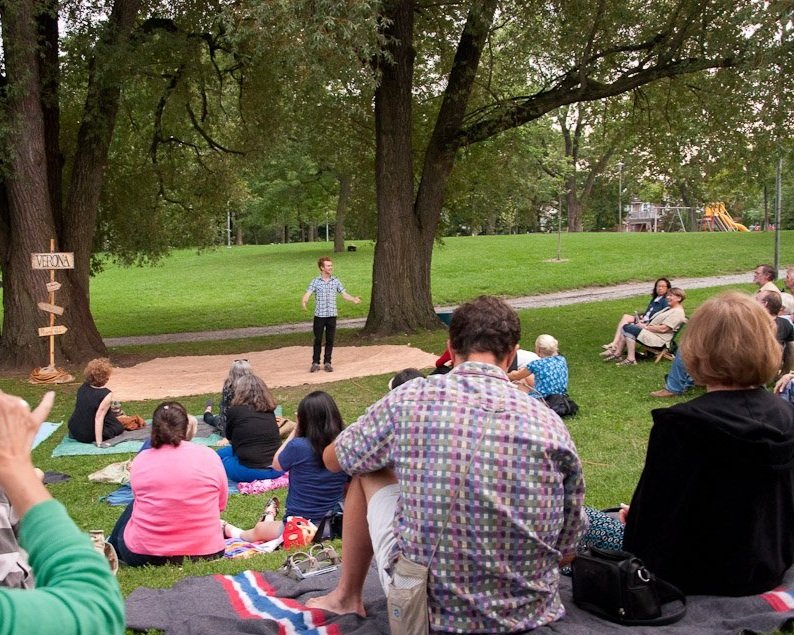
Governance Reimaginings (or, There’s Got To Be A Better Way)
Brendan McMurtry-Howlett on the challenges of navigating a board of directors as a young artistic director, and the project Generator has undertaken with Shakespeare in the Ruff and Toronto Dance Community Love-in to look at alternative governance models.
This is the first post in Generator’s ‘Governance Reimaginings’ blog series. You can find all posts in the series here, and everything we’ve published related to boards here. In this post, Generator Strategic Advisors Co-Chair and Board Member Brendan McMurtry-Howlett introduces the project.

Kaitlyn Riordan, Brendan McMurty-Howlett, and AJ Richardson (left to right) in Withrow Park, Shakespeare in the Ruff’s home base, in 2012 (perhaps contemplating the nature of governance, who’s to say?) — photo by Daniel Daley
So, my friends, we’ve had a couple blog posts about boards and governance already, primarily highlighting the shortcomings and challenges of the legislated model (i.e. systemic patriarchy and white supremacy). You can do a quick little recap here and here. You can also basically ask anyone who has ever sat on a board or worked with a board and they’ll likely give you a litany of issues…as well as a handful of positives.
Despite the widely acknowledged flaws of the non-profit board governance system that a company becomes beholden to as soon as it incorporates, “to incorporate or not to incorporate” is a question Generator hears routinely.
This, of course, is never as simple a conversation as the independent companies asking hope it will be (although we did write an ArtistProducerResource.com page about it to cover the basics). There’s pressure on indie companies who are looking to grow to pursue incorporation, either for regular non-profit status, or the coveted, yet misunderstood “charitable status” (Cue the pots of gold dancing in artists’ eyes.)
We’ve been having this discussion on repeat for years, emphasizing the systemic white supremacy and patriarchy that plagues the non-profit board of directors model—but we haven’t really had a clear alternative to point to. So, we thought we’d try to do something about it. We teamed up with Shakespeare in the Ruff and the Toronto Dance Community Love-in, two companies we’ve worked with closely over the past few years through our Company Collaborator program, to propose a project exploring alternative governance models—and lo and behold, the funding came through!
But first, how did I get here?
I’ve been peripherally connected to Generator (and even the former version: STAF) for a number of years. I helped found Shakespeare in the Ruff and served as the Artistic Director for the first five years, before passing the torch to Kaitlyn Riordan and Eva Barrie, who have now completed their tenures as well. More recently, I joined Generator’s board, curious to experience the board structure from the other side. See, as a young artist producer launching Shakespeare in the Ruff, I myself was lured by the promise of incorporation and charitable status. Well, to be perfectly honest, we were forced to incorporate in order to obtain a permit to perform in a city park. But, it seemed like a reasonable step to take since we wanted to grow the company and increase our access to resources.
I flew headlong into incorporation, and the accompanying “corporate” requirements and mandated board of directors, without much thought to what it actually meant.
I soon found myself trying to quickly learn the language of a corporation: Robert’s Rules, by-laws, minute-taking and motions. I filled our board with non-artists, as per the advice of the day: lawyers, accountants, corporate marketing experts, and the like.
I soon found I was living a double life: an artist in the rehearsal hall, actively embracing uncertainty with a robust creative process and vocabulary to navigate it; and a corporate executive in the board meetings, faking my way through meetings, discussing corporate decision-making procedures —steering clear of uncertainty at all costs lest the board of non-artists get scared and panic in a way that might undermine the organization. I found I was frequently undermining my own expert knowledge of the arts industry to defer to a corporate lawyer who waved around their “fiduciary duty” like a beating-stick.
I couldn’t provide leadership within the vocabulary and processes of a corporation, and the corporate directors couldn’t provide leadership for an arts industry they knew nothing about.
At the lowest point, our board imploded over disagreements of corporate procedure, and the company very nearly folded. No joke: Shakespeare in the Ruff, now celebrating its tenth anniversary and welcoming a third generation of leadership, almost went belly-up in year three.
I don’t believe there was malicious intent from any party. We were all simply pushed into a system of operating that did not arise from the values or ways-of-knowing of the artistic company itself. None of us had clarity on the actual functions of governance, beyond fulfilling the legal structure insisted upon by the Incorporation Act.
There were also many great experiences with Ruff’s board, where I was genuinely supported by a community of artists and non-artists alike to achieve more than I ever could have on my own. These polar oppositional experiences piqued my curiosity, and ever since leaving Shakespeare in the Ruff, I have sought to learn more about the spirit of governance and the legal structures we have in place. (I even went and did a Master’s degree looking at some of this stuff, but that’s a different story.) When the opportunity arose to join this project (and help write the grant), I jumped at it.

Brendan with Wayne Burns (right) in a production photo from Romeo and Juliet in 2016 — photo by Cylla von Tiedemann
Brendan welcoming Ruff audiences before a performance of Two Gents in 2012
So what is the project?
From the outset, the core of this project has been the desire to tackle the seemingly overwhelming topic of ‘governance’ within the context of a community of artist producers thinking about similar questions, but each through the lens of slightly different operating structures.
The Toronto Dance Community Love-in is an incorporated non-profit, and has operated with a collective leadership model since their inception. Shakespeare in the Ruff is a theatre company that has been operating under a co-leadership model, but is now undergoing a leadership transition towards a collective model, as well as a moment of transition with their board. Ruff is an incorporated charity which means they’ve got an extra layer of regulations and reporting requirements on their “corporate” structure.
We wanted to achieve a few things through this project. First, we wanted to learn. What are the other possibilities for governance models and structures? What are the exact legal requirements, and are there any loopholes in fulfilling them? What does “governance” actually mean separate from the non-profit board-of-directors model? Second, we wanted an opportunity within each of our three organizations, to try things out, do things differently, and experiment with governance and organizational structures based on our learning. Third, we wanted to share our learnings with the broader community…hence this blog post. And there will be more blog posts coming.
Throughout the past six months, we’ve structured our project as a series of (mostly Zoom) learning sessions, inviting in various knowledgeable folks who each bring a different perspective to the concept of governance and non-profit structures. These have been incredibly enlightening and exhilarating sessions, filling my head and heart with so many ideas, and allowing for an intimate discussion about the issues. We’ve been meeting with folks such as Jane Marsland, Yvette Nolan, Zainab Amadahy, Elder Whabagoon, Cynthia Lickers-Sage, and others.
What has struck me so far in these sessions is that governance is no one thing for any one person. It is about a practice of decision making that is undertaken in community. There is no magic wand, or perfect structure that will solve all the problems. Anything we create must be engaged with, nourished, and sustained by those impacted by and connected to the organization.
We’ve also had sessions where we’ve all shared our current thinking and questions, as well as how each of our uniquely structured organizations are wrestling with the shared issues. These sessions have been just as enlightening as those with invited guests, as I’ve been exposed to the innovative thinking and practical adjustments that my fellow participants have been doing within their own organizational contexts.
Over the next couple of months, we will be publishing a series of blog posts written by various people participating in this project. Some of them will be engaging with the learnings offered to us by our guest speakers. Some of them will be personal reflections on an evolving understanding of governance. We hope they will all be wildly entertaining. Or, at the very least, we hope to contribute to a growing community of folks in the arts (as well as other sectors) who are taking a good hard look at governance and the ways we make decisions together. We are all starting to recognize that in order to address systemic racism and patriarchy, we need to address our systems, and be bold in dreaming up something different.
These times of upheaval are an opportunity, if we can find the energy. As Yvette Nolan said to us, "I don't know how long this window is going to be open for." This is urgent work, and the more we share our growing knowledge on the subject of organizational transformation, the better our chance of enacting change that will reverberate through our sector…and honestly, hopefully the world too.
Governance Reimaginings asks how we can deconstruct inherited governance structures to create systems of accountability and community care that support, and are aligned with, the values of the organizations and individuals they serve. Structured as a knowledge exchange between Generator, Shakespeare in the Ruff, and the Toronto Dance Community Love-in, Governance Reimaginings took place between April-December 2021 and featured a series of instigations by invited guest speakers. We gratefully acknowledge the support of the Chalmers Family Fund, administered by the Ontario Arts Council, for this project.
