
Blog
Can Theatre Love Us Back?
In Zohran Mamdani’s mayoral acceptance speech last year, he spoke of the cynicism that has come to define the experience of working New Yorkers who once loved the city they live in, but no longer feel that city “loves them back.” This notion of how an institution like a city can practice “love” resonated with me. A city that loves us back might look like strong, well-resourced, responsive social infrastructure: accessible transit, affordable housing, a manageable cost of living, accountable leadership.
By Nikki Shaffeeullah
Generator’s Director of Programming
May Day / May Month at Generator
In Zohran Mamdani’s mayoral acceptance speech last year, he spoke of the cynicism that has come to define the experience of working New Yorkers who once loved the city they live in, but no longer feel that city “loves them back.” This notion of how an institution like a city can practice “love” resonated with me. A city that loves us back might look like strong, well-resourced, responsive social infrastructure: accessible transit, affordable housing, a manageable cost of living, accountable leadership.
I spoke with friends about how our own city does and does not love us back. I thought about how the institutions and industries we live and work in do and do not love us back. And I asked colleagues about their relationship with love and theatre. Love, in various manifestations, is usually what brings one to a career in the performing arts: a passion for the craft, a belief in its power to bring people together, an affinity for the community of fellow theatremakers that grows over the months and years and decades spent in our niche creative industry. But does theatre love us back? The industry remains a place that is difficult to enter and difficult to stay long term. Wages are low, other common labour supports like health insurance, sick leave, and paid vacation are scarce, and work is precarious. Almost all artistic work is engaged via short term contracts, and even creative work that goes on to full production is often initiated and developed through some amount of unpaid labour. Hiring practices are informal in a way that encourages inequitable practices. Arts workers who are without external supports like generational wealth or family/partner financial support, disabled or chronically ill, caregivers, or facing other historical marginalizations, have a much more difficult time sustaining a career. Despite pouring love into it, despite the relationships built through creative practice, despite the impact artistic work can have on audiences and communities, it does not always feel like the institutions that drive the theatre industry love us back. How can it? How can theatre love us back?
In observation of May Day (May 1, International Workers’ Day), Generator is thinking about how the performing arts can love all of us back. To bring this conversation to our community, and to show some love, we have three no-cost offerings for our community this month:
Tenant Rights for Arts Workers
In partnership with ACORN Canada
Wednesday May 6, 6-7:30pm EDT, ONLINE
Wellness Day for Arts Workers
For low-income and uninsured arts workers
In partnership with Rooted TCM
Friday May 22, all day, IN PERSON / LIMITED REGISTRATION
Free individual treatments in Traditional Chinese Medicine including: Acupuncture, Tuina, Shiatsu Massage, Acupressure, Cupping, Guasha & Moxibustion
Free group sessions: Soundbath, yoga, and community acupuncture
Registration information coming soon
Wellness Strategies for Arts Workers
In partnership with Rooted TCM
Traditional Chinese Medicine practitioner Saima Butt will lead participants through wellness exercises that participants can facilitate themselves, at home, to tune into their own rhythms, regulate their nervous system, and restore balance from within.
Sunday May 31, 2-3pm EDT , ONLINE
Registration information coming soon
We would love to hear from you. What are the ways you feel your workplaces in the performing arts love you back? What do you as a producer do to support the wellbeing and humanity of those who work for and with you? What else can we all aspire to and work towards?
In solidarity,
Nikki
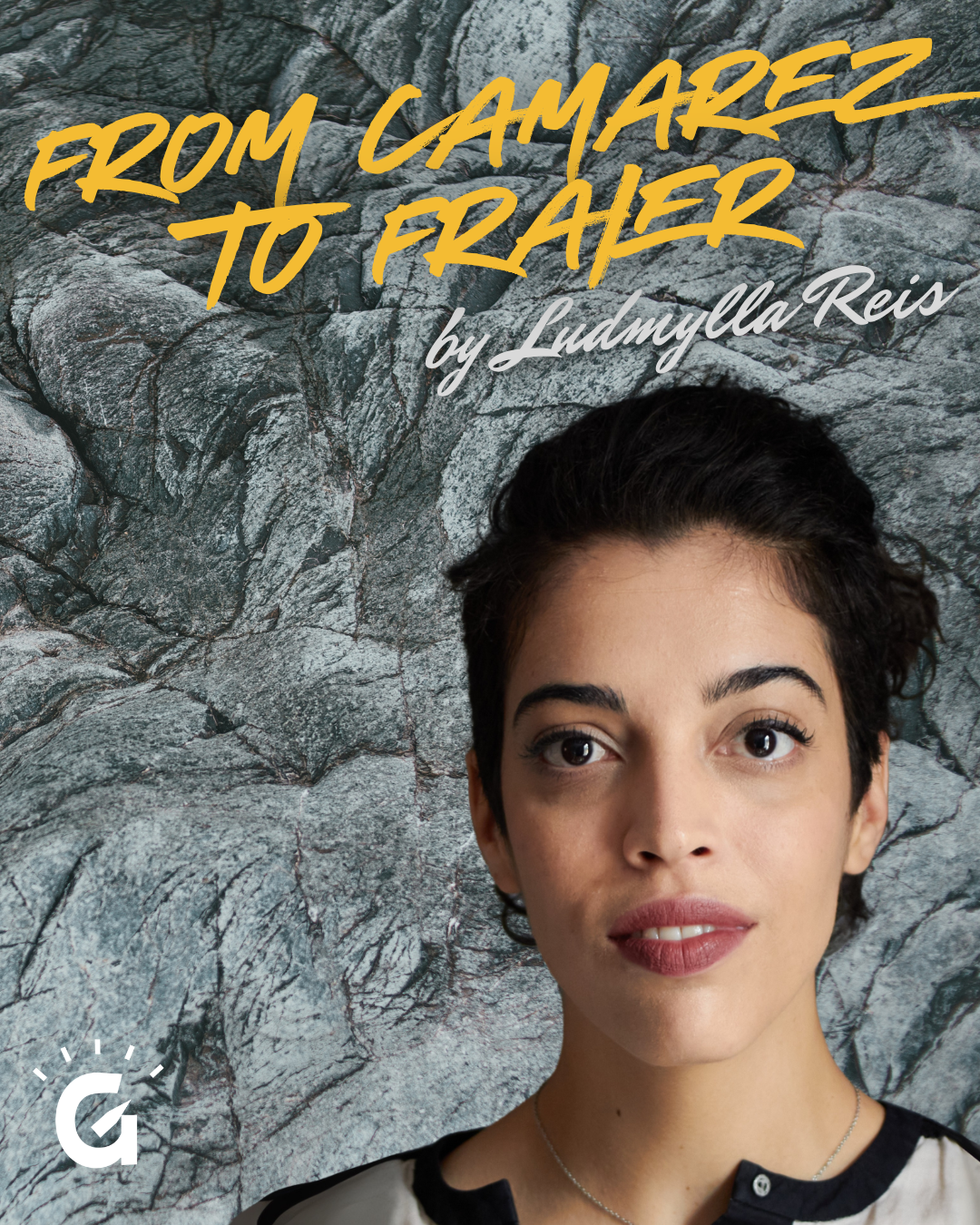
Sector Research: Ludmylla Reis
The next offering from our 2025 Artist-Producer Lab cohort sector research projects is by Ludmylla Reis. This sharing takes the shape of a creative short story titled "From Camarez to Fraier" it was written, edited, and performed by Ludmylla Reis. Enjoy!
The next offering from our 2025 Artist-Producer Lab cohort sector research projects is by Ludmylla Reis. This sharing takes the shape of a creative short story titled "From Camarez to Fraier" it was written, edited, and performed by Ludmylla Reis. We’re thrilled with the shape that this research project took. You can listen to it whever you find podcasts or by following the link below. Transcripts are included in both PDF and Word Documents. Enjoy!
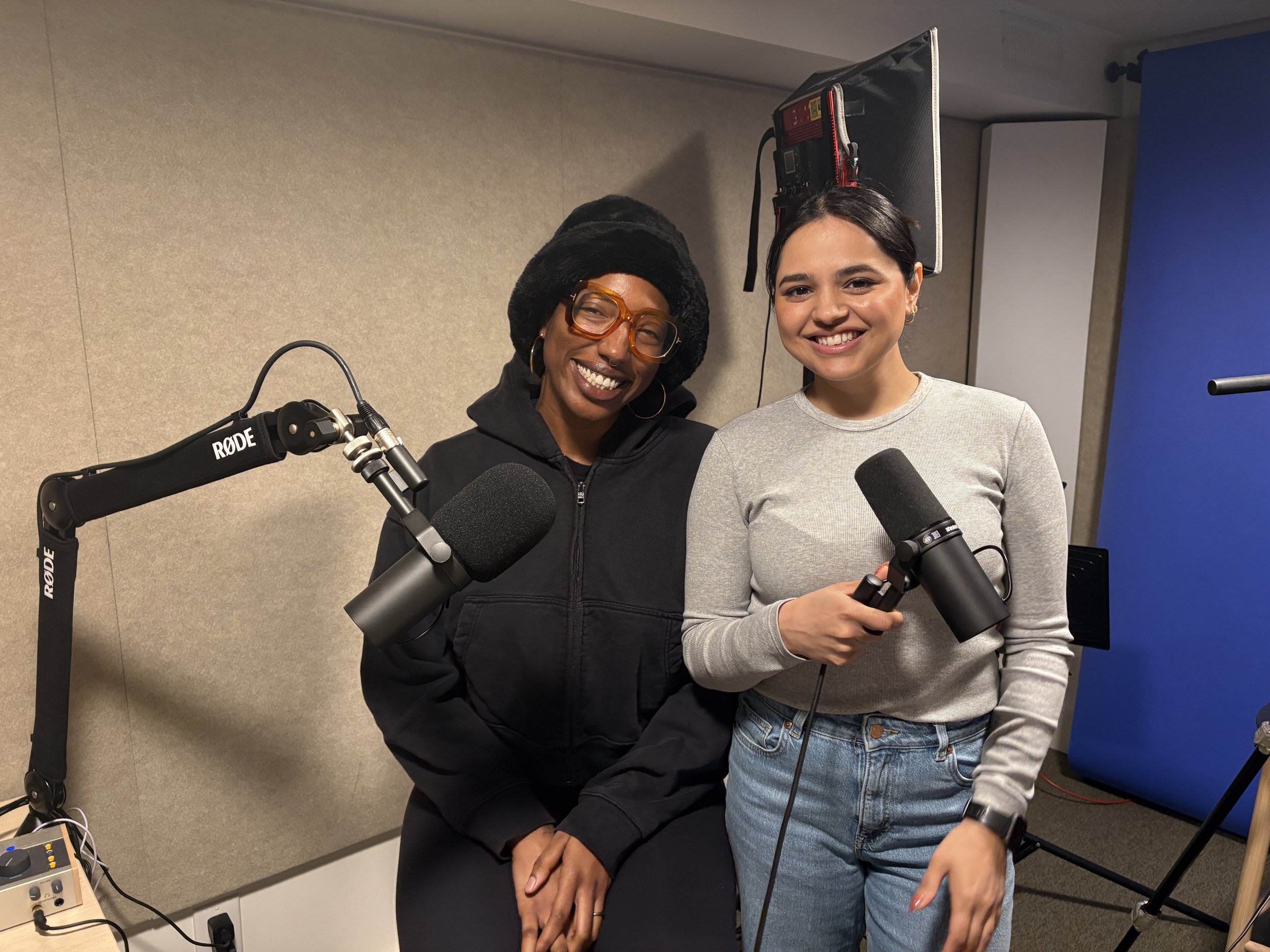
Sector Research: Kaylce Carter
We’re delighted to release the next micro-research project from our 2025 Artist-Producer Lab cohort. This piece is a podcast episode in which Taranjot Bamrah sits down with Kaylce Carter to talk about their research into the current state of accessibility and future-oriented accessibility practices (Dreaming Forward). Listen in! See a transcript of the episode here.
We’re delighted to release the next micro-research project from our 2025 Artist-Producer Lab cohort. This piece is a podcast episode in which Taranjot Bamrah sits down with Kaylce Carter to talk about their research into the current state of accessibility and future-oriented accessibility practices (Dreaming Forward). Listen in!
Find the Generator Podcast whever you listen to podcasts.
Sector Research: Josh Marchesini
What does it mean to produce a festival and ensure one’s physical and mental health is cared for, avoiding burnout and establishing sustainability and care for both the festival producer and the festival?
We’re delighted to release the first micro-research project from our 2025 Artist-Producer Lab cohort. Dive in to see what Josh Marchesini has been exploring.
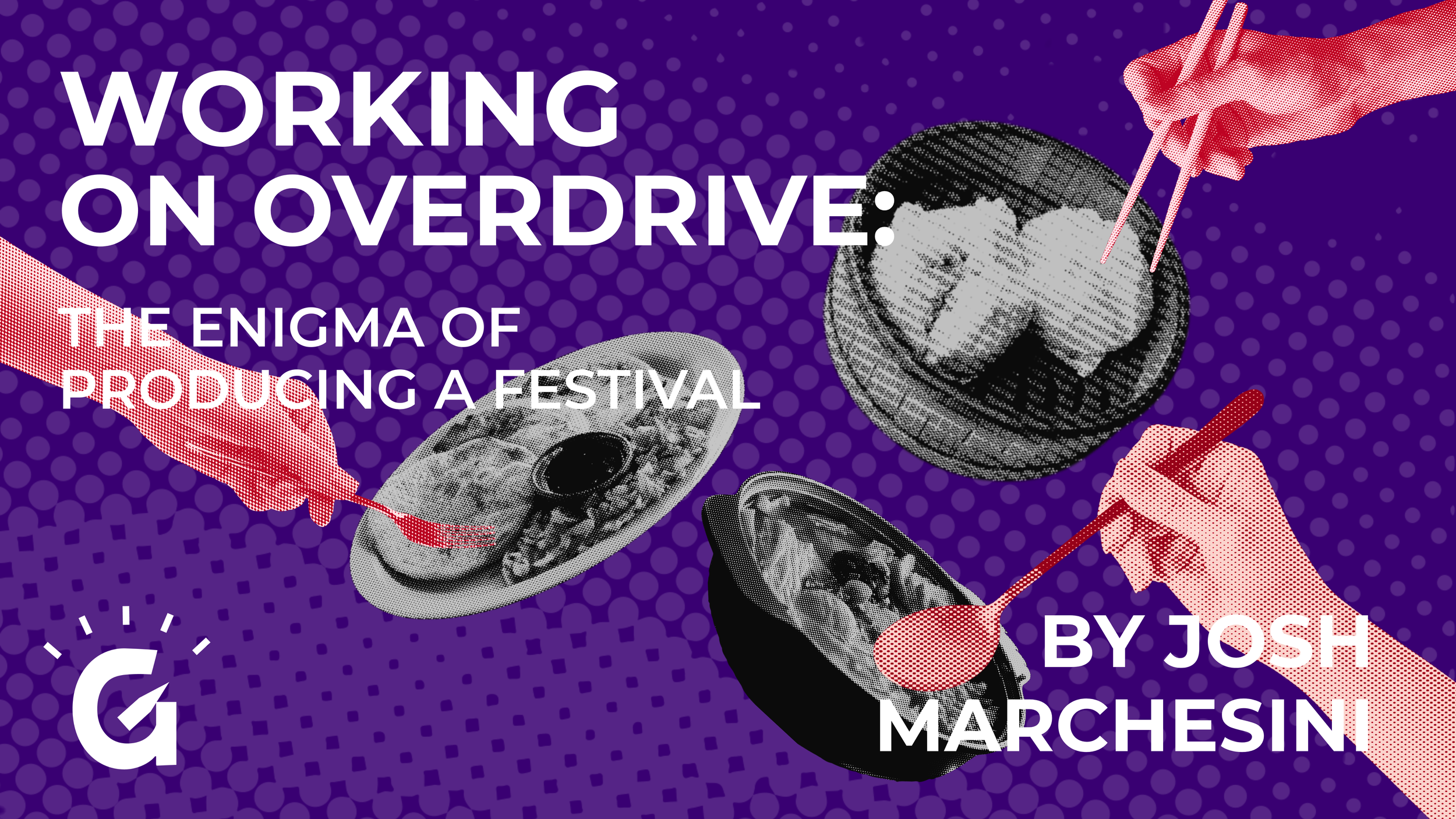
Graphic design by Oliver Pitschner
Working on Overdrive
The Enigma of Producing a Festival
Introduction
There comes a point when working on or running a performing arts festival where your brain goes into overdrive. Deadlines changing, projects shifting scope and the constant pursuit of a “successful” festival. My research project, as part of Generator’s 2025 Artist-Producer Lab, focuses on the enigma of a festival, because no one festival is like the other. As a festival producer, the need to take an intermediary position emerges: between artists and institutions, between Canadian and international artists/audiences, and between different views of what “Canadian” art looks like on our stages. In contrast to other performing arts producers, festival producers face specific challenges in producing a festival: they operate in a specific time, energy and cadence that they know best as the knowledge keeper of that enigma. The overarching question is this: What does it mean to produce a festival and ensure one’s physical and mental health is cared for, avoiding burnout and establishing sustainability and care for both the festival producer and the festival?
This research question also comes from my experience working at different theatre festivals in Montreal and Toronto, speaking to the assumption that working in the arts requires unpaid and/or overtime labour, which can come at a personal cost. (Frankly, I’ve lost count of how many times I’ve burned out since entering the arts in 2019.) This article features five festival producers working in some of our major cities across Canada:
Ludmylla Reis, Festival Director for Rhubarb! Festival, as part of Buddies in Bad Times Theatre (Toronto)
María Escolán, Festival Producer for the 2024 RUTAS International Festival of Performance and the 2025 CAMINOS Festival of New Works, as part of Aluna Theatre (Toronto)
Kafi Pierre, Producer at TO Live (Toronto)
Shannon Corenthin, Producer of the 2025 Club Zed Festival, as part of Black Theatre Workshop (Montreal)
Kelly Li, Managing Producer at Prismatic Festival (Halifax)
Lindsay Nelson, Producer at PuSh International Performing Arts Festival (Vancouver)
I hope this conversation helps imagine how arts workers could and should take care of themselves and the artists they work with.
If you had to describe producing as a meal, what would it be? Why?
ME: Like a meal prep where there are various ‘departments,’ like if it was pupusas there’s a beans department, the cheese department, the curtido department, the salsa department and the masa department - all essential - where each needs to be cared for so when they come together in the pupusas it’s amazing.
SC: Producing would definitely be a Christmas meal. There are a bunch of components that need to come together from various sources and outside forces (vendors and participants) who are either bringing sides or asking for different sides. It's wonderful when it all comes together, but the planning and executing process is an exercise in patience and organization.
KL: Perhaps it’s my Cantonese heritage speaking, but I would suggest dim sum as a comparison. Shared family-style, dim sum comprises a large array of small but highly intricate dishes that range widely in texture, flavour, temperature, and ingredients. Translated literally from Chinese, 點心 means to “touch the heart,” and this spirit reflects the degree of care put into the devising and execution of each bite of food. Most dishes involve a great deal of labour and technique, and include elements for which preparation begins days in advance. All of this comes together and ends up on your table as a harmonious meal, meant to be enjoyed slowly alongside conversation and tea.
LN: Producing is like eating dim sum with a group of friends. You’re all there together with shared resources (the amount of money in your wallet and the kind of dishes that are being offered), working towards a common goal (filling your belly with delicious food), but everyone has a different idea of what dishes are important, and everyone eats a different amount of food. The servers come around with different dishes and you must work as a team to decide when you need more dumplings, or if that’s too many pork buns, and you’re hoping you come in within budget when it’s all over.
KP: Producing a festival is like preparing a large, multi-course holiday family feast, like Thanksgiving. There are many ingredients, countless moving parts, and a need for precise timing yet the heart of the meal lies in the collaboration. A producer acts like the head chef, coordinating the menu, delegating tasks, balancing flavors, and ensuring that each dish complements the next. When done well, it becomes a shared experience complex, nourishing, and deeply communal.
LR: Either a five-course meal, which is a whole journey, and you eat one plate at a time, and at the end, you are satisfied and tired. Or maybe my favourite answer: a buffet, a self-serve hot pot, or something like that. It's a self-knowing experience to go to hot pot, really. Because you gotta know how hungry you are, decide what you're eating based on your desire. You have to make a series of small and big decisions in there. Are we going veggie? Are we going tomato broth? Is my tummy sick, and should I get something lighter? Should I get 700 grams? Should I get 300 grams? There's a lot of scope management there.
How do you practice caring for your mental and physical health in the lead up, during and after producing a festival?
LR Something that I got good at by training, I chose to be better at it, and it's really important to me, it's scope. It’s figuring out how much can be done with what we have, and then sticking to it, or adapting things, but still staying within the possible, within these resources. I feel like a lot of times, things get out of hand this way. Clearly, all you can do is a double espresso, but you really want a large Americano. It's not gonna happen.
So to me, my strategy has always been scope management. If this is what it is, this is how much we can do, and then we're gonna knock it out of the park within the scope. But we're not going to grow this scope, because that's unachievable.
KL: I think most people who work for festivals have accepted that the work is seasonal by nature and that during festival time, work may take over life. I consider this part of the deal and look to the rest of the year to find balance through the cycles of workload. By ensuring that my mental and physical health are well cared for outside of festival time, I’m much more capable of maintaining health during the busy weeks and emerging (mostly) unscathed at the end.
A couple years ago at Prismatic, we instituted a four-day work week, which goes a very long way in supporting work-life balance year-round. Following the festival, we close the office for a week. Making sure we have enough time off does the lion’s share for health, but actually taking that time off is vital. As commonly advised (though rarely adhered to), not working outside of work hours really does help tremendously.
During festival time, I find that relying on short routines for getting ready and decompressing helps to reduce mental load. I’ve started bringing snacks because remembering and finding time to eat can be hard, and eating out too much doesn’t feel good mentally or physically. It cannot be overstated how important it is to look out for your team, and to let others look out for you – covering each other to allow for more rest, making time to debrief together, being honest about how you’re doing.
SC: I have yet to find the optimal way to take care of my mental and physical health during and after producing a festival. It’s very time consuming and there are so many moving pieces. I would say, I try to implement an “end of work day” time and log out of my email at 4:30pm (which is the end of the workday for our organization). However, especially for the festival, emergencies usually happen last minute and as a producer you are the holder of most, if not all, of the information. What I definitely do is take time off after the festival to recharge and step away. Most post-production elements can either be done quickly or wait for a few days.
KP: Caring for my mental and physical health is a continuous practice that shifts throughout the festival cycle: In the lead-up, I focus on structured planning, realistic scheduling, and early delegation. I build in buffer time wherever possible so crises feel manageable rather than overwhelming. I also try to maintain exercise, sleep, and moments of quiet to stay centered. During the festival, I aim to stay attuned to my own energy levels. I take short breaks when needed, step away for a few minutes to reset, and stay hydrated and fed (even when the schedule is intense). I also check in regularly with staff, both to support them and to model the type of care I expect throughout the team. After the festival, I intentionally decompress. I rest, reflect, and create space to process what went well and what can be improved with the team and with myself. This recovery period is essential. It allows me to return to the work with clarity, gratitude, and renewed capacity.
ME: In the lead up, I mentally prepare for the longer hours, go grocery shopping for more than usual to last me through as much of the festival, sleep well and plan ahead when my first days off will be after the production - I aim for asap after the festival, when we don’t actually need to be on or standing by all day anymore. During the festival I make sure I don't skip meals, sometimes I cut out caffeine or sometimes I have it as a daily treat and I sleep as much as I can when I finally can. It also helps that I really enjoy the festivals themselves; I find all the art, connecting, and celebrating really energizing and the whole reason we worked so hard in the lead up. Afterwards I really log off, silence notifications and go into a total rest mode :) I also think having a good producing team that can be honest and caring together really, really helps at every stage of the producing process.
LN: I see festival producing as a year-long marathon that ends in a sprint. The more I prepare throughout the year, the better chance I have of making it through the last 2 months without burning out. Doing as much as I can early on means less last minute work, which gives me the time and mental space to deal with those fires that flare up. I practice physical and mental health care throughout the year, so that in the rush of the festival, and the month leading up to it, it’s already second nature. This includes things like hydrating regularly, staying active to build stamina, being gentle with myself when mistakes are made, finding small moments to fill my cup. I make good use of some tips that have been passed down to me - prep and freeze individual meals before the festival, carry individual packets of electrolyte powder for my water bottle, and when I need a boost, find a space, play a good song and dance for two minutes. Post festival I try to listen to what my body and brain need, I try to be gentle, and I recharge by spending time alone in the woods or with friends I haven’t been able to see.
Festival producers can be seen as intermediaries between artists and “institutions.” What is the core value or values you embody in this role as intermediary and producer?
KP: As a producer navigating between artists and institutions, the core values I embody include: Integrity – ensuring transparency, honesty, and clear communication in all directions. Advocacy – championing the needs, visions, and wellbeing of artists, while balancing institutional expectations. Especially when working with underserved communities. Care – cultivating environments where people feel safe, supported, and respected. Access – working to ensure that processes, opportunities, and resources are distributed fairly. Most importantly, collaboration – fostering relationships built on trust, partnership, and shared purpose. These values guide every interaction and decision I make. They ensure that both artists and institutions feel heard, respected, and aligned, ultimately strengthening the festival’s foundation and making the work more sustainable for everyone involved.
SC: Producers have their own core artistic values and also, when working within or for an institution, are made to be representatives of an institution to the artists. As a producer you want to provide the best experience for the artists who are participating in your festival whether that be by teaching, performing or being audience members. I think I separate it in two in my head: before the festival, I’m prioritizing the institution’s goals and needs, and during the festival, I’m prioritizing the artists and their experience. All the while keeping the mission of the festival in mind. I try to be fair, realistic, and open to the needs of both the artists and the institution throughout the festival to ensure we have a smooth experience.
ME: I think it’s mainly care and honest connections, with the goal of giving artists as much information as possible to make decisions along the way, asking about their needs and accommodating those as much as possible, communicating the needs and processes of the institutions that I work with, explaining anything that might be unclear so we all know why some processes are required, and keeping communication channels open.
LR: Well, being a festival producer for Rhubarb! has a rare specificity, because I'm both curator and producer, so I define who those artists are, and then I also manage the process with them. And then I'm inviting them to be at Buddies and engage with that organization. And so, there is… an alignment of all these roles that I specifically have to navigate to determine how that experience will be. And I think in many ways, perhaps even because of the size of Rhubarb! and the way the flow works, it makes sense that I am the curator and producer, because… It can be a bit of a scope challenge… Perhaps, a good way for me to start talking about that is thinking about the hiring process for the role itself and how there needs to be clarity in the conversation between you and the institution about what those values are, as much as what your skills are. So, there is a check-in on you know… can you do all the practical things a festival director needs to do? Can you write the grants, can you project manage? Can you curate?
LN: As an international festival, we have artists from all over the globe. Different cultures have different ways of working, with different values, methods of communication, and speeds of work. Artists may not have as much experience touring internationally, or may have varying levels of support behind them. Listening to them, and moving forward with curiosity, respect, and a desire to creatively problem solve is how I try to bridge the gap between the artist’s needs and desires, and my “institution’s” deadlines and budget lines.
KL: Racialized artists [Prismatic is mandated to present Indigenous artist and artist of colour] are very frequently expected to be mouthpieces for whatever worldviews or ideologies people want reflected back at them, and it is critically important that this expectation doesn’t exist here.
In presenting the art and in working with the artists, I try to afford as much care as possible. They trust us with their work; oftentimes they are also traveling great distances in order to be with us and to share with our audiences. We owe it to them to be attentive to their work and their experience, even if there is lots else going on. This includes personal needs and cultural protocols, which, in mainstream settings, racialized artists are rarely given the space to express.
Reflections
The producer plays a crucial role in a festival, no matter the time length, size or scope. This article, I hope, demonstrates the hard work and various ways we can practice care in producing artistic work. I hope that future research can develop a written and visual history of performing arts festivals in Canada and archive the work carried out by producers working behind the scenes. As festivals program for future years, I hope that the reader can look to support these producers and festivals as sites for celebration, dialogue and cultural diplomacy across the country and on the world stage.
What the Festival: What a year!
Now that 2025 is soon coming to an end and we’ve had a chance to rest and reflect after a very busy and exciting year, I am left feeling very grateful. Grateful that we as an organization were able to accomplish so much this year, and that we were able to overcome obstacles and still find success in producing our annual festival, WTF ‘25 this past September. We couldn’t have done it alone and are so grateful to be a part of a community that has shown up for us when we needed help and continues to motivate us to move forward knowing that our efforts are appreciated by various groups of local strange-making artists and anticipated by our growing audience.
In 2025, WTF hosted Spring Thing 2.0 in May with the return of our THING ONE and THING TWO cabarets and the addition of our Swap N’Sale costume and props sale. The summer leading into the fall was a total whirlwind. We had the pleasure of launching our Strange Maker Award at the TO Fringe in July and brought creative activation to the SummerWorks Festival’s closing night party in August. We hosted our first late-night cabaret at the Toronto International Buskerfest over the labour day long weekend and participated in the Queen West Arts Crawl with roaming circus acts presented by Hercinia Arts to enhance engagement with patrons and promote our upcoming festival. Amid all this activity, we also held a successful crowd-funding campaign which filled a significant funding gap and somehow planned an entire festival.
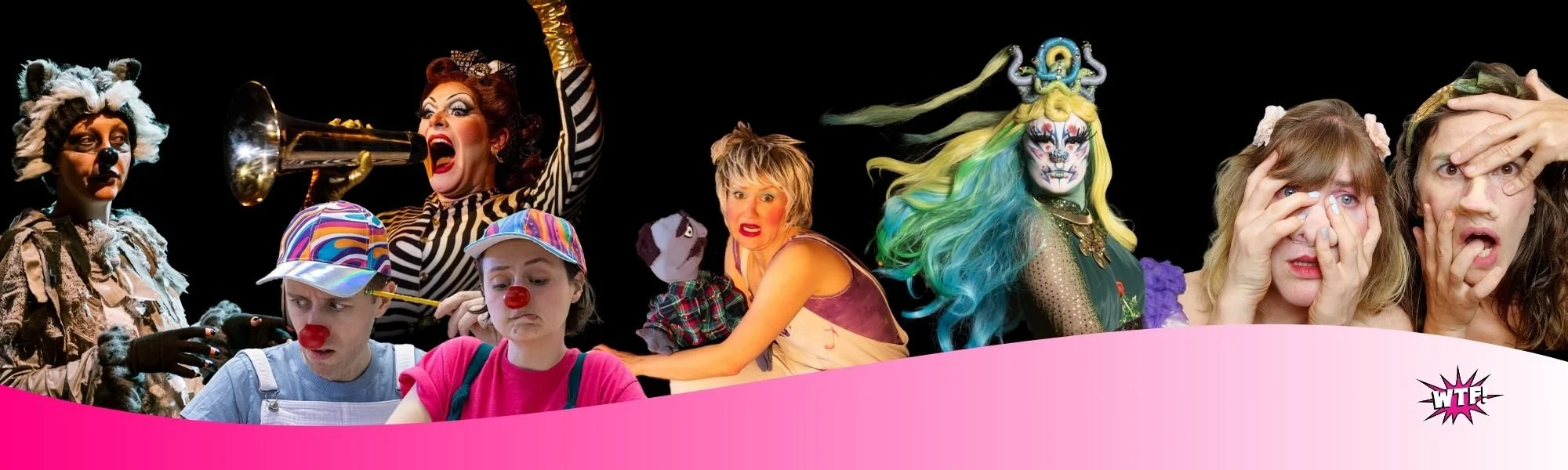
(L to R Meegan Sweet (The Shiniest Piece of Trailer Trash) Pearle Harbour (Strange Maker Showcase) Jonas Trottier and Emma Nelles (Milk Milk Lemonade), Morgan Joy (Peggy’s Place), Anne Alien (The (IM)Possible Cabaret), Animacy Theatre Collective’s Alexandra Simpson and Morgan Brie Johnson (Juice Break)
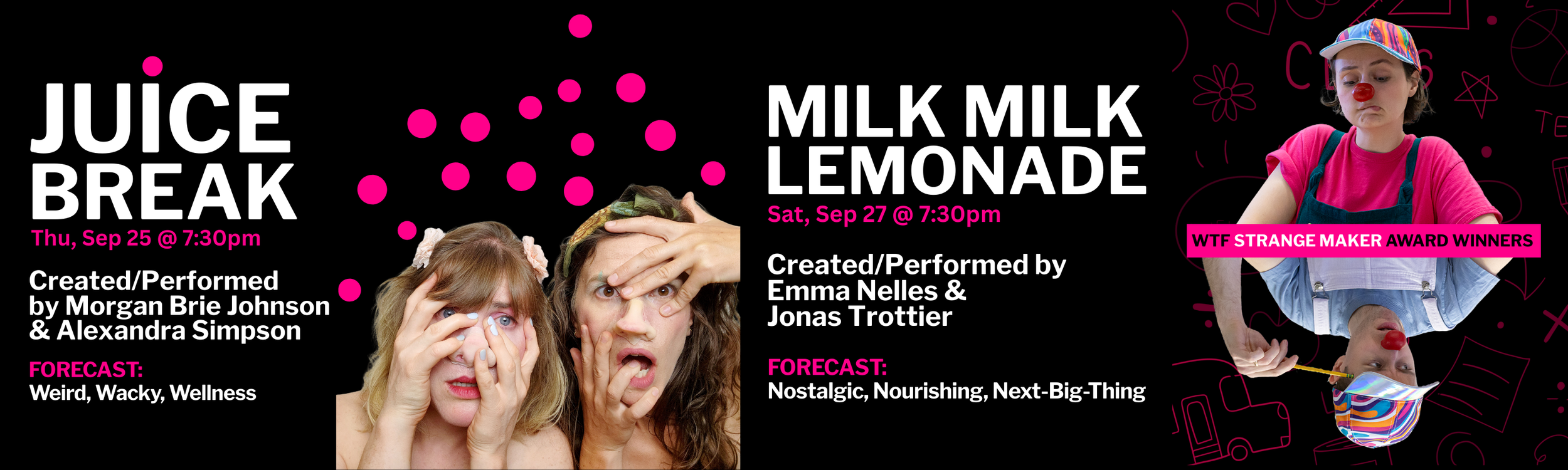
WTF ‘25 took place from Sep 25 to 27th, 2025 at Youngplace’s Sweet Action Theatre and Small World Music. We had 4 completely sold out shows and a 95% attendance rate overall. Our programming included the world premier of Animacy Theatre Collective’s Juice Break and the multi-talented Morgan Joy’s Peggy’s Place. This year, we also had our first out of town production, Meegan Sweet’s The Shiniest Piece of Trailer Trash from Edmonton and the Strange Maker Award winning production Milk Milk Lemonade performed by Emma Nelles and Jonas Trottier.
Our second annual festival also included the return of our signature Strange Maker Showcase, hosted by Pearle Harbour and the debut of the new (IM)Possible Cabaret intended for the most odd and outrageous acts we could find, hosted by Anne Alien. Our cabarets continue to be a wild display of local strange-making talent including Clown, Puppetry, Drag, as well as Burlesque, Circus and more. These events provide the opportunity where anything can happen. For example, this year’s Strange Maker Showcase included an alien invasion (by Andre The Alien) and the delight of “Millions” an eager-to-play audience member who added much silly surprise to the event.
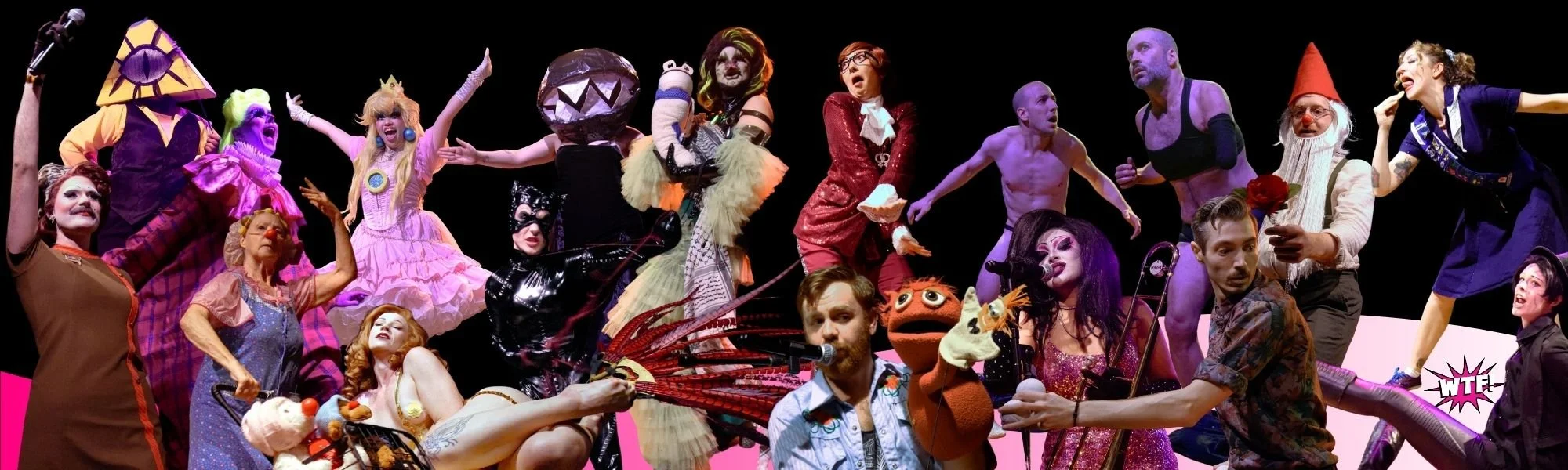
(L to R Pearle Harbour, Fox C Shanty, Pinkity Twiniky, Christine Moynihan, Jupiter Lightningstorm, Kanna Worm, Carly Rae Stepson, Anne Alien, Dyce 2 Watch Out 4, Bobby Knauff and Andre the Alien, Joshua Bonnici and Goldy Yason, Conjunctivisis, Jayden Gigliotti, Garden Gnome, Glinda Mercury, Cherry Bomb Photo credit: Alejandro Reyes)
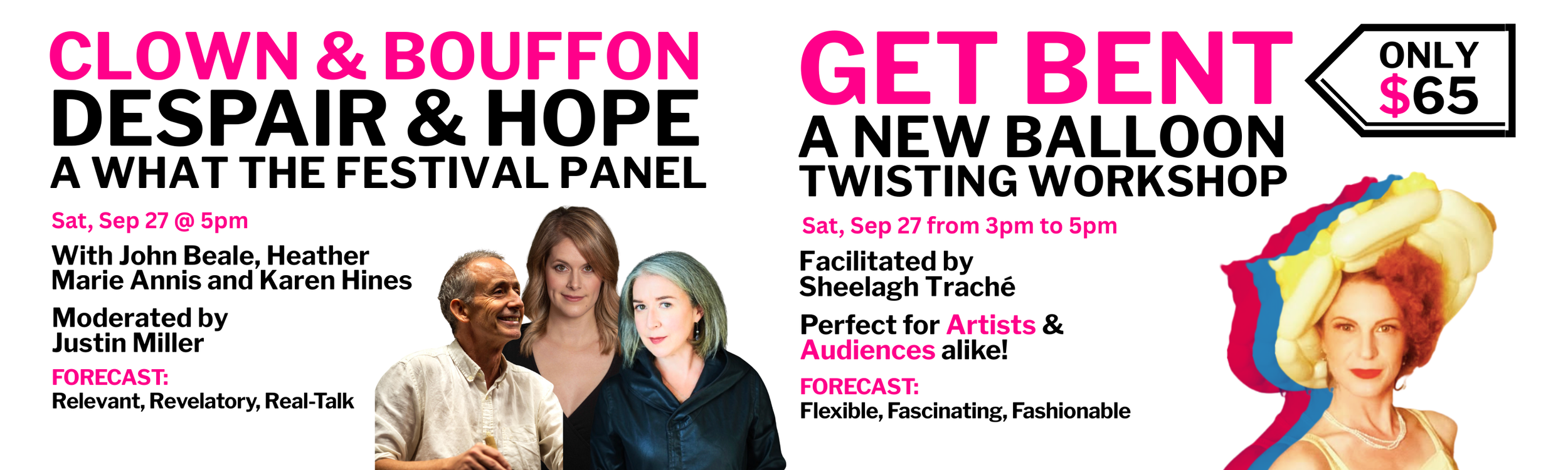
Our community engagement efforts were also a great success in the delivery of our Get Bent: Balloon Twisting Workshop facilitated by Sheelagh Traché, and our Clown and Bouffon: Despair and Hope panel discussion that showed a great level of interest in a deeper exploration of different approaches to Clown as well as an appetite for the opportunity to hear from some of Canada’s most accomplished Clown performers, teachers and directors in terms of their own experiences and insights.
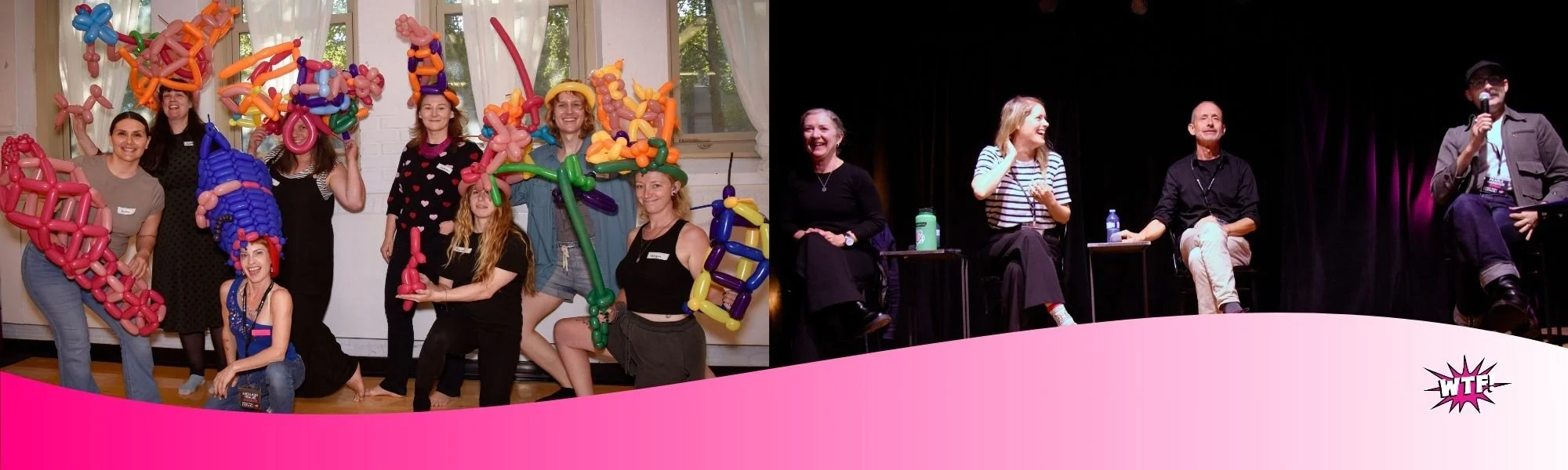
(L to R. Get Bent Balloon Twisting Workshop participants with workshop facilitator Sheelagh Traché. Clown and Bouffon: Despair and Hope panelists Karen Hines, Heather Marie Annis, John Beal and moderator Justin Miller. Photo Credit: Alejandro Reyes)
We also had exciting Lobby entertainment brought to our audiences by Magician Robert Chan, Puppeteer Bobby Knauff and Drag King Archie Called. New this year, we also hosted a pop-up market on Saturday featuring vendors from Toronto’s Arts Market including Effing Dice (Re Magill) who is the maker of puppets and 3D print materials, and Sonyah Shop, run by Olha Dovzhenko who is a maker of original Lino prints, wool jewelry, stickers and more.
For everything to come together so seamlessly after overcoming funding shortfalls and managing a reduced planning timeline for the festival, is a huge accomplishment. We were fortunate to have the support of a great team of staff, amazing volunteers and our venue and community partners who were truly dedicated to help us ensure that WTF 2025 was a great success. (You can read more about the team involved with WTF ‘25 here.)
As this is our fourth and final article written for Generator, we are grateful for the opportunity to reflect on and share our journey with others and we thank Generator for giving us the soapbox to reach readers. What we set out to do, in creating WTF as a home for Toronto’s strange-making theatre artists, was and still is very ambitious. As much as we have been successful in producing 5 major events to date and forming partnerships with several other local organizations, we still have a long road ahead in order to keep this train running for years to come.
Looking into 2026, the future of WTF is somewhat unclear not out of a lack of commitment to the cause, but in finding more sustainable ways to operate and manage growth. We’ve been incredibly lucky so far to always generate just enough funding to get us where we needed to go, however this has required many hours of unpaid labour and now after 3+ years of dedicated work, burnout.
We have been fortunate since the very beginning to have had the artistic direction of Byron Laviolette who has been instrumental in our birth, introduction with many community partners and overall success. As Byron has decided to move on from this role, his contributions as WTF’s co-founder will continue to be appreciated and acknowledged in our organization's mission and values. As we bid farewell to Byron, we send best wishes for his future endeavours with much gratitude.
As Executive Director, my goal for 2026 is to recruit new members to join Strange Maker Collective as the force behind What The Festival and to work towards incorporation so that WTF can benefit from the support and protection of an active and committed board who share a passion for our mission. But for now, after a non-stop year of activity and a lot of fun, time to rest and recharge is necessary.
We look forward to seeing you again in 2026!
What The Festival: What have you done for me lately?
OMG, have we been busy!
Like busy beyond what we ever dreamed might happen with WTF. And while that’s amazing, it’s been quite the ride from SPRING THING 2.0 to this point. So, what have you done for me lately?
In our last post, we talked a little about partnerships, and how we value them amongst some of the most important things we do. That remains true, but we kinda went overboard since then.
First off, we partnered with the Toronto Fringe, and sponsored the very first Strange Maker Award for the best Drag, Clown or Puppetry show at that festival. We saw 17 shows with our amazing jury, featuring past WTF alumni Adam Francis Proulx (The Family Crow - WTF ‘Test Fest’), Srutika Sabu (WTF 25 - Santosh Santosh) and Alexandra Simpson (WTF 24 - Up And Comer Cabaret)

[Note: Alex (along with Morgan Brie Johnson) are premiering Dora Award Winning Animacy Theatre Collective’s newest show JUICE BREAK with us this year. They kick off the festival’s fun on Thu, Sep 25th at 7:30pm - don’t miss it!]
The winner of the Strange Maker Award was a delightful playful and precocious red-nose clown show called MILK MILK LEMONADE, and they were given a $500 cash prize, as well as a spot at WTF 25 (They’re on Sat, Sep 27th at 7:30pm, so get your tickets before they sell out!) We are so happy with how this rollout went, and are excited to offer it again next year with the Toronto Fringe.
Next we found out we didn’t get one of the grants we rely on to keep WTF alive…so after we moped and cried a little, then put on our big girl/boy pants and ran a crowd funding campaign!
Our FILL THE GAP fundraiser was an opportunity to speak our truth - that it’s a very hard time for arts organizations, and with rising costs, competing interests and a world seemingly growing angrier by the day. We also talked about how committed we remain to making sure there are bright spots of joy, delight and strangeness for people to gather, celebrate and play!
And it seemed to resonate, because we raised over 7k through the kindness of 55+ donors!
After this, Byron left the province (no correlation, lol) to travel to Edmonton for their International Fringe Festival where the staff and team there, led by Murray Utas and Megan Dart, welcomed him with open arms and an onion cake - if you know, you know…
This continued a partnership that began last year, where we encountered THE SHINIEST PIECE OF TRAILER TRASH by Meegan Sweet, who will be bringing an updated version of the show to WTF on Fri, Sep 26th at 7:30pm, and since it’s all about a raccoon, we know Torontians will love it! (We sure do.)

During this time, we were invited to activate the 35th anniversary party for Summerworks at Factory Theatre. True to form, we staffed this event with a who’s who of past strange-makers, including Alexander Mantia (WTF 24 - The Zucchini Club), Andrew Gaboury (Thing One - Spring Thing 2.0), Dank Sinatra (WTF 24 - Don’t Drag Me Down Cabaret) and Snackbaby Thiccums (WTF 24 - Up And Comer Cabaret).
When Byron finally returned to us, we had the pleasure of running the first ever, 18+, late nite cabaret at Toronto International BuskerFest for Epilepsy. It was an event to remember for sure, full of beer, bears, Beyoncé and a bra full of lasers!! The incredible performers were led by Jesse Buck (WTF 24 - Strange Maker Showoff) and featured Randy Boots (Thing Two - Spring Thing 2.0), Fleur Fantasie (Thing Two - Spring Thing 2.0), as well as newcomer Molly Kewl who we had seen at the fun and frantic CosGay event at Buddies in Bad Times.

And so here we are!
We have one more event before WTF 25 - this time with the lovely people at the Queen West Arts Crawl, where we’ll be joined by Hercinia Arts (WTF 24 - Strange Maker Showcase) who will be roving and rambling through the crowd as two of their signature characters: The Mosquito and The Starfish! We’ll be in Trinity Bellwoods Park (just a hop, skip and and a jump from our home at Youngplace - 180 Shaw St. - from 3pm to 6pm on Sat, Sep 20th.
THEN WE ARE (FINALLY) RUNNING A FESTIVAL!!!
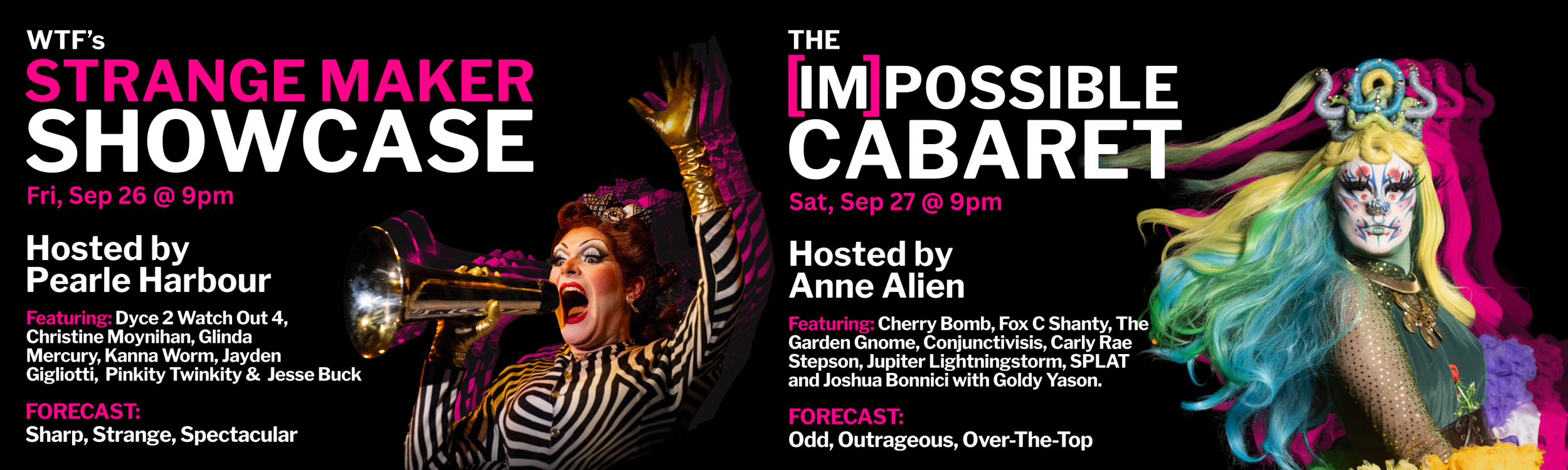
And have we got a line up planned. As we mentioned, we have JUICE BREAK, MILK MILK LEMONADE, THE SHINIEST PIECE OF TRAILER TRASH, plus Morgan Joy (Thing Two - Spring Thing 2.0) is bringing her puppet whirlwind PEGGY’S PLACE on Thu, Sep 25th @ 9pm.
WTF 25 also sees the return of our STRANGE MAKER SHOWCASE (Fri, Sep 26th @ 9pm) hosted by the nation's premiere tragicomedienne Pearle Harbour (WTF ‘Test Fest’ and WTF 24 - Post Drag Race Drag Panel), plus the brand new, totally oddball [IM]POSSIBLE CABARET(Sat, Sep 27th @ 9pm) hosted by one of CosGay’s own hosts Anne Alien!
We’ve also got a wild and wonderful workshop - GET BENT (Sat, Sep 27th from 3pm-5pm) with Sheelagh Traché aka. The Balloon Girl. This once-in-a-lifetime opportunity costs only $65 -materials included - and focuses on how you can transform balloons into hats, wigs, dresses and more! Perfect for audiences and artists alike, learn how to transform helium holders into haute couture!
As for our panel, this year the topic is CLOWN & BOUFFON: DESPAIR & HOPE and it is stacked with some of Canada’s most recognized artists who will dig deep into the contemporary state of these art forms, how they deal with despair and hope in their work and the stories they tell, and how they understand their place amidst it all. This event is FREE (Sat, Sep 27th from 5pm-6pm), is hosted by Justin Miller with panelists Karen Hines (Pochsy, Mump and Smoot), John Beale (Ecole Philippe Gaulier, Randolph Academy) and Heather Marie Annis (Morro and Jasp, Therapeutic Clown).
Then there’s another amazing energy exchange, with WTF hosting an ARTS MARKET POP-UP (Sat, Sep 27th from 4:30pm to 7:30pm) that will feature some of their best and most bizarre vendors. If you’re looking for that perfect surprise for your crush, a holiday gift for your cool aunt, or even a special something just for you, we’ve got you covered!
Lastly, but absolutely not least, and in the spirit of partnerships, we are welcoming THREE new team members to our WTF family. Claire Whitaker joins us as Marketing and Outreach Manager, Sabrina Gomes as Patron Services Coordinator, and Jenny Serwylo as Associate Producer. [Ok, so Jenny actually stepped in and helped us at WTF 24 when someone couldn’t make it because of a fall and…she’s official now!] We also have PEGGY’S PLACE’s Morgan Joy rounding out the crew as the Workshop Organizer for Pedro Fabião’s ‘Effortless Clown’ workshop that will take place immediately after the festival.
So, what have we done lately? A lot! And for who? Well, hopefully for all those who love and enjoy strange-making work, and believe that the world is a better place because of it.

For more info about WTF 25, and to book your tickets, check out www.wtfestival.ca/now and join us for smiles, strangeness and of course, popcorn!
Companion Piece to The Art of Being a Ding Dong - Snippets from Artistic Leaders
Over the spring/summer months in 2024, I began reaching out to artistic leaders and asking them the very vulnerable question: “think of a moment where you didn't handle conflict/harm responsibly - what would you tell yourself now?”. I had some very wonderful conversations with humans from across the industry. I used the term “artistic leaders” loosely, so not just artistic directors, but instructors, production managers, stage managers, general managers, mentors - essentially anyone who manages a group of people.
I asked those I reached out to to not be too polished, to speak from the heart, to include those “umm’s” and draft-speak, and simply offer a minute of vulnerability. Terrifying huh? But they did it!
I began gathering these moments because a big block that appears during conflict/harm reduction is the idea of a person being a “bad person” because they caused harm. It’s caused me to go down to routes: I either give up, think I’m horrible, and cry until my eyes are raisins and my cheeks grow moss (not super helpful to the other person), or I think “there’s no way I could have done that because I’m a gOoD pErsOn and therefore am incapable of harm” (which leads to gaslighting, denial, and again, not super helpful to the other person). I chose these people to reach out to because they have done so many wonderful things in their communities, so if they are capable of mistakes or causing harm, maybe the rest of us are too. Accountability is a learned skill, not a trait we’re born with. It takes work, practice, and a tonne of humility. Many of the moments they share also reflect times when they went against their own principles and values because of stress or external influence. As we move towards a more embodied understanding of leadership, discovering tactics that keep us grounded in principles, despite all that stress, is deeply important. Embodied leadership isn’t simply about taking a course, or thinking the thoughts, it’s about a deep, mental, and physical practise that allows us to continue growing and transforming into a person who can remain principled in their actions, even when trauma and stress want to veer us away.
Thank you to the wonderful people who contributed. You are doing such a great service by showing your bruises and scrapes, and it is so valued. Thank you as well to the folks I spoke with “off the record” who didn’t yet feel ready to share their stories publicly, but took the time to reflect on building accountability skills.
This piece is a companion piece to: The Art of Being a Ding Dong
Keith Barker

Keith Barker is a Métis playwright, actor, and director from Northwestern Ontario, and the current Director of the Foerster Bernstein New Play Development Program at the Stratford Festival. He is a former artistic director at Native Earth Performing Arts, and former theatre program officer for the Canada Council for the Arts.
Yolanda Bonnell
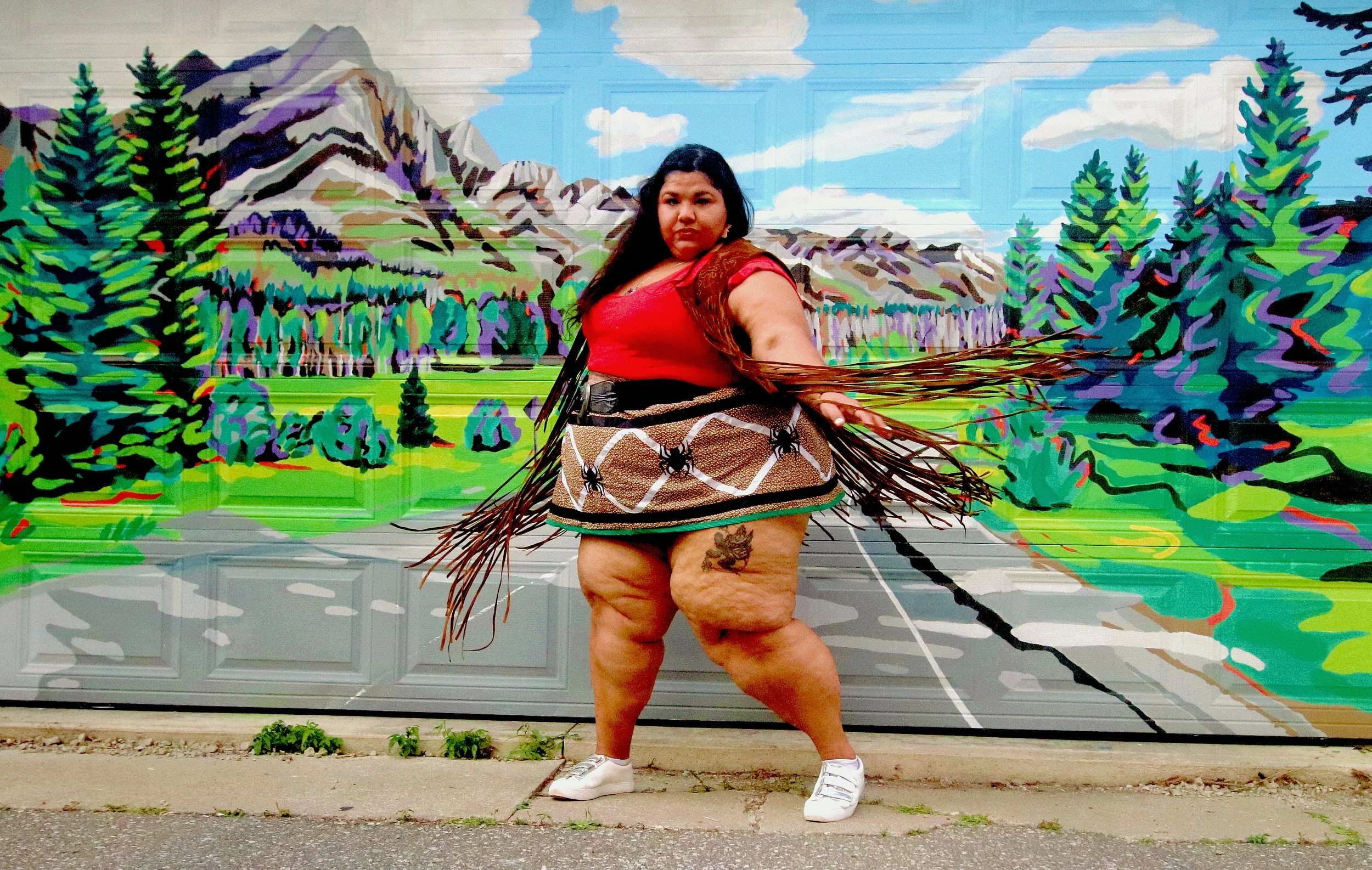
(They/She) is a Queer, 2 Spirit Ojibwe, South Asian mixed-race multi-Dora nominated storyteller/theatre maker. She has just completed her first full length young adult novel and she proudly bases her arts practice in Anishinaabe methodologies, working towards disability justice in theatre.
Jill Carter
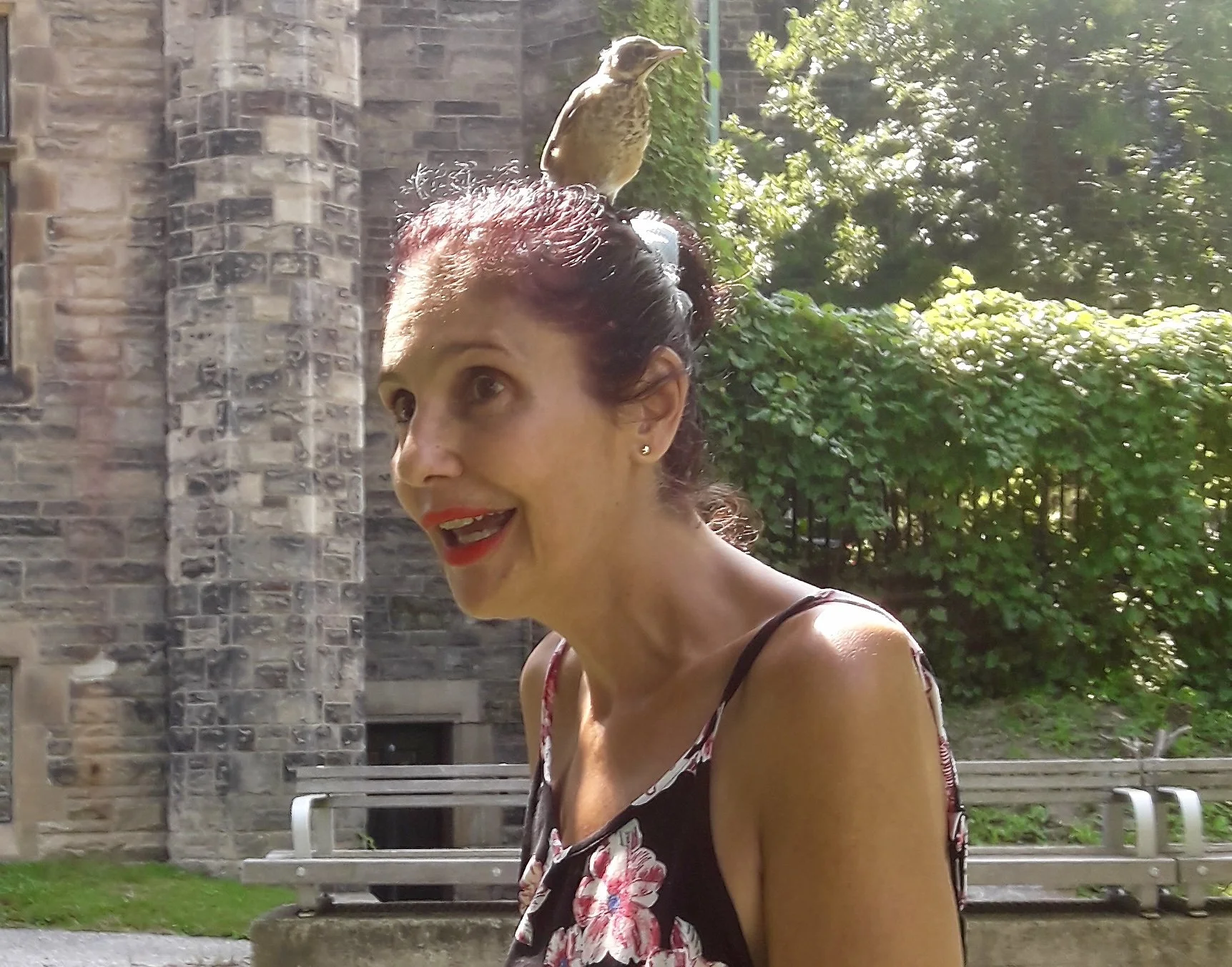
Professor Bird Brain (a.k.a.Jill Carter ) is a mixed blood (Anishinaabe-Ashkenazi) theatre maker and educator based in Tkaron:to.
Rodney Diverlus

Rodney is an art maker and creator. They are living today for sunset picnics, and grooving to the latest Amapiano track with a balanced sativa on hand, and teeth-rotting lollipop in the other.
Sarah/SGS, VP of Programming joined the Arts Commons team in 2023. Prior to her move to Calgary, she was the Artistic Producer for the National Creation Fund (NAC). In her spare moments she continues to co-steward the historic Birchdale, direct and dramaturg for the theatre. SGS holds her Ph.D. in Cultural Studies from Queen’s University.
Aria Evans

is a queer, award winning interdisciplinary artist and intimacy professional who’s practice spans dance, theatre and film. Advocating for inclusion and the representation of diversity, Aria uses their artistic practice to question the ways we can coexist.
Sarah Garton Stanley
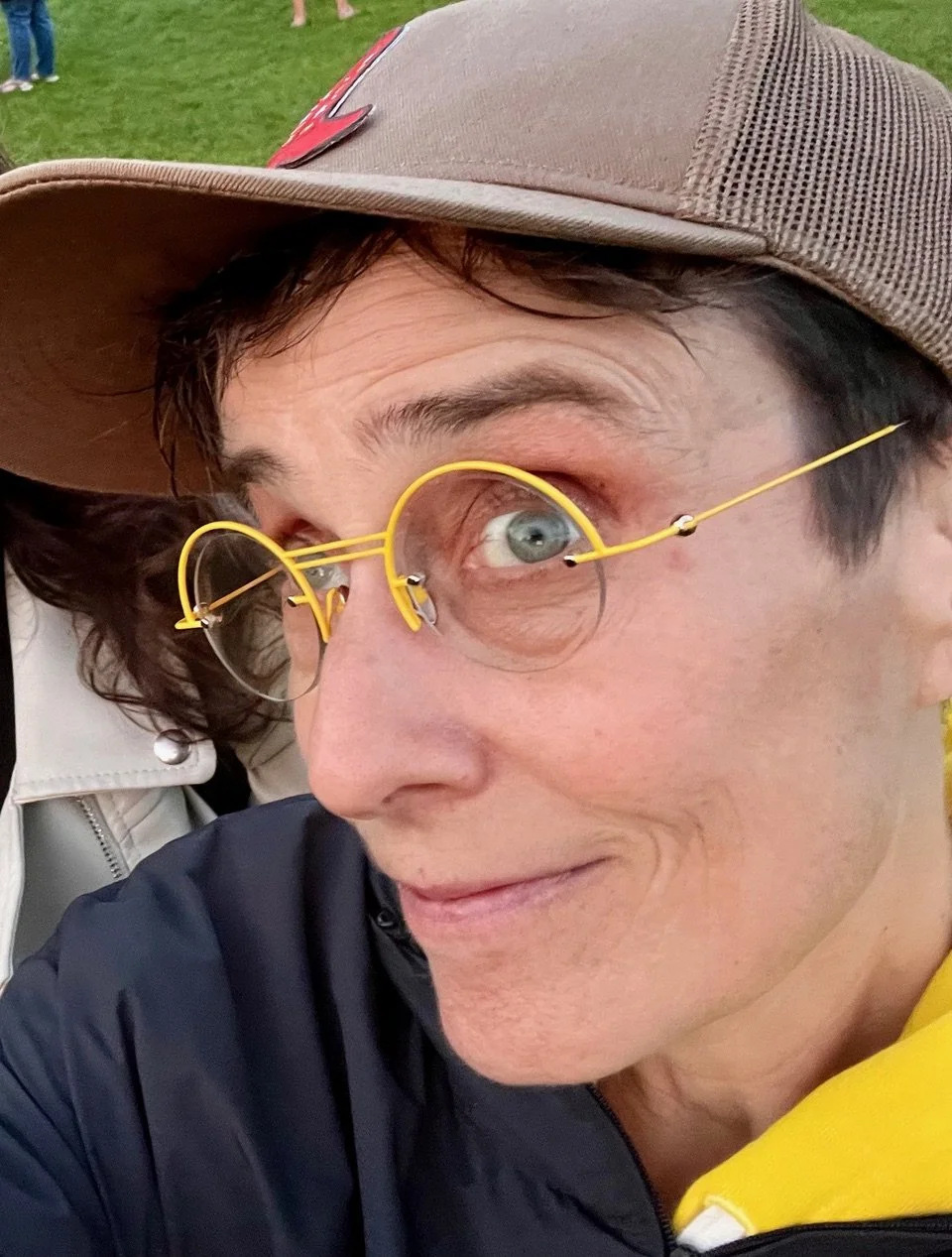
Sarah Garton Stanley (SGS) is a cultural strategist, creative leader, and national voice in the evolving story of Canada. She is also a theatre rat which has come in useful in a myriad of ways. She works across disciplines to spark meaningful change, champion new voices, and imagine bold futures. From theatre to think tanks, her work asks: What do we value, and how do we live it out together?
Martin Julien

Martin is an artist and instructor in Toronto. He loves working with younger people, older people, and everybody else.
Crystal Lee

Crystal Lee (she/her) is a Chinese-Canadian theatre practitioner originally from northern New Brunswick. She’s passionate about empowering new ways to collaborate in art making through technical leadership. Crystal currently works at Why Not Theatre as their Director of Production and Technical, leading many of their large-scale, international projects.
Richard Lee

Richard Lee is an Award-winning actor, fight director, sound designer and theatre educator, and theatre producer. Always grateful for challenges, Richard embraced his love of all things based in movement, sound and being bossy, which have led him on many interesting journeys.
Sean Lee
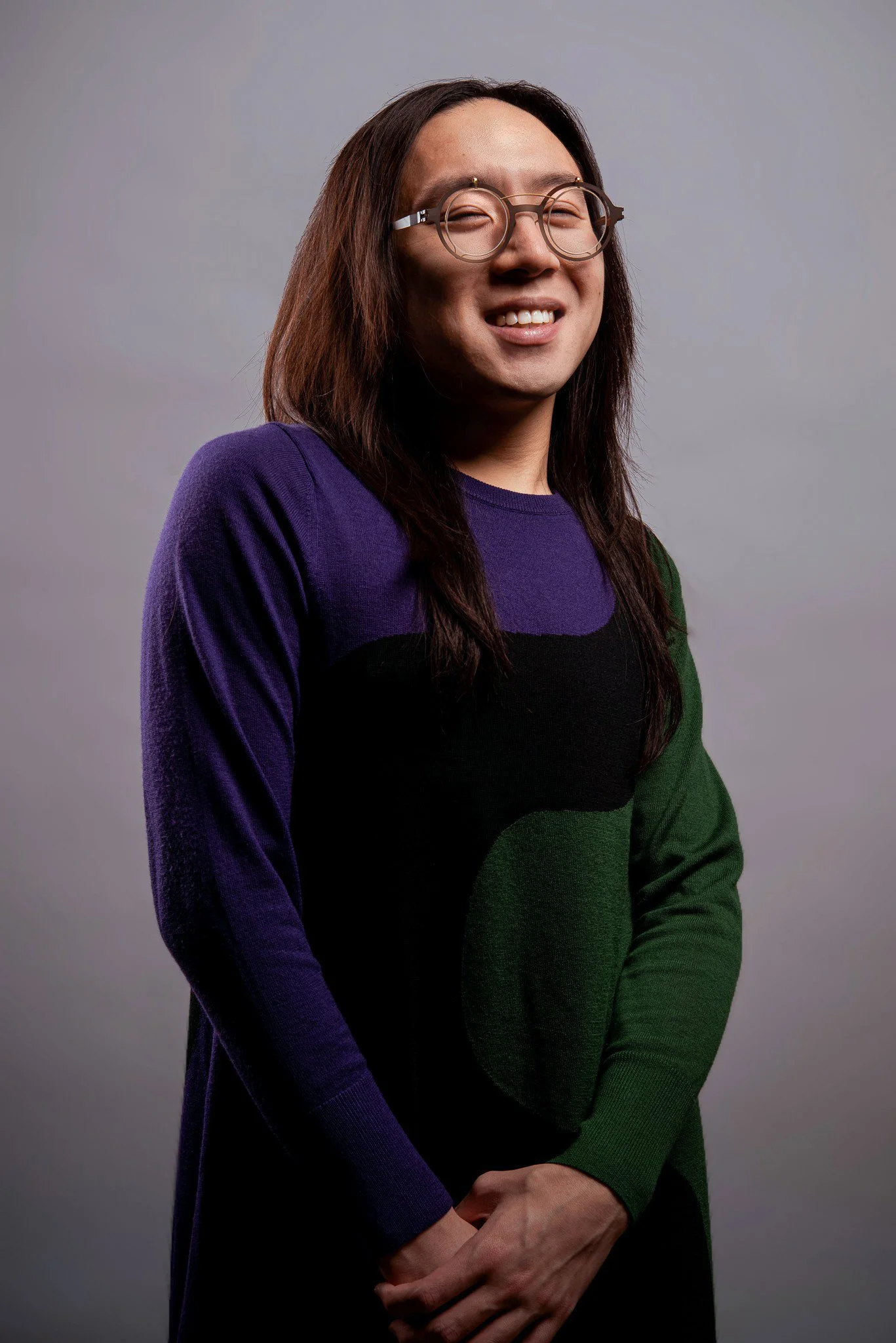
Sean is the Director of Programming at Tangled Arts + Disability, and someone who enjoys being overdressed at events.
desirée leverenz

desirée is an artist: she is a thinker and a doer. her brain dreams of ways to create art that shows how we can live together in a way that is filled with more depth, more fullness, and more spirit. she makes plays in her backyard, in theatres across Tkaronto, and at the university of toronto where she is a professor.
Sage Lovell

Sage Lovell is a Deaf multidisciplinary artist who likes to work their magic, using different art mediums to shift perspectives and spaces.
Sage’s Response:
Breathe. Take a pause. Feelings are valid. Feelings are also temporary. Acknowledge your feelings and unpack why you feel this way. Take your time. Ask for a break. Breathe. Breathe in. Breathe out. Ask for clarity. Avoid jumping to conclusions and gather facts. Remember, feelings are valid but they are not always logical. Breathe.
It's okay to be messy. It's okay to be vulnerable. It's okay to ask for boundaries. It's okay to feel. Breathe
Jiv Parasam

Jivesh (Jiv) Parasram is a multidisciplinary theatre artist and cultural worker currently based on the unceded territories of the xʷməθkwəy̓əm (Musqueam), Skwxwú7mesh (Squamish), and Səl̓ílwətaɬ (Tsleil-Waututh) nations -- also known as Vancouver, BC. He is the founding Artistic Producer of the Internationally acclaimed socio-political collective, Pandemic Theatre - and the current Artistic Director of Rumble Theatre.
Mike Payette

Born in Tiotià:ke (Montréal), Quebec, Mike has worked as a director, actor and educator for many years, and in theatres from coast to coast. As an actor, he has performed with some of the country’s finest companies like The Citadel, Vertigo Theatre, Manitoba Theatre for Young People, Banff Centre, Artistic Fraud of Newfoundland, Repercussion Theatre, Segal Centre, Centaur Theatre, The Grand, Factory Theatre, Neptune Theatre, and the National Arts Centre, among others.
Luke Reece
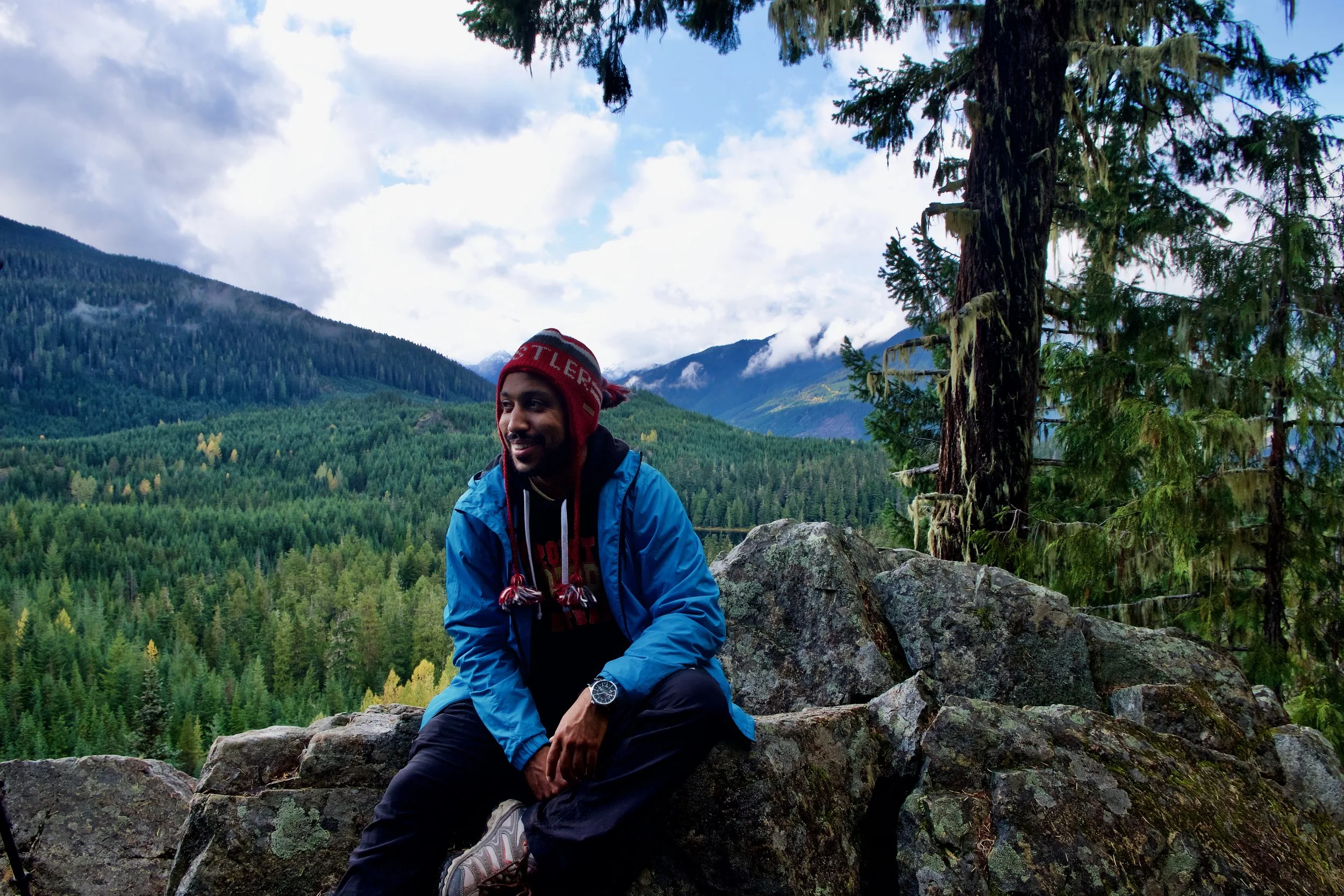
Luke Reece is an internationally renowned spoken word poet, a playwright, producer, director and educator. He is the Associate Artistic Director of Soulpepper Theatre, and a lover of both prehistoric and modern-day Raptors.
Jenna Rodgers
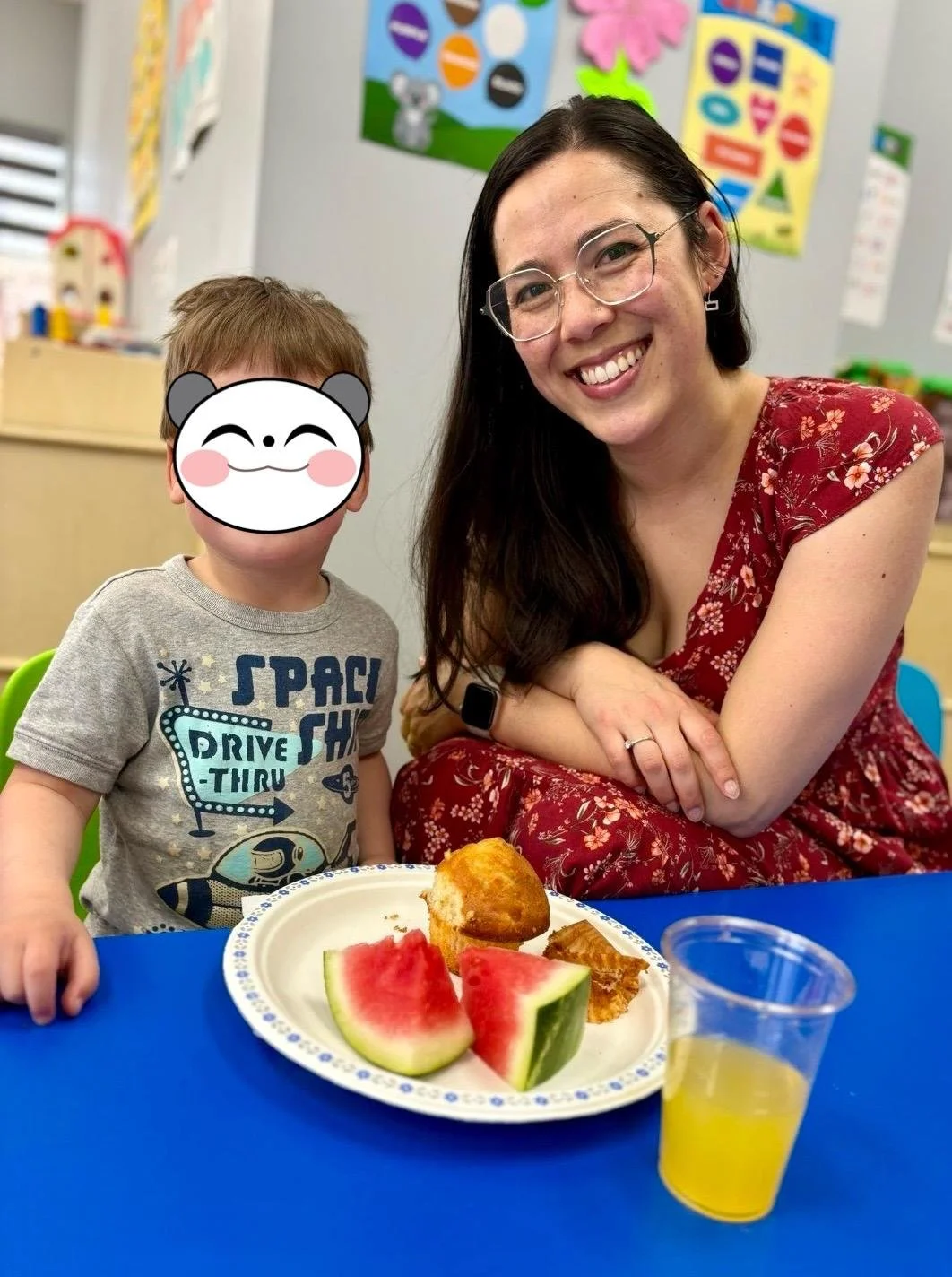
Jenna is an award winning director and dramaturg who currently spends her days worrying about Calgary’s inconsistent ability to demonstrate collective responsibility in times of crisis while trying to raise two small creative humans.
Marcel Stewart

Marcel Stewart is a father, artist, facilitator, and dope wordsmith who loves vacuuming the house while listening to the Waiting to Exhale soundtrack. He is artistic director of b current Performing Arts and one of the co-curators of FOLDA.
David Yee

david yee is a playwright and artistic director. he lives in toronto but, all things considered, would rather be in sausalito.
This campanion piece to The Art of Being a Ding Dong was compiled by Eva Barrie


The Art of Being a Ding Dong: Building the skill of accountability, with lessons from someone who sucks at it
In simplest terms…I’ve made a lot of mistakes. Today, I’ve decided to make a little float, and parade all those mistakes in front of you. Why? Because accountability is a learned skill, and the best way to learn is to fall flat on your face. I offer my bruises up because I see a lot of my peers and our arts leaders fumbling as well. As anti-violence advocate and founding member of Accountable Communities Consortium, Shannon Perez-Darby puts it “accountability is not a personality trait or identity. It’s a skill necessary for each of us to build and cultivate in order to have loving equitable relationships, communities and movements”.
This piece was written by Eva Barrie with support from Nikki Shaffeeullah and Signy Lynch.
Hi my name is Eva and I’m a Ding Dong.
Some may say a fool, a nincompoop, a human experiment gone wrong where all the brain bits turned into dryer lint.
In simplest terms…I’ve made a lot of mistakes. Today, I’ve decided to make a little float, and parade all those mistakes in front of you. Why? Because accountability is a learned skill, and the best way to learn is to fall flat on your face. I offer my bruises up because I see a lot of my peers and our arts leaders fumbling as well. As anti-violence advocate and founding member of Accountable Communities Consortium, Shannon Perez-Darby puts it “accountability is not a personality trait or identity. It’s a skill necessary for each of us to build and cultivate in order to have loving equitable relationships, communities and movements”.
Right now, I’m witnessing a crisis of accountability in our theatre community. Which makes sense: it’s not a sexy skill to have. It admits mistakes, failure, lack of knowledge, and scariest of all: being human. What’s worse, the structures in which we work haaaaate accountability. The non-profit system, with its deep roots in the plantation system (read up on it here ¹), relies on power imbalance, manufactured scarcity, and opportunism. Much of the time, any “accountability system” set up by a theatre is based on protecting the interests of the major stakeholders - the highest positions, and the wealthiest donors. But here’s the thing…it doesn’t need to be that way.
Before I talk about what could be, I’m going to talk about what is. There are other creative infrastructures and ways of working available to us, but first, we need to acknowledge the problem. A lack of accountability causes harm and impedes not only sectoral change but change on a broader, societal basis. I believe art-makers are disruptors of society, and meant to, as Toni Cade Bambara so beautifully put, “make the revolution irresistible”. In order to move towards this revolution, we need to be super honest with ourselves as we recognise that we’re missing a key skill. And to be mega clear: I’m not talking about treating each other “politely” or being “friendly”: I am talking about humane working conditions. We are working in an industry where those humane working conditions are often dismissed. I don’t want that…do you?
So let’s get to it!
What I am offering today is a collage of my clusterfucks, a smorgasbord of my schlemielism, an assortment of asshat-ery: I’m telling you about my mistakes. But more specifically, I will tell you how after I made a mistake - a very human thing, especially if you work/live in diverse communities with various needs and perspectives - my mishandling of that mistake escalated to harm because that’s the avoidable part. I will also bring in some examples from my own life where I was harmed by a lack of accountability, because - oh baby - our industry is ripe with them. In these examples, I’ll focus on where the person fumbling the accountability was in a position of relative power (the manager, project lead, AD, supervisor, instructor, mentor, etc), because that unequal relationship is packed with potential for Ding-Dongery.
With that, I say these thoughts are thoughts I’m currently working through, with my now-brain. To quote the preamble to presentations at afikra - a very wonderful organisation celebrating Arab culture, storytelling and curiosity - “I am not an expert, but I promise that I tried to learn as much as I could to satisfy my curiosity about this topic.” Because my now-brain is just mine, I’ll also offer some other materials that have helped me think critically about this topic: some podcasts, poetry, books, interviews, and people. I also took the time to ask some artistic leaders about their moments of Ding-Dongity, and their responses are in this companion piece.
So, let’s look at all the moments that make me drop my face in my palms out of embarrassment² and what those moments helped me learn.
1 The Plantation’s Fall and the Nonprofit Sector’s Rise: Addressing the Influence of the Antebellum Plantation on Today’s Nonprofit Sector by Shonda Nicole Gladden and Jamie Levine Daniel
2 FYI, I’ve been loosey goosey with pronouns and identifiers because it’s never about the individual. It is about the culture we work in that enables and justifies behaviour that hurts people. Secondly, at times my writing style may make it seem like I’m flippant about the harm I’ve caused. I’m not. I have a lot of gratitude for what these people taught me.
FACEPALM ONE: How dare you be so cruel and ask me to stand by my values?!
“Defensiveness creates unnecessary barriers. Sometimes people leave movements or communities, or stop attending events when they’re met with defensiveness, so please be receptive to feedback and give thanks for the gift that it is.”
Being asked to be accountable can be painful, as making mistakes can feel like a personal failure. A lot of folks express personal fears and challenges around being “called out” or “called in”. It can stir up a lot of emotions, and those feelings can be painful. But it’s important to distinguish between the pain of shame and the pain of harm caused by others.
In my Ding-Dongest of times, I was under the impression I was “above” certain mistakes. I had reached Gold Status in the Enlightenment category. I truly wish I could tell you this was when I was fresh out of the womb, but no. It was after years of justice work. Despite the organizing tenet that people are works-in-progress and ever-learning, I hadn’t fully internalised those fundamentals. So, when an artist approached me to share that my language and action around a certain topic was oppressing a group of people, my first thought was THAT’S IMPOSSIBLE! Which led to a series of arguments about how that was truly madly deeply IMPOSSIBLE, and included five-star “proof” akin to “but some of my best friends are from said community.” I was so busy caring about my feelings and the person I wanted to be (or be seen as), that all I could do was think about how HORRIBLE and MEAN the person who was asking me to maintain my publicly stated values was. Oh ding-dong Eva. Mayor of Ding-Dong Land.
I wonder if a big part of this is rooted in Canadian culture, where there’s a long-standing belief that shows itself in many circles, in many ways: we have Good People and Bad People. Good People don’t hurt others. Good People have “done the work”. Good People never make mistakes or cause harm because Good People would never flirt with being a ….Bad People.
But the thing is, you aren’t a bad person if you make a mistake. You’re worse than a bad person… you’re human. And that sucks, doesn’t it?
Our world has been shaped by a lot of pain: colonialism, white supremacy, white supremacy’s BFF capitalism³, and it’s near impossible to assume that these ideologies would not shape your behaviours, relationships, thought-processes, and therefore how you handle conflict. And, unfortunately, no one is above that because we all grew up in this dumpster-fire world. We all carry a lot of pain, and I’m a believer that we need to approach our work - and ourselves - in a trauma-informed way. Staci Haines, author of The Politics of Trauma writes: “While we have all inherited the social conditions in which we were born, while we have embodied them, and been shaped by them, we have many choices — and accountability — about what we do with them once we have more choice and agency as adults” (Haines 2019, 87).
“When we avoid conflict or move through it carelessly, we end up acting out and reinforcing micro versions of oppressive structural patterns unconsciously, even if we are from an identity harmed by those systems. This can end relationships, sidetrack organizations, and undermine social movements.”
I think one aspect that made (and continues to make) confronting my own actions so challenging is a culture of perfectionism. Back around the #MeToo time, I remember seeing a tweet from a pal that said something along the lines of “you know who doesn’t create abusive work environments? Women and people of colour”. If I remember correctly, this person was calling for more diverse leadership in the theatre community. Though the tweet was very well-intentioned, as someone who is both a woman and a brown one at that, it made me tighten up. The “perfect minority” myth robs the global majority and other historically marginalized groups of their humanity. I’d been brought up to believe that in order to be taken as seriously as my white male counterparts, I needed to be undeniably excellent at what I did. But that often leads to “excellence” being defined through a white lens. That white lens looooves perfectionism. It’s suuuuper into the unsustainable “star hero” leader⁴ concept; and lastly, it perpetuates white supremacy by robbing BIPOC leaders (especially Black women⁵) the ability to make mistakes and be met with compassion and the right to grow and learn.
If I could go back and speak to the Mayor of Ding Donglia (though I’m not sure she could have heard me from up on her high horse), I’d encourage looking at events as individual events shaped by society, and not markers of being a Bad Person. If we remove our own ego/reputation/resume from the equation, then we can address the moment, and put the focus where it really belongs: taking action so it doesn’t happen again, addressing unconscious bias, and finding remedy for the situation that needs repair.
If I may reference a mega-academic source for a moment: in Pixar’s Inside Out 2 when the lead girl is having an anxiety attack, the character of anxiety (yes, emotions are characters) takes over the control board in the little girl’s head (just watch the movie). Anxiety is so powerful, that it becomes this storm, and none of the other emotions or thoughts are able to get in there and balance the girl out. I really relate to that animated depiction of a human girl.
I feel like, in moments where someone comes to me and shows me I’ve swayed from my values, the little shame character in my head takes over, and tells me everything I’ve ever done is garbage, I’m garbage, and I should go and live in a trash bag. And instead of recognising that that was my own action that prompted that feeling, my shame character instead takes it out on the person messenger - they’re garbage! Everything they’ve done is garbage! I hope plastic bags flatter your silhouette - you garbage!
But lashing out at other people is kind of the opposite of accountability. So let’s hop into that shame bucket for a moment.
3 When I talk about these two ideologies/systems today, I’m not only referring to the overt white supremacy (ya know, the white hood kind), or overt capitalism (ya know, the billionaires behind the white hood kind), and I’m also not referring to them in our psychology. We live in a world that doesn’t just feature capitalism and white supremacy, it shapes the world, us, our ideals, values, and relationships.
4 The idea that a company’s integrity and identity is based on their leadership, rather than their work and mission (Kaust and Goodwin, 291). It leads to impossible succession planning, and also, it’s inherently flawed: individuals conform to their environment (Callander & Whitaker), which means unless there is deep structural change and a removal of dominant systems (ie: non-profit system), then there won’t be a lasting or meaningful change.
5 The State of Black Women Leadership Is In Danger by Cyndi Suarez
FACEPALM TWO: I disagree with you, NOW BURN IN HELL!
I was once supervising someone who I ended up not seeing eye to eye with, in a lot of ways. Where they saw comedy, I saw tragedy. Where they saw black, I saw white. Where they heard nails on a chalk-board, I heard Josh Groban’s 2007 Noël Album (I weep at the key change in Little Drummer Boy). So, when conflict arose, we had very very different viewpoints.
When this person came to me with their concern, my first impulse was to dismiss and brush them off. They were wrong! They were wrong about other things (the Josh Gorban thing?!).
“My sense is that if I spend more time talking to you than I spend complaining about you, then something wonderful often happens and the enlightenment is mutual ”
Other people viewed the situation the way I did! Plus, this person, according to previous employers, wasn’t really Mr. Congeniality, so that meant my views of them must be right (that’s what we call confirmation bias, but obviously I didn’t want to learn about confirmation bias - that wouldn't help me confirm I WAS RIGHT). I spent more time looking for reasons to NOT listen to this person, than I did investigating their actual concern.
When I took a break from my nonsense and took a step back, I remembered that as a person working for a not-for-profit company, it was literally my job to listen to and serve my community. Like actually. It’s breaking Canadian labour laws if I don’t. Leadership isn’t about writing grants or programming art; it’s a job of service, and, if we, as a community, begin to recognise that, it can lead to sectoral change. So I put my ego (my beautiful perfect ego!) aside, and when this person and I got to talking, and I got to listening (like actually listening. Not the kind of listening where you wait to say your point and win your argument⁶), I saw where they were coming from. I understood their anxiety and hurt much more.
“So, you know, when you have a conversation, you never know what’s going to come out of your mouth or out of somebody else’s mouth.
”
Organizations need disruptors, and they need to welcome disrupters wholeheartedly. Institutional conformity leads to staff members not seeing problems where they are, even if they are blaring from an outside perspective⁷. The issue is, because our workplaces and understanding of leadership is based in patriarchal values, “institutional dissent” is seen as a negative quality, when, in fact, it’s vital to progress⁸. Even (and often) the most progressive orgs⁹ can fall trap to this, and need to do the work to ensure their values are in line with handling conflict in moments of stress.
Ultimately, this person’s coming to me was an act of generosity. They cared about the work and wanted to enhance my leadership. We shared the goal of treating artists well, and thankfully (once I actually listened), I understood that. It took me an embarrassingly long time, but I recognised that you do not need to agree with someone to be compassionate.
6 Great read: ”Dismantling Privilege with Mindful Listening” in Beth Berila’s Integrating Mindfulness into Anti-Oppression Pedagogy: Social Justice in Higher Education
7 McMullen: “What Makes an Entrepreneurship Study Entrepreneurial? Toward a Unified Theory of Entrepreneurial Agency”. If you’re interested in institutional conformity, I have a lot of sources that are a touch less dense than this one (see works consulted)
8 Engaged Dissent: Entrepreneurship and Critique in the Institutional Practice of Three Contemporary Artists by Adrienne Callander
9 Staci K. Haines: The Politics of Trauma
FACEPALM THREE: Do I look like Curious George? Keep your Nancy Drew questions to yourself!
“Before we make any judgements, we must ask questions. This is the deepest meaning of the idea, often repeated but little understood, that the study of art shows us how to live ”
I once had a manager who didn’t ask questions. If I offered something she didn’t understand, she would never dig, but move on, as if it was not an important element of the conversation if she didn’t know it. When someone in the company expressed concern, her go-to was “that’s not a problem here”.
Looking back, I think it was because of insecurity not narcissism, but that didn’t change the fact that conflicts continued to escalate because there was a deep lack of curiosity in the other person’s perspective and knowledge. Jordan Klepper, best known for being an undercover leftist interviewing people at Trump rallies, hosted a TED talk about how to disagree with people (and thus, save democracy), and offers that the phrase “‘I don’t know’ invites softness”.
In their Turning Towards Each Other Workbook, Jovida Ross & Weyam Ghadbian invite us to treat every complaint as though a percentage of it is true, and it’s our job to find out how high that percentage is. I also like to look at this with a dramaturg’s eye: in a play, nothing ever happens “by chance”. A poor dramaturg is quick to dismiss an element of the story if it doesn’t fit their understanding of the play so far. Similarly, poor accountability happens when we assume a concern is impossible/untrue/outrageous/in bad faith. So, instead of dismissing any complaint, turn up your curiosity and figure out how much truth there is to it.
“Shut up and listen. Shut up and listen. Shut up and listen…and once you’ve heard, ask poignant questions about what you don’t understand.”
If someone comes to you and surprises you with a concern or hurt, even if you can’t imagine any truth in their offer (which…come on, let’s be real, that’s pretty douchey), make the assumption that it is at least 25% true and find out where that 25% is hiding.
Especially if you are working interculturally, there is absolutely no way of knowing everything about someone’s experience - that’s beautifully impossible, and why art can be so profound! I was working on a show about the experiences of folks in the South Asian diaspora (which is a huge and diverse group of people, much to the confusion of many North Americans). Things began to get crunchy in both a creation and producing way when some peoples’ views and needs were met with more care than others, in ways that replicated the systems of supremacy in the region. I asked to have a conversation about it, but management said they didn’t see the problem, because for them, it seemed like a fuss about “slightly different brown skin tones”. I didn’t expect this person to know the ins and outs of colonialism, the violence of partition, forced displacement, the caste system, India’s current right wing government, Hindutva, colourism in India and its ripples in the diaspora and and and….but, looking back, a more responsible - and certainly more brave - response may have been “I don’t know enough about that, can you tell me more?”.
Curiosity often leads to beautiful art. As arts leaders, why not embrace that in our organization as well?
FACEPALM FOUR: I WILL ONLY LISTEN WHEN YOU’RE ABSOLUTELY PERFECT
I spent a lot of my youth learning to get people to listen to me. I would avoid loaded words like “racism” when actions were clearly racist, and instead try to find cute lil substitutes instead. I’ve attended a lot of conferences and workshops on “speaking up” and “not being a bystander”. To this day, I still send any email that might be received in a negative way to at least a few colleagues and mentors, and I’ve looked over many emails from friends doing the same. I have followed the proper workplace safe-space reporting channels to a tee, and followed all the company’s stated rules.
And you know what? If the interest in building accountability skills isn’t there, I don’t think any of that matters. No matter how the person harmed addresses you, if you don’t want to listen, you’ll find a way to shut them down.
The go-to tactic to get out of accountability is to blame the victim. Whether it’s nitpicking their words, finding something they didn’t do perfectly, or feeling the way they responded to the harm and violence you are responsible for wasn’t chill/kind/professional/polite enough, whatever your tactic is, it distracts from the real problem: the behaviour and action you and your organization have committed. Civility politics will always derail the bigger picture and gaslighting will always be easier than taking responsibility.
There’s a trend at the moment to claim a victim is overstating harm. I’m really not into that. Firstly, it dismisses that percentage that may be true that we explored in Facepalm II. Secondly, and for me, more importantly, what if we dropped the bar for compassion? If someone comes to you and says “you sprained my wrist” and your response is “psssht, come back when the whole arm is broken”, what does that say about you, and us, as a whole? In an art form where we strive for vulnerability, and the words “empathy” and “compassion” appear smattered across websites and grant applications, do we actually celebrate those traits, or are they just marketing tools?
FACE PALM FIVE: BUT NELLY FURTADO’S SONG ‘POWERLESS’¹⁰ WAS WRITTEN ALL ABOUT ME!
Leading is sometimes a very thankless job. People don’t see all the battles you fight daily. You are working in systems that aren’t conducive to artistic success and risk, and it can feel like you are constantly hitting against a wall.
There are a lot of intersections of identities that can affect power dynamics in relationships (race, class, gender, ability, etc), but one place where a leader certainly has power is over the person they hired. Because…they hired them.
If I may get nerdy with you (who am I kidding, you’re reading a Generator blog. You’re all a bunch of nerds), the way Marx defines capitalism is the inherently exploitative relationship between employer and employee. As a worker, you do not need to feel exploited to be exploited, you systemically are¹¹. The employer has more power than you, and makes decisions that affect you, for you.
And when we think of the freelance/gig work system, if you can choose whether or not to work with someone, you have power over them. If you sit on juries, conduct auditions/castings, and have the ability to make someone who expressed concern to you feel small and unwelcome when you run into them in an industry setting…hullo power.
In their essay The Death of White Supremacy Culture in the US Creative Sector and Implications for Arts Management, authors Floyd and Cuyler discuss how an understanding of critical race theory can help people in arts management positions better create healthy working environments. One thing that struck me was their articulation of how people who have formal or informal power insist on a “right to comfort” which means protection from “open conflict”¹². This right to comfort allows those in power to maintain power. Over the years, I’ve heard an increase of “self-care speak” being co-opted by those in power, but never granted to those with less power¹³. This connects to Floyd and Cuyler’s thoughts on the colonial-capitalist worship of individualism, or what they call the “I’m the only one” mentality: the person in power is the only one with the knowledge, expertise, and experience to lead the team, and denies the essential principle that human beings are interdependent¹⁴ (connected to the star-hero complex of Facepalm One). White supremacy culture then turns this against the person with less power in a new, perverse way: if someone with less power acts in a way that protects their individual dignity (ie: whistleblowing or simply voicing concerns), they are seen as not “a team player”¹⁵. Think about the summer of 2023, when Marit Stiles removed Sarah Jama from the NDP caucus after she advocated for Palestinian human rights. In an email to NDP supporters, Stiles said it had nothing to do with Jama’s advocacy, but about “principles of trust and working together as a team”¹⁶. Now, that’s white-speak for “I felt uncozy when you reminded me of your humanity” if I ever heard it.
So, when someone with less power comes to you with a conflict, work to even the field, or better, empower them. People can’t listen or communicate when their nervous system is in threat mode (the flight/fight/appease/dissociate mode)¹⁷. So, ask them how they want to have a conversation and respect their rules. Sometimes texts/emails feel safer, but we lose important information, and there isn’t an opportunity to actually have a dialogue (especially non-verbal dialogue). When I’ve asked someone to meet with me in sensitive situations, I will encourage that person to bring a pal, and meet them in a place that will make them feel safe to express themselves. Some people feel uncomfortable about this because of “confidentiality”; however, when working under Canada’s Charity Act, I argue that transparency and accountability are far more important than protecting the confidentiality of those in power (I also think NDA’s in the non-profit sector should be banned, but who am I?). After the meeting, it’s also helpful to say you’ll be checking in in a week or so, and then do so. Why? Let people decompress. Take away the pressure that this was the only chance to talk. Nurture a relationship. Care about your community on a deeper level, not just on a mandated HR level.
Accountability is hard. It requires us to be very honest with ourselves. What are YOUR intentions going in? Are you just there to tick off a box, avoid a lawsuit, or (upsettingly often) punish the person for their criticism and foster a fear of reprisal in your organization? Are you acknowledging the power imbalance and your responsibilities as a manager/leader/facilitator/instructor/elder? In leadership, that kind of radical reflection and honesty is not a trait that is celebrated, as it threatens profits and power. But maybe it’s time we re-prioritized what we believe is effective leadership. What if we welcomed tenderness, compassion, and reflection?
10 This song is a banger and it should be played more often, more loud.
11 Richard Wolff: Understanding Capitalism, pg 148
12 The Death of white Supremacy Culture in the US Creative Sector and Implications for Arts Management: A Critical Race Theory View” by Quanice Floyd and Antonio C. Cuyler
13 In my life, I have asked for a mental health leave three times (I would have benefitted from more, but I was trained in the era where if you weren’t deeply mentally distraught, you weren’t working hard enough). The only time it was ever afforded to me was when I, myself, was in a leadership position. Every other time, I have been told to “buck up” followed by a meaningless “but if you need to chat, girl I’m totally here for you”, or been removed from the project.
14 This is also discussed in Sins Invalid “Skin, Tooth, Bone”...and a really fantastic primer about disability justice.
15 Floyd & Cuyler - great read!
16 Email “A Message to Davenport”, Oct 25th, 2023
17 Staci K. Haines: The Politics of Trauma
FACEPALM SIX : Loyalty Part I: I took your cat to the vet, you must bow down to me forever!
Just because you got someone a job, programmed their show, bought them a house, or attended their goldfish’s graduation,that does NOT mean that you can dismiss their concerns.
The paternalistic behaviour of “I made you” needs to go, but it can rear its ugly head in big and little ways. If an artist you supported comes to you and expresses a fear or hurt, do not diminish their experience, talent and hard work. They do not owe you loyalty in the face of harm. And when there is a difference in power, there is no such thing as two-way loyalty. They can lose way more than you.
“‘Sir, please don’t say that’ Why? They said ‘We think it’s very inappropriate to say so’ Why? I’m president. I want to protect the women of this country. They said ‘sir, I just think it’s inappropriate for you to say’. I pay these guys a lot of money, can you believe it?”
Economist Richard Wolff talks a lot about the psychological toll capitalism has on us¹⁸. It engrains itself in relationships, making people believe that all relationships are transactional. It stops being about humane, compassionate, joyful interaction, and more about opportunism and aligning with the people who can bring a person the most economic/professional gain.
It’s hard to stand up to power, and I’ve talked to a lot of people who feel they just can’t do it, or support someone who is doing it. And if someone commissioned your work, championed you along the way, or frequently hires you ensuring steady income…I get it. But I wonder what could happen if we rewired our brains to believe that holding someone accountable is not attacking them. What if we, as leaders, celebrated people who help us serve the community?
18 Richard Wolff: Understanding Capitalism, pg 159
Loyalty Part II: Ronaldo took my cat to the vet! Bow down to Ronaldo forever!
“Even after all this time
The sun never says to the earth,
“You owe Me.”
Look what happens
with a love like that
It lights the Whole Sky”
Let’s say someone approaches you and says, “hey, Ronaldo over there punched me” and your answer is “what?! Ronaldo is a hoot at all my parties so slap some frozen peas on that black eye and get back to work”...are you acknowledging that Ronaldo is a human? Is it compassionate to view Ronaldo as a one dimensional perfect robot? Or is it in Ronaldo's best interest for you to support them in their journey of accountability, while simultaneously acknowledging the hurt person seeking help from you?
I was once in a conflict with a colleague over an initiative we were launching. I wanted to GET IT DONE and they needed more time to work it through. I called up my mentor, asking how I should deal with this VERY difficult person who is VERY wrong about everything. I expected my mentor to tell me I was so right, so pretty, and so cool. Now, she has been mentoring me for many years, and there’s a reason for that. When I finished telling the story, she thought for a moment and asked “well, sure, okay, you sound very passionate about this but…do you think you might be steamrolling your colleague? And isn’t that the bigger issue here?”.
We need people who will pull us down to earth and encourage us to contemplate our actions with humility, like my mentor did. Surround yourself with those people. Work with those people. And hopefully…become those people.
Loyalty Part III: But it wasn’t me! I’m just hanging out here with Ronaldo!
I think, at times, we are more loyal to our proximity to power than we are to our values. If harm occurs during a working process, it is not an interpersonal spat - it is a workplace issue. Just because you aren’t directly involved, doesn’t mean this issue does not deserve your attention. By turning away you are complicit in the harm, which will - without attention - inevitably grow into an engrained workplace culture.
Moreover, if we don’t address harm in the workplace, or if we pin it all to one “problem individual” we aren’t looking at the whole structure that allows that behaviour to continue¹⁹. I relistened to a chat between Jill Keiley and Weyni Mengesha the other day, where Jill asked Weyni how she felt about needing to make amends for the actions of Soulpepper’s previous administration. Weyni’s very thoughtful response includes how she is now benefiting from an institution that enacted harm, and that she is “interested in doing the work, and the only way you can do that work is to acknowledge what’s happened” and goes on to add “I take just as much responsibility because we need to. We all need to be active”. I’ve known a lot of leaders with less mature and reflective responses, but I’m very grateful for the grace Weyni has to recognise and address the responsibility that comes with being a community leader.
When it comes to addressing organisational harm, you can put your head in the sand all you want, but eventually your silence is hurting everyone (including you). Yes, it sucks and it’s hard and dangerous to stand up for others, but I also urge you to reflect on accountability to yourself. Are you staying true to the person you want to be? What’s getting in the way? Who can you reach out to for support on re-aligning your moral compass?
19 Reverend angel Kyodo williams chats about this in this ctznwell podcast very thoughtfully.
An Important Sidebar: Understand Gaslighting.
Gaslighting has been a term that has been in heavy rotation the last few years. Some may see the term and believe it’s over-used, but I think it’s indicative of how pervasive the problem is.
A lot of the above examples move towards gaslighting, and it’s important to understand the specifics, especially of “workplace gaslighting”, or “whistleblower gaslighting”. Gaslighting is psychological manipulation, and it is against Canada’s Occupational Health and Safety Act and employment laws. Despite it being against the law, it is extremely prevalent in the Canadian theatre industry. In order to foster an environment of accountability in your organization, make sure that you are well aware of the signs of gaslighting, and watch for signs of this within yourself and others.
Workplace gaslighting can look like: “trivialization by a supervisor [by] changing topics to place blame on [the victim], minimizing concerns, making promises that don’t match their actions, twisting or misrepresenting things [the victim] said and making degrading comments about you and pretending [the victim has] nothing to be offended about” (Forbes). Gaslighters can also abuse power by claiming they are the victim in order to emotionally blackmail their subordinate (think about the “right to comfort” premise), disregard or ignore facts you put in front of them, or convince someone that they are alone, and no one sides with them.
I once was harmed by the supervisors of a project, and after some time, we entered the mediation phase. The process was sold to me under a transformative justice lens, and meant to be respectful, caring, and with the goal to listen to each other. When I got there, it felt like a thesis project on why I was unworthy of compassion. I was spoken over, lied to repeatedly, scoffed at, had my racialized experience belittled, my character questioned, my intelligence minimized, made to believe my supervisor was victimized, and told I had imagined behaviours I had experienced despite the fact there was clear proof. I reached a point where I actually couldn’t speak or articulate my thoughts anymore (and look at the word count on this article, if anything I’m verbose). Looking back (and with help from therapy), I understand now I entered the trauma response of “appease” in attempts to stop the ever-expanding harm²⁰. The way this manifested was that I withdrew my original complaints of sexism and racism. This sucked, for a lot of reasons. Firstly, it lets the company believe that if they use cruelty, they can silence and control community advocates, and continue inside the abusive systems that give them power. Secondly, I was so excited when I woke up that morning. I am hopeful to the point of naivety, and I really thought repair and rebuilding the relationship would start. But it wasn’t the time.
For me, it took me a while to figure out what was happening. It affected every single relationship I had, or was to have, for a long time, and affected the way I approached my work and studies. I closed off. I stayed away from theatre work, out of fear of it happening again. Physically, I became unhealthier. My self-worth took such a blow, I was convinced that not only was I not strong enough for theatre work, I was not strong enough for life. It was especially tough because it was from people I trusted and cared about. But these are the effects of gaslighting; it truly shatters individuals.
Capitalism trains us to accept the suffering of others. It’s part of the game²¹. We do “the best for the project”, or make sacrifices for the “art”. But we actually need people to make art. We need collaborators. No art can be made in a vacuum, and no artistry needs to rely on abuse.
*A note to those who have been gaslit:
I’m really sorry. I wish I had a fix for you, but I’m not there either. Do seek professional help (that was very helpful to me), and find someone to work through the trauma not only mentally, but physically as well (our bodies store trauma). One offer that was made to me was to stop trying to receive solace from the abuser(s). They are on their accountability journey and it’s best not to wait for them. Surround yourself with people who want the world to be more courageous and humane. Be inspired by them, and know there are so many of them.
20 Staci K. Haines: Politics of Trauma
21 Richard Wolff: Understanding Capitalism, pg 160
FACEPALM SEVEN: Sit…. …sit…..Stay. Good Leader - Hey! Get back here!
Shame often leads to a desire for self-preservation. We want to stop this feeling as quickly as possible, and save ourselves. So the answer? React as quickly as possible. Don’t waste time considering other possibilities or gathering information, but press the “EJECT” button as quickly as possible. I’ve seen this destroy teams, art, and people.
“I’m so used to being very responsive, take-action-now kind of person. And always told myself this was a good thing, and that I confront issues as they happen, but a bit of age and wisdom have shown me just how counterproductive it can be when it comes to interpersonal and inter/intra community conflict. So many times adding more fire to the fire, only makes it burn longer.”
A culture of false urgency is alive and well in many organisations. The Montreal-based Centre for Community Organizations created the White Supremacy in Organizations resource, which articulates how false urgency is a key element of what the authors define as ‘white supremacy culture,’ and lists ways cultures of urgency undermine anti-racist values. Notably, it takes away inclusive, thoughtful conversations, and doesn’t allow us to consider long term consequences of our actions. We attempt “quick fixes” without actually looking at the root of the issue.
Furthermore, a culture of false urgency lessens our ability to handle real urgency - mental health emergencies, death/illness/injury, as well addressing harm. Often our workplaces put capitalist pursuits (the production) above all other labour, responsibilities, and life circumstances. They remove us from life…and how are we supposed to make plays about living if we consistently diminish its importance?
So, next time someone expresses you caused them harm, it’s good to take the time to breathe and process - but be sure to communicate that; don’t leave them hanging. And don’t add false-urgency-things like “I’ve got a show to open” or “this grant deadline is coming up” or “I am making a pinata and I really need it to look like a life-like version of Jeff Goldblum”. Shows can “go on” in multiple ways, grants are there to support - not supersede - people, and maybe the pinata thing is actually urgent so you keep glueing on those paper strips, girl.
And speaking of opening shows, grants, pinatas, and other juggling…
FACEPALM EIGHT: OUR STATUS QUO IS “LOL everything sucks anyway”
“It is what it is” is the most unimaginative sentence, and it’s infuriating coming from creatives.
Theatre in Canada is very conservative, and why? It was designed that way. The non-profit industrial complex and charity as we understand it was created by puritans (Calvinists), who were mega horny for capitalism, but still thought selfishness would send them to hell, so they invented charity to feel chill about their capitalism²². Because of this, a lot of non-profits function under capitalist norms, and rely on the existence of capitalism to thrive.
“We need each other. We need each other’s differences. We need the many different things that each of us has to offer. This is about relentless humility: we do not know how to make the changes that we need to make, and we will only discover the paths together.”
But guess what? We can do better! I promise! There are alternative models (worker coops, fiscal sponsorship, participatory budgeting/democracy practises) that root themselves in anti-capitalism, and therefore are anti-racist (because here’s a tough nugget of truth: if your anti-racism isn’t also anti-capitalist, it’s not anti-racism, it’s an instagram post). Inviting new ideas from outsiders allows for “ontological facileness”²³; which is nerd-speak for the ability to imagine a different way of existing. This is crucial in building up capacities for accountability. The less open we are to new ideas, the less likely we will be to take responsibility for harming someone, because we can’t possibly imagine a world where that harm didn’t need to occur.
Recognise that your status quo may be cozy - or at least unsurprising - but an outsider may see how you can pursue your mission with more care and success. Remember: caterpillars turn into literal goop before they become butterflies. It’s not comfy. It’s gross and weird. But embrace the goop.
22 “The way we think about charity is dead wrong”, TED Talk by Dan Pallota
23 “What Makes an Entrepreneurship Study Entrepreneurial? Toward A Unified Theory of Entrepreneurial Agency” by McMullen, Brownell, & Adams.
FACEPALM NINE: Set our organization up for conflict? Naaaah…. We have excel sheets to colour code.
I was once producing a project that was a doozy. Artistically it was challenging (in a fun way), and logistically it was a nightmare (in a nightmare way). Once opening came, my co-producer and I were EXHAUSTED. We decided I could take a weekend off, and upon my return he would take time off. While I was gone, DRAMA unfolded (and not fun drama, nightmare drama). When I returned and the drama was doing a drama-dance in front of me, my response was “how could you let this happen?!” rather than the much better response of “how can I support you” or, even better, “how can we set ourselves up better to avoid these situations, and also respond thoughtfully when they do happen?”. We were both too exhausted to effectively deal with a conflict, so it escalated and caused harm.
That incident led us to revisit our values, our protocols, and the company organisation. Our organisation was unhealthy, which led to us making unhealthy decisions. It required consultation and a freeze in day-to-day operations, but that was OKAY because ultimately, it made the work more sustainable, and allowed us to begin the journey addressing conflict with compassion and clarity.
One piece of advice from a mentor was to normalise conflict, so we dedicated time in every staff meeting to discuss resolved and unresolved issues. Initially, it felt self-congratulatory (“so-and-so were in a conflict, but look how perfectly we handled it!”), but with time, I noticed that team members were less conflict averse, and even felt empowered to bring seemingly resolved but still crunchy moments to these meetings. It also was an opportunity for us to practise receiving feedback (ugh so hard) and learn the skills to listen, process, and work through moments of challenge. In these sessions, and then as a company, we were practising the ongoing and ever-evolving journey of accountability (guess what: no one is ever done learning to build this skill). What it taught us was that accountability is not only about reacting in the moment, but how you can prepare, plan, and work together daily.
Rather than assuming conflict won’t ever come up - bet that it will, and that’s not a bad thing! Invest in training and time to build that skill.
FACEPALM 4 MILLION²⁴: BUT MY BUDGET IS A GET OUT OF JAIL FREE CARD
It’s so easy! You just shrug and say “oh man, if only we had more money! Shucks!” and the conversation is done and everyone hugs. If only…
Budgets are much more than numbers. They are made by people, and they reflect our values. They tell our stories, create hierarchies, reflect long term goals, and spotlight our biases or inherited historical inequities²⁵
Many years ago, I had a pal that was on tour in Europe, and as her and the creative team jumped from country to country, she found out that the actor she was working alongside had a per diem. It had been negotiated into his contract, because he’d worked with the company before, and it was standard based on his home province. It was just the two of them in the show. She then approached management and asked for a per diem as well. The company said it was too late, and they didn’t have the budget for it. She then shared that this made her uncomfortable because it meant that a brown woman and a white guy were doing the same job, but he was being better compensated for it. The conversation ended, but a few days later she was called back to a meeting. She had high hopes that they reallocated money towards a per diem for her. That wasn’t the case. In the meeting, she was asked to apologise to the management because she had “made it about race” and therefore accused them of being racist (just quick reminder of facepalm one: accountability is not an attack!).
This isn’t the only story I’ve heard like this. A lot of folks put a lot of weight on intention, which I understand. But if we only care about the intention of an action, we’re ignoring the harm the action caused. With budgets, maybe you didn’t intend to tell a certain story with your budget, but the story was told, nonetheless.And rather than telling someone they are wrong about the numbers they can see on the page, take responsibility for the very real consequences of your decisions.
One of the people who really engrained this in me was Marjorie Chan. I met with Marjorie when she was still the AD at Cahoots and supported their initiative to create the Deaf Artists and Theatre’s Toolkit (DATT). I expressed that I was concerned that the company I was working for couldn’t afford a Deaf Community Consultant. She said to adjust my language and say “the company I am working for is not investing in inviting the Deaf community into our work.” Marjorie really nailed it: that was not a story I wanted to tell, but it doesn’t change that that was the simple fact of the matter.
When I changed that language, no, the numbers in the budget didn’t suddenly quadruple, but I found ways to be more resourceful, advocate for what the company needed, and make long term goals. We did end up hiring a Deaf Community Consultant, and not only did we find ways to make a fee that worked for both of us, we created a longer relationship that led to more impactful and better resourced initiatives. Looking back, the impact of the relationship with the Deaf Community Consultant (Elizabeth Morris - super cool. Hire her!) on the company (and me) was so valuable, to think that I had originally shrugged it off as a line item in one fiscal year is so banana-pants.
Capitalism teaches us to treat humans with the same preciousness as stuff. Equating people to things is exactly what got us all into this crumbling world. Reframe the story. Embed humanity into your budgets.
24 Ugh, long essay huh?
25 For instance: work that has been performed by queer people and women - ie costume design/building - has been traditionally paid less than other departments. This is slowly shifting, however, these departments are often the last to unionise, leading to less support, more hours, and unethical output expectations.
FACEPALM THE LAST: SORRY NOT SORRY
My last facepalm is one I’ve learned because of my many missteps in accountability: learning to apologise and actually mean it.
“We are all waking up. It is going to get messy. The good news is there are brooms and there are rags
”
I once really screwed up with a close friend of mine. I had no idea I was doing anything wrong (in fact, I thought I was hELpInG). When I learned I caused them pain, I wanted to make it right, so I pulled out Rania El Mugammar’s²⁶ (an amazing poet and anti-oppression facilitator) Anatomy of an Apology, which offers a guideline for apologising. After I did that, my friend and I could develop plans where I actually was hELpINg, and we were closer than ever. Now, in case you hear the clip clop of my high horse in your ears, remember…getting to that point took probably 36 years (34 if I use my anti-aging cream). I don’t know if I ever made a real, earnest, selfless, apology before then. But now, it’s in my blood and hopefully I can do it again, when I’m horrible the next time.
What I love about Rania’s guide is that it forces our ego aside. During our apologies, there may be the desire to give our Resume of Good Deeds, explain away the harm we caused, or not take accountability (ie: apologising for someone’s feelings, rather than your own actions). But Rania presents a roadmap for apologies that should be a tattoo on everyone’s arm.
26 I’ve taken a few workshops with Rania, and she’s incredible. If you are looking for a facilitator to support the evolution of your organization (or if you’re an individual looking for affordable and brilliant workshops), visit her website.
PALMS OUT…LAST OFFERS
If we learned to communicate better and celebrate tenderness despite the hardships and challenges that exist within a recovering industry, we might be able to find better solutions to problems hurting our world. If we can practise accountability with our friends, our colleagues, our organisations, maybe then we will be better equipped to practise it on a larger scale. If we let ourselves be full, messy, ding-dongs and then figure out ways to be in conflict compassionately, what would that do to us?
For me, the crisis of accountability is not limited to the theatre sector, but it defines how we exist in the world. If we spend so much of our lives in workspaces that do not practise accountability - 40 hours per week (or 48 in theatre, for some archaic reason), how can we ever build those skills? How can we ever value accountability, if we never experience the care, compassion, and generosity it generates?
I was at a protest for an Arms Embargo at the end of last October. It was at a Kamala Harris rally, and a young man came over and asked what we were up to (he saw a group of people in keffiyehs and got curious). I told him we were trying to pressure the Biden-Harris administration to stick to their word and uphold international law. He kept asking me who I would vote for, but I kept deflecting, as Biden could, that very moment, withhold weapons and stop the killing, which would actually support his cause (a vast majority of not only democrats, but Americans were in support of a halt to supplying weaons). We both agreed that would be the most humane and true to the Democratic party’s values. We talked about the historic precedent for Biden implementing an arms embargo immediately, but then this fellow and I chatted about his recent 30th birthday, his town in Virginia, how it resembled my hometown in Alberta, a specific episode of Parks & Recreation, and parted. Shortly after, I noticed him go to another group of protesters, whom I know to be Palestinian-Americans. I couldn’t hear what they were saying, but noticed their exchange turned tense, and he left. The Kamala rally started, we started protesting, and then, this young man started egging on other rally goers to shout over us, intimidate, and physically attack us. We were maybe 20-30 people at that point. This was a huge rally (estimated 75 000 people). I saw what he was doing, and went over. I didn’t have a chance to say much but he saw on my face how betrayed I felt by him. He yelled “but they called me racist!”, got a sheepish look, and then disappeared into the crowds. A group of Kamala supporters began violently attacking the protesters. I positioned myself between them and some small kids and other vulnerable protesters. Soon after, a group of anti-zionist rabbis I grew acquainted with through other protests formed a barrier between the Kamala supporters and the protesters. Eventually the police arrived, and arrested someone (I can’t remember which “side” that person was on, I vaguely remember them being a Kamala supporter, but I don’t know if my memory is clear in the violence of it all). I do remember the only people who warned the police that they were filming and watching for police brutality were the Arms Embargo protesters.
“What are the small and significant places where you can be practising accountability not as a way to respond to crisis, but a as way to build intimacy, to change and grow in your everyday life? ”
We don’t know how to be accountable to ourselves, each other, our governments, and our values. Maybe it’s the incessant survival mode. We’re so busy trying to come up for air, we don’t bother to question if the air we’re breathing is safe. We’ve become accustomed to an individualized framework where we make enemies and push each other away. In order to justify that, we become the thing we thought we were fighting against.
Theatre is a really special place. In ancient Greece, it was mandatory for citizens to attend - it was part of their civic engagement. It was a place, and continues to be a place, where we can create the worlds we want to live in. But before you create a world, you need to be curious. We can’t make new worlds if all we do is uphold this broken one. So get your hands dirty. Practise radical empathy. Listen. Apologise when necessary, and learn learn learn.
I wonder, if we had the courage to do that, what it would do to our art. If we let it be as nuanced as ourselves, with the bravery it takes to sit with shame and mistakes. What if we took lessons from community organizers, and people working outside of our oppressive systems to really lean into the conversations of the world? What if our characters weren’t perfect, but messy and struggling with the big problems we’re struggling with? What if we collaborated deeply, and chose compassion over ego, and humanity over institutions? What if the art lets us think forward, by actually listening to the present? Wouldn’t that be beautiful?
And I bet it would be fun too.
(end)
Works Cited and Consulted
Note from Eva: I’m currently pursuing an self-created masters that investigates reimagined creative infrastructures and dramaturgy. I’ve been pretty immersed in this stuff over the last year, and am happy to share what I’ve learned. I’m a big believer in the African proverb “if you want to go fast, go alone; if you want to go far, go together” and the closely connected philosophy of Ubuntu (loosely translated: I am because we are). I’ve added some works I’ve directly cited, as well as other ones that have influenced/inspired my thinking. If this list feels overwhelming to you and you’re not sure where to start, reach out to me! I’m happy to recommend some sources based on what you’re grappling with.
Also, since alternative creative infrastructures is my thesis, I’ve written a tonne of papers, so I may be able to send you some that help (I’ve been told my writing is “decidedly un-academic”, so I promise they aren’t too boring).
Anatomy of Apology from Rania El Mugammar. http://www.raniawrites.com/
Rania is an artist, anti-oppression consultant, and liberation educator. Her transformative justice workshop invites you to think of punishment, and the way it has and does exist in your life. I’ve taken a few of her workshops, either with companies I’ve been part of, or signed up as an individual. I’ve learned so much from her.
Accountable Communities Consortium https://accountablecommunities.com/
Supports individuals and organisations through education and collaboration. Founding Member: Shannon Perez-Darby
afikra https://www.afikra.com/
afikra is an incredible organisation that celebrates Arab curiosity, culture, and storytelling. They have live events in many cities around the globe, with topics ranging from “The History of Eyeliner” to “The Importance of Za’atar” (I went to that one, and it satisfied my nerdiness and tastebuds).
A Comedians Take on How to Save Democracy, Jordan Klepper Ted Talk
Deaf Artists & Theatre Toolkit
Be sure to read the “Cultural Context” section before diving into the practical offerings!
“Everyday Resources for a Punishment-Free World” https://abolitionist.tools/
Resources include: Self-Accountability and Movement Building (referenced here), Fumbling Towards Repair, and many other helpful slide decks/topics.
first person by Ed Roberson
A poem
“Governance Structures for Theatres, by Theatres” Yvette Nolan
“One-size-fits-all does not fit anyone, and has created a culture that allows dysfunction to hide behind a structure that gives the appearance of legitimacy, the illusion of oversight.”
Nicole Daniel, Instagram @NicoleOlive
Nicole is a comedian with a character called “Nonprofit Boss”. Satire has the beauty of shining light on flaws. She’s also just stupid funny.
Rabbi Sharon Brous on Lovett or Leave It
Interview Only: Young Men Find Community in The Dark Corners of The Internet... They Should Go to the Synagogue
Full Podcast Episode: Tower to the People | Crooked Media
In her interview with Jon Lovett on the podcast Lovett or Leave It, Rabbi Sharon Brous talks about an incident where, as she was calling for an end to the illegal settlements in the West Bank, she was confronted by an aggressive leader of the settler movement. She sat down for lunch with him, agreed on absolutely nothing, and left extremely troubled. Years later, she learned he had a change of heart based on their interaction. Jon asks her if the experience was worth it even without the happy ending. Rabbi Brous says that even if he didn’t change his mind, she - for her own sake - needed to see his humanity. Seeing someone for their humanity isn’t a panacea, but it is a vital step in creating policies that make lasting social impact and change.
I like to remind myself of that story when I get on my petty train. I can’t control what people think or do, but I can control my own capacity for compassion and humanity when doing so.
The State of Black Women Leadership Is In Danger by Cyndi Suarez, November, 2023, NPQ.
White Supremacy Culture in Organizations from the Centre for Community Organizations (COCO) COCO offers workshops, online resources, and consultations for community organizations hoping to create more equitable work environments.
White Supremacy Culture
This resource is often cited in multi-racial spaces and created by white racial justice advocate Dr. Tema Okun.
Skin, Tooth, and Bone: The Basis of Movement is Our People from Sins Invalid.
This is a great disability justice primer, and there is a huge overlap between philosophies discussed, and the solidarity economy.
Conflict is Not Abuse: Overstating Harm, Community Responsibility, and the Duty of Repair
By Sarah Schulman
So I hesitated about including this book as a suggested read, because I know there is a lot of controversy around it and the author. I chose to include it because I believe there is value in it, because I believe all books have value. However, I do not agree with everything offered (which is totally okay, especially when it comes to socio-economic topics), but engaging with it critically is still worthwhile. If you want to avoid it, I’m happy to recommend other sources.
Understanding Capitalism by Richard Wolff
So I don’t think a lot of people recognise how they are psychologically conditioned by capitalism, because they don’t know that capitalism isn’t the only economic system. I think this book is super simple to read, and helps remove the idea that “well I’m not making money, so I’m not perpetuating capitalism harm” that exists in the non-profit/theatre world.
The Serviceberry: Abundance and Reciprocity in the Natural World by Robin Wall Kimmerer
Knowing what capitalism actually is helps us identify worlds outside of it, and how we can build deeper relationships with each other. I read this in just a few days, and loved every page. Pair this book with Richard Wolff’s book.
Capitalism in the 21st Century - Book and Movie
I’ve only watched the movie, because it’s hard to turn pages with buttery popcorn fingers.
Inside Out 2 - Pixar
Make it a movie night!
When Your Month is Lonely… by Christine Kwon
Another poem
Democracy as Creative Practise edited by Tom Borrup & Andrew Zitcer
Great read. Very practical and based on accounts from working artists.
Creative Infrastructures: Artists, Money and Entrepreneurial Action by Linda Essig
This is a fantastic read that unpacks a lot of issues in our theatre world. Linda is a dramaturg, so the way she applies institutional dramaturgy to companies and their mandates, while placing the theatre ecology in a wider lens is really helpful.
Practising Cooperation: Mutual Aid Beyond Capitalism by Andrew Zitcer
I think this is a great book, though I’d pair it with other writers from organizing communities, so as not to get stuck in the theatre-world too much.
The Art of Relevance by Nina Simon
Quick and useful read for theatre leaders. Nina has a lot of ted talks as well.
The Politics of Trauma by Staci K Haines
This is a book I’ve referenced a lot, as I’ve noticed its use in organizing communities and in theatre. Engaging in trauma-informed leadership, which also means unpacking your own trauma so you’re not throwing it at other people.
Identifying Gaslighting: Signs, Examples, and Seeking Help
There are so many instances of gaslighting in the theatre world, and many employers/supervisors believe this is simply a way of communicating and proving their point. Learn what it is, so you don’t not continue this abusive tactic.
What is Gaslighting from Forbes Magazine
Neither of the above sources will fully teach you (highly recommend The Politics of Trauma for a deeper understanding of trauma-informed engagements), but are useful to begin your journey.
Integrating Mindfulness into Anti-Oppression Pedagogy: Social Justice in Higher Education by Beth Berila
Even though this is about higher education circles, I think it is so useful for leaders in creative industries. It taps into dismantling white supremacist defaults and making spaces actually liberated, rather than just plastering a “it’s all cool here!” sign on the door.
Radical Dharma: Talking Race, Love, and Liberation by Rev. angel Kyodo williams, Lama Rod Owens and Jasmine SyedullahThis book took a while to grow on me, but it definitely did. The authors discuss their journeys with embodied activism, and how to ensure our values and principles can exist within our actions, even in times of stress. I read this with Politics of Trauma, and there was something great about the two approaches side by side.
Pleasure Activism: The Politics of Feeling Good by adrienne maree brown
So you may notice I allude to a lot of resources outside of theatre. The reason is that theatre is quite conservative, and dominated by neoliberal thinking. I’ve learned more about community building and conflict engagement in organizing circles than in theatre. I think looking to those spaces is a very useful way to grow.
What Happened, Miss Simone?
I found this documentary heart-breaking. It offers a look into what happens when we don’t confront our trauma - and I don’t simply mean as individuals, but as a society. Trauma, in a contemporary sense, is not an individual failing, but a product of the systems we live in. Nina Simone was an incredible artist and activist, and seeing her struggle without support is so devastating.
American Revolutionary: Grace Lee Boggs
This documentary is helpful because it takes a look at humility and principled action. It also confronts many of the misunderstood conversations around identity politics that exist today.
“If Black Women Were Free”: An Oral History of the Combahee River Collective from Marian Jones
The Combahee Collective coined the term “identity politics” which has been perverted by the left and right. A closer look at the collective’s actual language shows its not simply about representation, but collective justice. They also discuss engaging with conflict between themselves and those around them.
Prentis Hemphill Prentis talks about embodiment in a lot of ways: books, classes, and I especially love their podcast.
The Oxford Handbook of Arts and Cultural Management
Okay, so this is a stupidly expensive book, so request it through the library (even a chapter or two). I think the :Shared Leadership and the Evolution of Festivals: What Can Be Learned?” and the “The Death of white Supremacy Culture in the US Creative Sector and Implications for Arts Management: A Critical Race Theory View” are really useful for the topic of accountability.
Some academic papers I found useful:
Amy Whitaker’s "The Rise of Hybrid Practice: Creative Institutional Design as Arts Entrepreneurship."
Paloma Ragoo’s "A Social Construction of Accountability." In Reframing Nonprofit Management: Democracy, Inclusion, and Social Change,
Richard W. Scott’s . “The Adolescence of Institutional Theory.” In Theories of Organization
McMullen, J. S., K. M. Brownell, and J. Adams. “What Makes an Entrepreneurship Study Entrepreneurial? Toward a Unified Theory of Entrepreneurial Agency.” Entrepreneurship Theory and Practice
Welcome to the Intern Chronicles: A Journey Through Art and Growth
This past season, James Jumaway joined Generator as our Generator Intern for Communications. In this blog post, James shares his reflections, learnings, and behind-the-scenes moments from his time with us. At Generator, we deeply value the fresh perspectives and creative energy our interns bring, and this internship program which was developed by the brilliant Seika Boye, continues to be one of our highlights from the season. Read on to hear more from James about his experience!
This past season, James Jumaway joined Generator as our Generator Intern for Communications. In this blog post, James shares his reflections, learnings, and behind-the-scenes moments from his time with us. At Generator, we deeply value the fresh perspectives and creative energy our interns bring, and this internship program which was developed by the brilliant Seika Boye, continues to be one of our highlights from the season. Read on to hear more from James about his experience!
Professor Seika Boye: The Visionary Behind the Internship Program

Seika Boye
Professor Seika Boye, is the driving force behind the Internships: Performance and Cultural Arts Organizations (DRM480Y) at the University of Toronto. Through the Experiential Learning Fellowship, she has crafted a program that offers skill-building, career education, and critical feedback, connecting students to vibrant communities of practice.
“The desire to provide performing and cultural arts internships has been growing for years – I have benefited from a wealth of mentorship in my career. The opportunity came through the Experiential Learning Fellowship at UofT which involved a year of learning about how to build a course that offers skill building, career education and support, critical feedback, reflection, and student and partner accountability – in a way that is beneficial for everyone involved. Internships in cultural arts organizations are essential for connecting students to communities of practice where they can see how art makes it to the public and to discover that they have so much to contribute to this process.”
Meet James Eric Jumaway: A Filipino-Canadian Actor with a Passion for Theatre and Human Geography

James Jumaway
James Eric is a dynamic student at the University of Toronto, specializing in Theatre and Human Geography. His time with Generator as the Communications and Artist Producer Resource (APR) Assistant has been nothing short of transformative. Having once found the doors to Toronto’s arts scene tightly shut, James found himself at the heart of an organization that nurtures emerging artists. A standout moment for him was the Edit-A-Thon event in February, but he fondly remembers helping Patricia migrate information from the legacy Artist Producer Resource website to its new, and more accessible platform.
James Eric is excited to finally graduate and plans to help his grandpa transform his backyard into a mini farm, before diving back into his acting pursuits. You can see him next on an episode of Secrets of Ancient Structures as King Suryavarman II – a TV show to be released this summer.
“I am so grateful to Prof. Seika Boye for creating this amazing course, to Ilana (PhD Candidate) for her assistance, to Patricia, Bianca and everyone at Generator for this opportunity. This has been an invaluable experience, I can only hope many more arts organizations and artistic directors in the city welcome those who are lost and looking for guidance artistically.”
Meet Macarena Coronado Harman: A Multidisciplinary Artist from Lima, Peru

Macarena brings a fresh perspective to the arts scene, having traveled from Lima, Peru, to explore the theatre world in Toronto. Her internship at Generator as the Programming and Operations Assistant has been a pivotal experience, teaching her how to navigate the Toronto theatre industry:
“t has taught me how to navigate this industry without sacrificing one’s values or wellbeing, helping me feel more prepared, secure, and even hopeful in the prospect of a career in theatre after graduation.”
A highlight for Macarena was participating in Generator’s Financial Literacy Courses
“As an immigrant, being new to the Toronto Theatre scene, these courses have been so illuminating and informative, while also being accessible and inclusive in their forms of teaching and the content they provide!”
With graduation on the horizon, Macarena is eager to kickstart her career in Toronto. Armed with newfound skills and a passion for the arts, Macarena is ready to shine.
“I am currently working on a collaboratively devised physical and object theatre piece for the Paprika Festival as part of the Creators Unit, (which will be presented on three dates in the week of May 13th!), an opportunity that has been informed and inspired by much of the learning I’ve done at Generator! Similarly, I plan to continue moving forward doing what I love, now with the tools to do so successfully!
I am extremely grateful to Generator, to Bianca, my supervisor, and Trish, for reigniting that hope and for helping me create a toolbox that will help me move forwards towards my future in the arts!
”
Patricia Allison’s Pro Tip: Set Clear Goals for Success

Patricia Allison photo by Dahlia Katz
Patricia is the the Director of Communications for Generator and has valuable advice for future interns.
“Make your goals from the beginning of the internship clear. Limit yourself to 1-3 so that you can really focus on those. This will give an anchor in the work that you do and give you a point of reference for check-ins. When I was working closely this semester with James, we had the massive ArtistProducerResource.com project to ground ourselves in.”
Cheers to a Bright Future Ahead, Macarena and James Eric!
Additional Content: Here’s a link to other intern’s thoughts on their experience with Internships: Performance and Cultural Arts Organizations (DRM480Y)
“Beyond the stage: A&S Drama students explore diverse career paths through new internship course


What The Festival: A Different Kind of Party
Hello again!
At What The Festival our goal is to create as much JOY as possible! For EVERYONE!
Being a theatre festival that provides a home for what we call ‘Strange-Makers’ - Drag, Clown, Puppetry, etc - we are all about celebrating differences and being inclusive of types of performances and people who are often excluded.
What The Festival, co-founded by Byron Laviolette and Alicia DiStefano, is a four-day event dedicated to the promotion, presentation and popularization of Clown, Puppetry and Drag performance. The festival is the flagship operation of the Strange Maker Collective, which also hosts the annual SPRING THING variety cabaret series.
What follows is the second post in a quarterly series of thoughts, reflections, and observations on WTF’s journey throughout 2025.
Hello again!
At What The Festival our goal is to create as much JOY as possible! For EVERYONE!
Being a theatre festival that provides a home for what we call ‘Strange-Makers’ - Drag, Clown, Puppetry, etc - we are all about celebrating differences and being inclusive of types of performances and people who are often excluded.
We talked last time about how the world is a scary place right now. People are often divided, uncertain and afraid. It feels more and more unsafe for those who look, think, act, or simply are different.
What better time to throw a party where everyone is invited!?
(It’s happening May 3rd. You should come!)

(Cabaret Cast Photos - SPRING THING 2.0)
As with all our events, we want participants to not only enjoy the entertainment they bought a ticket to see, but to feel included in a fun and exciting environment that extends beyond the walls of the theatre and considers the experience of our guest’s from arrival-to-exit.
We take our parties seriously. You have to if you want:
To create JOY when there is so much sadness and separation.
To give people a distraction and escape from their worries and fears even if it's only temporary.
And to create as much love, light and connection in dark and uncertain times.
Hospitality goes a long way in creating enjoyable entertainment and providing an atmosphere for sharing, socializing and making new friends. That is why when you come to a WTF event you can expect some of the following…
Lobby Entertainment: We love to enhance our events by including interactive performances before our shows. This is also a great way to include a larger variety of artists in our programming. In the past we’ve offered things like Magic, Tarot card readings and provided twisted balloon hats and flowers to create excitement and play before performance events.
Atmosphere: We like to get noticed and be colourful. You won’t miss us at one of our events because of our bright pink and white decorations and signage. You can also expect funky music that will boost your energy and many photo opportunities for social media sharing. We want to create the impression that this is THE PLACE to be!
Community: We want to be the place where community happens, strengthens and grows, and where new connections are formed. This is why we offer a welcoming lounge space where audience members and artists feel invited to mix and mingle between shows.
Treats: We want our audience to be greeted with the addicting smell of (FRESH!) popcorn being made and a candy hat being passed around for anyone needing a sweet treat. For an element of surprise, we often include raffles for free swag and tickets to our next event. Everyone deserves a treat every once in a while.

(Lobby Entertainment - WHAT THE FESTIVAL 2024)
So, to make it clear:
Will you be greeted upon arrival and made to feel welcome?
Yes.
Will staff and volunteers help you find your seat and the nearest washroom?
Of course!
Will there be decorations, refreshments and fun and games?
You betcha!
Inside of the theatre, things can definitely get wild - especially with the type of programming we offer which includes an eclectic mix of Drag, Clown and Puppetry plus a healthy dose of Burlesque, Bouffon, Circus and Magic. To consider audience members who are less familiar with this kind of party, we have our cabaret hosts prepare our audience for what’s to come. This includes:
Encouraging our audience to reward the risks our strange-making artists are taking with high energy and an invitation to play along.
Preparing audiences to know how to engage with performances if willing or how to subtly signal for a performer to pick someone else by making a “X” gesture with their arms.
Informing audiences about things like the ABC’s of Drag: Applaud and @ us, Bills/tipping, and Consent!
These considerations further our ability to ensure everyone to play in a way that feels SAFE and FUN!
We believe that what makes a party great is the people who participate and the shared experience they have. As much as possible, we offer discounted or free community tickets for anyone who wants to attend our events but have limits to what they can afford to increase accessibility and give back to our community. We also include our partners and allies to take part in the festivities. In the past, we’ve included various organizations in terms of fundraising and spreading awareness about upcoming events. This includes:
The Toronto Fringe Festival
The Toronto Burlesque Festival
Glad Day Bookstore
CAMH
All of this isn't always easy. It creates additional costs and coordination on our part, but we feel it's worth it for the JOY and INCLUSION we can create.
Sounds fun?
It is. And you’re in luck. We’re hosting SPRING THING 2.0 on Saturday Mar 3rd at Youngplace (180 Shaw Street) and everyone's invited!
SPRING THING is WTF’s annual celebration of surviving the winter which includes a one-day, two cabaret series that showcases all things WEIRD, WILD and WONDERFUL. You can learn all about our acts, our wonderful hosts - Morro and Jasp (THING ONE, 2pm) and Kenneth Cheung (THING TWO, 7:30pm) - as well as our ‘OTHER THING’ by visiting www.wtfestival.ca/now
We’re thankful once again to GENERATOR for giving us this space to share our thoughts, ideas and dreams, and we hope to see you at SPRING THING 2.0!
(In fact, we have a special discount code ‘SPRINGTHING5’ you can use for $5.00 off tickets. You’re welcome.)
Until next time!
- The WTF Team
#bettertogether

A Look Inside Paprika's Strategic Planning
As someone who learns best by doing, being invited to participate in Paprika’s Strategic Planning was a treat. It had been 5 years and a whole new staff since the 2018 Manifesto and it was time to do some reflecting on where the company was at currently while honouring the hard work of our predecessors.
On March 26th, 2025 the Paprika Festival released it’s 2024-2029 Paprika Festival Roadmap which outlines the trajectory of the next few years for the company. Artist Cheyenne Scott was invited to witness this process and offers insights and reflections from the inside.
As someone who learns best by doing, being invited to participate in Paprika’s Strategic Planning was a treat. It had been 5 years and a whole new staff since the 2018 Manifesto and it was time to do some reflecting on where the company was at currently while honouring the hard work of our predecessors. What had been accomplished so far and what still needed to be addressed? Dominique Giguère and Jed Decory from Currents Group Inc. helped us facilitate this process. They developed surveys and conducted community research to help us understand our positioning in the climate post quarantine. The whole process was several months and many many zoom meetings. At first it felt muddy and there was no clear outcome in sight. Apparently, according to Dominique and Jed this was a completely normal part of the process. They would outline the data they received and make suggestions and we would discuss with the board what felt compelling with our known experience of Paprika. At the time I was the Community Programming Producer and had been with the company for 3 years.
This experience gave me the agency to voice my thoughts and observations (believe me I have many big opinions but sometimes it’s difficult to express them and I really appreciated having the space to strengthen those muscles). I was curating and brainstorm programming at a high level with a team of supportive people. Here’s some hot tips from what I learned:
1. The Board must be involved. This may seem obvious to some people but for me I assumed that Outgoing Executive Producer Keshia Palm, and General Manager Julia Dickson, and I would be doing most of the labour and then presenting our findings to the Board. When in fact, the Board needs to take the reins and be involved so that they have ownership over the strategic planning. Especially, at a place like Paprika where the staff are also young emerging leaders and the organization is a stepping stone for them to enter into the industry. Therefore, it is anticipated that there be turn over and the Board is required to share their intrinsic knowledge while also holding the core values of Paprika as new leadership steps in over the years.
2. Community Consultation. One of the big things that Keshia wanted to investigate is making sure there was Indigenous leadership at the top level of the organization and that meant looking at the organizational structure. There hadn’t been someone in this position since Leslie McCue who brought the Indigenous Arts Program to Paprika. We wanted to make sure that this program was being properly supported. Was this something the community still wanted? Is Paprika still the right place for this program? What kind of outreach initiatives could we take on? This meant making phone calls to the Indigenous arts community and having some honest conversations. It’s so important to get feedback directly from the community. I may be one Indigenous artist but I am not from the Tkaronto territory so it isn’t for me to decide what kind of programming should be taking place there. I think it’s always useful/responsible to engage in conversation with community because ultimately that’s who the work is for.
3. It takes time. One of the things I had to recognize was that these aren’t aspects that take place immediately. Unfortunately, you don’t just have a conversation and update the website. It is a lot of work and expecting to implement every strategic initiative at once would be counterproductive to the goal of managing capacity. These things take place over time. I learned what would be most effective is mapping out a trajectory for these goals based on priority. Be thoughtful and patient with the process and focus on the long game.


What The Festival: A Place to Belong
What The Festival, co-founded by Byron Laviolette and Alicia DiStefano, is a four-day event dedicated to the promotion, presentation and popularization of Clown, Puppetry and Drag performance. The festival is the flagship operation of the Strange Maker Collective, which also hosts the annual SPRING THING variety cabaret series.
What follows is the first in an quarterly series of thoughts, reflections and observations on WTF’s journey throughout 2025.
What The Festival, co-founded by Byron Laviolette and Alicia DiStefano, is a four-day event dedicated to the promotion, presentation and popularization of Clown, Puppetry and Drag performance. The festival is the flagship operation of the Strange Maker Collective, which also hosts the annual SPRING THING variety cabaret series.
What follows is the first in an quarterly series of thoughts, reflections and observations on WTF’s journey throughout 2025.

We want YOU! (And we mean that.)
That’s what started this whole experiment - the idea of building something that is not only inclusive of genres but also of people. Of approaches. Of perspectives. Of identities.
For those who may not know, WTF is in-part a resurrection of the Toronto Festival of Clowns, an organization that ended in 2018 but operated for 13 years as the central hub and platform for what we now call Strange Makers - Clowns, Puppeteers, Drag artists and beyond. It allowed local artists to share their work and inspired a new generation of artists to invest in their development, knowing that they all had a home to be seen and recognized. Its loss was felt by many.
So, to honour what the TFoC achieved, and to build and improve upon it, we wanted to create an organization whose sole focus is to showcase what’s weird, wild and wonderful in an environment that not only celebrates difference, but also extends an invitation for all walks of life to feel included to play along with us.
“I recognized how carefully the festival was curated - from the box office to the welcoming atmosphere of the preshow to the post-show experience. The obvious desire to enhance the way the audience was welcomed was very special, as were the efforts to make everything at the festival open and supportive for all - audiences and artists alike.”
Amongst the MANY things we love about clown, puppetry, and drag (and by extension bouffon, mask, burlesque, etc.) is that they are all audience embracing art forms in a way a lot of other theatre isn’t. Drag Kings, Queens and Things rely on the crowd to play along. Fools of all types can’t thrive in a silent room. Even a puppeteer's use of felt, fur and feathers expect the audience to be in on the game, trading the suspension of disbelief into an investment in belief.
We deeply value the fact that, with Strange Makers, what you're seeing on stage is a physical, musical, and sometimes comical manifestation of how someone sees the world around them. Sure, the human being behind it all can be concealed behind a nose, or makeup, or covered in sequins or spandex, or contained under a mass of felt and fur, but this isn’t meant to hide anything. Quite the opposite. What we get instead is a brightness, a boldness, a creature or character that while fictional - appears to be more real than us - who shows us what life is or might be like.

Image provided by WTFestival
And the world is a scary place right now. People are divided, uncertain and afraid. It feels more and more unsafe for those who look, or think, or act, or simply are, different. There is a real push towards conformity, towards control and conservatism that seems to encourage people to step in line and be afraid.
So the perfect time to start a festival dedicated to inclusion and community, right?!?
For us, yes. 100%
“I really enjoyed the warmth I felt from everyone behind-the-scenes. I was warmly welcomed when I arrived, and the excitement and joy from the WTF team was palpable. It really helped me feel comfortable and excited for my own performance!”
Now, let’s be frank - WTF’s leadership team is white. And straight. And old. (Not that old, lol, but older than most of our acts are) and that can be complicated. And yes, in 2024, of the 28 cabaret acts selected by WTF, 40% identified as members of BIPOC communities, and 39% identified as emerging artists between the ages of 18-30. And we proudly stand as allies to the LGBTQIA2S+ communities - many of our performers identify as queer, or trans, or intersex. But there is still so much work to do.
So what are we? Advocates and champions of these art forms? Artistic leaders brave enough to produce full time? Gate keepers? (By its very nature, a curated festival means some people get in, and others don’t. For example, we had 82 artists apply for 32 cabaret spots - that’s turning away more than half of our applicants!) In truth, we’re probably all these things, but what we hope to be above all else is enablers, motivators and activators paving the way for difference to be celebrated rather than feared and for often unheard voices to be amplified - now louder than ever .
The question, of course, is how do we make sure we can continue to hold and create space for strange making? By shining brighter, by banding together, by being friendly and inviting. (That might sound a bit childish, but so often, live art forgets this, seemingly seeing the audience as a necessary evil rather than the very reason to exist.)
“Artist: I thought it was a fantastically well-organized and welcoming festival for artists on the fringe. My perception of the festival from afar was of a really cool space full of a diverse array of artists and when I arrived in person it lived very much up to my hopes and expectations.”
But it’s not easy. Care costs money, and time. We struggle, constantly, to afford offering accessible ticket prices while being committed to paying artists equitable fees and properly compensating our staff for their (incredible) efforts. And while these challenges are not new, we still are.
So this is us. These are the things we are thinking about, worrying about, caring about. It’s not easy, but we do it happily because we believe so deeply in holding space for those often seen as ‘others’, or who are often not seen at all. For us, Strange Makers are the most special, the most interesting and the most deserving of support. Especially now as we have the potential to advocate for the benefits of radical inclusion and the celebration of difference through our presence as a form of resistance.
“I love the community around WTF! Everyone I interacted with was positive and excited to be a part of the festival whether they were on the organization side, artists participating and audience members seeing shows. Hanging out after the show felt fun and WTF crafted a great atmosphere to stick around and chat in!”
We hope you will join us this year - both here and at our events - and follow along to learn more about how we grow, change and attempt to honour radical inclusion in everything we do.
As we say at WTF - #bettertogether. Now it’s time to prove it.

You can learn more about who we are and what we do at www.wtfestival.ca


On Pauses and Pace: What we can learn from Paprika Festival’s past and present leaders, Keshia Palm, Julia Dickson and Amanda Lin
I've often understood capital T "Transformation" in arts organizations to mean the infrequent but seismic tumult of tectonic plates— unearthing long patterns and installing new structures for the foreseeable future. However, the leaders of Paprika showed me their own version of change that looks more like an ocean tide going in and out, shorter cycles that ebb and flow with regularity.
On December 2nd, 2024 Keshia Palm (the outgoing Artistic Producer of Paprika), Amanda Lin and Julia Dickson (the new Artistic Producer and General Manager) met with me on zoom to discuss their leadership transition. As I learned more about them as individuals, artists, and arts workers, a portrait of a changing Paprika was being painted. If you've been following, the organization recently announced that they were reducing the scale of their operations "in order to increase pay and support for everyone at Paprika". In the weeks that followed our chat, I've reflected deeply on what we can learn from Paprika— especially around the ideas of pausing and pacing.
I've often understood capital T "Transformation" in arts organizations to mean the infrequent but seismic tumult of tectonic plates— unearthing long patterns and installing new structures for the foreseeable future. However, the leaders of Paprika showed me their own version of change that looks more like an ocean tide going in and out, shorter cycles that ebb and flow with regularity. Keshia described a historical leadership changeover rhythm of 2-3 years, with some board members wanting to increase the length of the average term moving forward. I was struck by how different this is than the slower turnover of artistic directors that spend a decade (or more) in their position, and how despite efforts to extend these terms, it seems the current pace of leadership changeover does contribute to Paprika's youthful energy and exploratory character.
Keshia and Julia shared with me that this is true. In some ways, leader changeover reflects the way Paprika's programming focuses on intensely training their artists and participants. Julia phrases the sentiment as: "Can you learn as much [in your time here] and then go on to do bigger and better things?"Also true however, is that the regularity leads to the repetition of cycles without much room for change or redirection. During an especially challenging transition period in 2020, both General Manager and Artistic Producer roles had to be vacated and onboarded simultaneously due to unavoidable circumstances. Consequently, Julia and Keshia experienced a very hands-on training period. Rather than shadowing or watching a full festival period, Keshia "ended up doing the thing, […] all hands on deck" as the circumstance required. Entering her position in tandem with provincial COVID-19 lockdowns, Julia recalled thinking at that moment: "leadership is just holding things together, wrapping it with a bandage and hoping nothing crumbles. The structures of arts non-profits often tell the same story: very little time or money available for smooth transitions of leadership, and folks on either side of the hand-off doing the best they can with what they’ve got.
Knowing that the tide of change was only 2-3 years out from their onboarding, Keshia and Julia began to plot the next changeover early on. In thinking through what the organization needed moving forward, they were simultaneously confronted with a workload that often strained the limited hours their positions were assigned. Even from before her official start with Paprika, Amanda remembered her concern that the hours both leaders were working was potentially out of balance with their compensation.Their arrival coincided with the completion of Paprika's last strategic plan (2018-2021), and Keshia and Julia had the foresight to apply to the Toronto Arts Council's Open Door Grant. Open Door "supports ideas with the potential to create transformative change for arts organizations and collectives and/or the arts sector". With the strain on current staff, industry-wide exhaustion, and the rising cost of living in Toronto it was clear— Paprika could not continue on as usual. A change needed to be made.
None of us are strangers to the seduction of rhythm's predictability. Fitting snugly into structures, cycles, or shapes that have been formed before we arrived and will likely persist after we leave feels safe, and also the "s" word that funders love so much: "stable". And yet, what if this shape is equally comforting and crumbling? In a blog post about the change, current Artistic Producer Amanda Lin notes "The topic of staff burnout and turnover is coming up a lot at arts organizations, and more and more folks are exiting the industry because they simply can’t afford to continue, financially and emotionally." I wonder: what does it take to move this from a side-conversation to the urgent forefront? What does it mean to stop the ocean tide, even swim against it?
As Keshia and Julia entered into a strategic planning process, it felt like for the first time, they were able to get in a room with the board and talk about Paprika's values without the urgency of attending to current programming. Stewarded by the folks at Currents Group the leaders met with the board, drafted sometimes as many as 6 different operating budget versions, and began engaging in community consultations. All this sculpted a period of rich re-imagining of the shape and structure of Paprika.
Keshia, Julia, and Amanda all agreed that one of the most crucial elements of the process was the community consultations with Paprika's artists and their community. When it was clear that a cut had to be made, Keshia and Julia lamented at how to decide what crucial programming would be compromised. Thankfully, Keshia said "[the consultation process] released us as leaders." Rather than bear the burden of this decision alone, community consultations allowed for a pluralistic approach, inviting in other voices to join Keshia and Julia, contributing to the discussion and guiding the final decision. Reducing programming that has become beloved and expected is tricky, and Paprika's decision to keep all their programs at reduced frequency speaks to their commitment to the communities they engage with, from emerging and aspiring producers, designers, to the artists of their Indigenous Arts Program. With detectable pride, Amanda told me "the [programming] change was made with so much love and care for the people, and you don't get to say that often".
They landed on a biannual model. Amanda's blog post explains "Instead of running six annual programs, Paprika will be running three programs per year on a two-year rotation." The post outlines all the programming costs will experience a much-needed increase and contribute to better experiences for everyone involved. I'm most interested in the increase in the Artistic Producer salary, which Keshia & Julia were determined to make "one people would actually apply to". Though arts leadership titles offer some career advancement, at smaller organizations they can often fall near or below what is considered Toronto's living wage of $67,280 a year. What message are we sending our future Artistic Directors and Artistic Producers in explicitly telling them that this important and exhaustive work isn't valuable enough to sustain a life in this city?
Among the many things this leadership transition at Paprika is teaching us is the power of pausing and pacing. Rather than passively go with the flow of the tide they entered, Keshia and Julia had the courage to stop the whole ship. Rather than feel pressured to continue as usual, the two appropriately read the moment they were in— not just the economic state of the arts in Toronto but also coming out of pandemic-related lockdowns that left other organizations shuttered. This foresight and insight was affirmed not just by the approval of Paprika's board, but also in the succession of bright new leader Amanda. In believing that their organization deserved the kind of candidate that valued fair labour practices in the arts, they got one. I look forward to seeing the next chapter flourish under Amanda’s new vision and care.
Not all reception has been positive though. With the majority of funders supporting Paprika's change, a few just don't get it. Sometimes the values don't align. Companies and individuals outside of the arts sector might see declining numbers of participants per year and only form negative interpretations of that information, even if this change increases the compensation, resources and support Paprika artists receive. However, this problem is not Paprika's alone— "there are many other arts organizations going through the same muck" remarks Julia. If most organizations are struggling with changing social context combined with outdated structures, how can we join our voices with Paprikas to tell a truer, fuller story? How can a collective outcry show our funders and sector what is really needed to care for artists and their work?
My hope is that the Paprika's transformation inspires other brave leaders wanting to pause and change pace. The truth is, the realities of making art have changed. The structures past organizations were built on are often incompatible with the moment we find ourselves in. Keshia, Julia, and Amanda have found a way to respect the legacy of Paprika while challenging it to be better to its people. As we all take up the task of challenging the structures in front of us, may we do it with the same priorities of Paprika: genuine "love and care for the people", as Amanda put it.


Upcoming Grant Deadlines 2025
Looking for grant deadlines for 2025? We've put together a big list to help you stay on top of key funding opportunities. This project was compiled by our intern, Macarena Coronado Harman, who joins us this season through the University of Toronto – Performance and Cultural Arts Organization Internships. While this isn't an exhaustive list of every grant out there, it's a pretty comprehensive resource to get you started!

Inside the Artist-Producer Lab with Azeem Nathoo
In this blog post, Azeem Nathoo reflects on his journey as part of the inaugural cohort of the Artist-Producer Lab (formerly Artist Producer Training). His experience this summer highlights the our commitment to adaptability, community-driven support, and the ongoing reimagining of processes that better serve independent producers.
In this blog post, Azeem Nathoo reflects on his journey as part of the inaugural cohort of the Artist-Producer Lab (formerly Artist Producer Training). His experience this summer highlights the our commitment to adaptability, community-driven support, and the ongoing reimagining of processes that better serve independent producers. If you’re interested in participating in programs such as the Artist-Producer Lab make sure that you follow us on social media and you’re registered for our newsletter to stay up to date on calls for submissions.
I became familiar with Generator’s wide-reaching support of Artist Producers through my own need, like many before me, to produce work which I had yet to see on Canadian Mainstages. Through its Artist Producer Training (APT) programmes, Generator has continuously supported diverse independent theatre makers while also providing free access to online resources for indie theatre producers seeking guidance.
The inaugural 2024 Artist-Producer Lab (APL) which I am so grateful to have been part of this summer has proved no exception. It arose as a result of the last APT cohort’s suggestion for the programme to gravitate toward a practitioner-centric model of artist-producer support, and away from intensive training.

Photo by Duane Cole
Generator’s ability to absorb participant feedback and quickly evolve according to the needs of the community it serves, demonstrates an exemplary level of adaptability which ought to characterize every arts organization; especially in times of ever-present change. In my view, adaptability is key if any organization is to keep up with the continuous evolution of demographics and voices of both artists and audiences alike.
The APL 2024 consisted of guided workshops through which each of us as participants could expand our own practice while creating the space to reimagine processes that would better serve independent producers compared to existing models. How can funding models be altered to create better support for independent producers? How can we redefine corporate responsibility toward local communities? Why are certain kinds of programming more dominant than others among the large theatre companies?
Early on in the programme our cohort was invited to the Producing Spectrum, produced by Undercurrent Creations, in association with Why Not Theatre, Generator and The Theatre Centre. I found this to be an incredible gathering of a variety of articulate independent theatre voices seldom heard on the mainstream. In my mind, this gathering represented the future of Canadian theatre, if not a significant force ready in the wings to bring more currency to the main stage. The Producing Spectrum offered a variety of ways in which ideas could be communicated, from welcoming anonymously written responses to key industry questions (e.g., board governance and corporate sponsorship); to inviting discussion across a long table where participants could join ad existing conversation, write thoughts down on a paper-covered table, or simply listen and observe; and also to exchanging ideas informally over a community meal.
The variety of processes through which information could be gathered and ideas shared paralleled the process we experienced through the remainder of the APL. This included relaxed conversations, guided exercises and partnering with each other to reflect upon anything from specific processes we wished to learn, to dreams of how the system can evolve to better support our practice as independent theatre producers.
Not only were we all able to further explore how to make our own artistic visions more actionable through Nikki Shaffeeullah and Bianca Guimarães’ guidance or via Patricia Allison’s social media insights, we were each paired up with mentors aligned with our own journeys. My own mentorship under Michelle Yagi of the NAC continues to be hugely impactful in providing the clarity of vision for my own journey as co-founder and Artistic Director of Phoenix Arts. Learning from my fellow cohort participants was also a hugely impactful for me, as I was able to obtain a much deeper understanding from my fellow peers who brought such valuable queer, neurodivergent and racialized perspectives all informing each of our gatherings. It is a tribute to Generator and this (and past) programmes to be continuously prioritizing voices which some mainstream organizations still find difficult to do … at least at the time of this writing ;-)
And when observing my fellow APLers navigate their own journeys in Artistic leadership, it was so gratifying to see Generator offer supports according to what best served each participant. Such supports ranged from fidget tools to reduce anxiety and enhance ability to process lots of information during meetings, to a variety of avenues through which one could deliver additional research opportunities. My own gravitation toward text-based delivery was the key impetus for electing to write this blog post, for example. But video, and podcast were other forms available too. I’m sure I speak for everyone in the 2024 APL cohort that Generator’s support reached beyond ourselves as individuals, crucially embracing our missions which, without exception, exist to serve the broader community, especially those who continue to be underserved.

Photo left to right of (back) Charlie Petch, Ashley T, Jules Vodarek, isi bhakhomen, (front) Taran Bamrah, Nikki Shaffeeullah by Duane Cole. At Generator Spark Night which was held after the Producing Spectrum event.
So thank you Generator, for continuing to welcome new voices, for being the example of how to evolve according to an ever-changing artistic landscape and for keeping the questions coming as we continue to challenge our own practices daily.


Meet the Artist-Producer Lab Mentors
We are thrilled to introduce the mentors for the Artist-Producer Lab's 2024 season. These knowledgeable individuals are pillars of the Toronto arts ecology, bringing invaluable expertise to our cohort.
We are thrilled to introduce the mentors for the Artist-Producer Lab's 2024 season. These knowledgeable individuals are pillars of the Toronto arts ecology, bringing invaluable expertise to our cohort. They will work one-on-one with participants to shape their research questions, fostering innovative thinking and exploration.


“I coulda did Halle’s hair in The Little Mermaid,” says Arlette Pender, Kitchen Beautician Turned Hairstylist to the Stars
This is second of two reflection posts made by Karen Lee on behalf of The Black Pledge about the organisation and the current state of anti-Blackness in the Toronto theatre scene.

Arlette Pender, courtesy Roshan Spottsville
I started doing hair for $12 so I could be paying for my dance classes. So I like to say I’ve been a business woman since I was 12. Miss Arlette not only financed her jazz and pro class dance lessons in Brooklyn, but graduated beauty school, garnered a list of celebrity clients, moved to Arizona, and founded HAIRLOKS by Arlette, a natural hair care studio with her own product line and training program. My Hair is Beautiful, her non-profit movement, offers workshops and mentorships for girls ages 5-13. CURLYLOKS, is a community service to educate, train and help mothers of all ethnicities care for & style their African American or bi-racial children’s hair and skin. From kitchen beautician at 12 years old, Miss Arlette is now a Master Hair Care Pioneer, beautifies celebrity clients, is published in Essence Magazine, and is the author of A Suite Business: How to Obtain and Operate a Salon Suite.
Miss Arlette, was flown in from Arizona to Toronto, to be Adrienne C. Moore’s personal hairstylist for her character Det. Kelly Duff, in Pretty Hard Cases, CBC. I processed Adrienne’s hair every morning in 18 minutes. So seamless were Miss Arlette’s hair pieces, weaves and extensions that Production didn’t even realize that what they were seeing was not entirely Adrienne C. Moore’s real hair. Miss Arlette had to problem-solve, reportedly losing sleep while enduring hostility from the key on Pretty Hard Cases:
“In Season 2, they wanted Adrienne’s hair in tight ponytails or a bun. I was up all night trying to figure out how I was gonna get Adrienne’s hair into a bun because her sides and her back are cut very short. So, I had a wig I was trying to design…I asked one of the assistant hair stylists to help me cut the wig into a bob. And oh, my goodness! It was a big thing. She told the key…The key took me outside and she reprimanded me like I was a young child. And I was like well, if that wasn’t protocol, all you had to say was don’t do it, but she reprimanded me like I was a young child.”
While negotiating this hostility, here's how Miss Arlette delivered:
“Girl, I got her hair down in a rubber band, then I pinned these braids onto the back to make a bun and it looked awesome! And I was very pleased…Girl that was the hardest hair I did. Adrienne asked, “What kind of sorcery are you doing right here?” because I couldn’t blow dry her hair. She didn’t want any heat on her hair so I had to figure it out. ”
Even though Miss Arlette is a Master Hair Care Pioneer, specializing in undetectable hair pieces and hair texturing, she needed to be licensed to work on Pretty Hard Cases. The fact that she does not work with chemicals was irrelevant…going over to Canada, they were trying to make it an issue because they have a union… Skilled hair and makeup artists like Miss Arlette, face barriers getting into film and television unions.
The George Floyd awakening impacted film, TV, and theatre in Canada and the United States, sparking many panels on anti-Black racism, DEIB interventions and surveys. One such panel, The Future of Equity in Hair and Make Up - Pt 2, features panelist Sarah Koppes, HOD Film and Television Stylist and Chair of Hair Department. She confirms that to become a permittee, you need 60 days plus a license…then you need 90 days on a production to become an IATSE member. IATSE stands for the International Alliance of Theatrical Stage Employees, Moving Picture Technicians, Artists and Allied Crafts of the United States, Its Territories and Canada.
Angela Moore, the panel moderator, UBCP/ACTRA Executive Board Member, and Chair of the BIPOC Committee proposes, there could be a category that speaks to Barbers specifically that would allow them to be members within the department and not require makeup skills.
Makeup artists don’t need a license. For all we know they could have trained on an Etch A Sketch, a disheveled Barbie or kid siblings. If you have ever been made to look like an ashy corpse, inexplicably blackened like some non-verbal Freudian slip or turned into a golliwog with watermelon lipstick too pink for dark skin, then you have felt these microoppressions deep in your craw.
Here are some Black hair basics: When our hair gets moisture in it, it swells up (Miss Arlette). Education would let some union hairstylists know that a fine-toothed comb and a twist out do not a happy marriage make. Or that a spray bottle of water should not be used within a 20-mile radius of a perm or hair styled with a pressing comb. Or that you cannot just shave a Black woman’s hairline to offset a jacked up wig placement.
This is what happens when folx don’t see colour.

We are the ponies that dance to make the man the money.
We are what brings in the money. (Samantha Walkes)

Shadrach, Gordon. “Brace,” 2022. Toronto History Museum, Toronto.
…shaving the face of a BIPOC individual versus shaving the face of someone who has very fine Caucasian hair is quite different. There are a lot of problems that can happen when people aren’t shaved properly.
To see a makeup artist pull out a makeup bag that says Black on it is not cool. (Angela Moore)
I’ve walked into hair and makeup. You see how dark I am. Somebody has put baby powder on me, so I’m not going to look like anything but a corpse if you do that.
If you’re not comfortable working on Black hair or Black skin, get someone who is. (Viv Leacock, actor)
Just because you’ve been doing it a long time doesn’t mean you’re good at it. (Roger Cross, actor and producer)
From: Panel: The Future of Equity in Hair and Makeup - Pt 1,

Shadrach, Gordon. “Sustain 2,” 2022. Toronto History Museum, Toronto.
“So now I have to go on camera…I look exactly the way that I did 50 seconds ago and I have to pull it out of my ass to be the best new character. Whereas, you know, Miss Thing got three hours to prep and has a new hairdo and has a new look…and all these little details that influence the role. It’s also just proper human treatment, right? Like, why would you…have my colour in the bottom drawer in the bottom of the bucket and don’t even know that you need to mix that for me and that maybe I am three shades and not one. I just want even skin y’all. I just want even skin. I don’t have training in hair or makeup. They do, yet I am doing the work. There has actually been physical damage as well and also, a lot of trauma has gone on. ”
(Mariah Inger, actress, and both ACTRA Montreal and National’s Chair of DEIB.) Shaping Black Characters on Screen: Hear from Canada's Top Black Hair and Makeup Pros.
Discrimination has been widely reported among BIPOC actors in film, TV, and theatre, who do not enjoy the same access to or treatment by skilled hair and makeup professionals as their white counterparts. It’s not just Black, it’s Indigenous and Asian people are having the same issues. People who are multi-ethnic, biracial are having the same issues in their hair and their makeup, our stunt performers…(Angela Moore). In December 2022, ACTRA filed a Hair and Makeup grievance against the Canadian Media Producers Association and their French counterpart, Association québécoise de la production médiatique, for violating protections guaranteed under the Human Rights Code.
Black and texturized hair is not a requisite component of standard cosmetology training or licensing. The fact that Milady Standard Natural Hair Care and Braiding, is a separate textbook from Milady Standard, the holy book of cosmetology, is a case in point. IATSE Canada introduced a free weekend course called Black Hair Education in an attempt to address pervasive gaps in education. Mykaël Jackman, a Black, Red-Seal Hairstylist / Barber / Educator / Certified Teacher, taught the Saturday March 25, and Sunday March 26, 2023 course. He is an instructor at the Durham Hairstylist Academy, with 30 years’ experience. The course synopsis posted by IATSE Canada Local 822 reads:
This course will help to demystify some of the art of manipulating textured hair for a variety of styling purposes. It is about building knowledge and skills in the areas of product use, braiding techniques and silk-press styling as well as many additional tips and tricks. The students will learn how to identify various curl patterns, which products to utilize, how to perform a number of hair braiding extension techniques, how to utilize the hot-comb and flat iron to achieve the popular silk press results/dreadloc formation skills and black hair techniques for styling.
This demystification initiative is being funded by the Canada Performing Arts Workers Resilience Fund (CPAWRF). A cursory Google search at Skilled Trades Ontario, on how long it takes to become a hairstylist reveals:
Generally, the time-frame to become competent in the trade of Hairstylist is 3,500 hours (approximately two years) consisting of 3,020 hours of on-the-job work experience and 480 hours of in-school training.
480 hours of technical training is about 16 weeks long. A successful certifying exam would result in a Certificate of Qualification renewable annually. While the IATSE Black Hair Education efforts toward bringing hair professionals up to speed on Black hair are much-needed and long overdue, [1]one of these things is not like the other. The multitudes of our tender and fabulous natural Black hair, protective tresses, loctitian tactics and silk presses, can. not. be. learnt. in. one. weekend.
(Also, capital “B” for Black people please, IATSE.)
[1]Cooney, Joan, et al. Joe Raposo and Jon Stone. "One of These Things (Is Not Like the Others).” Sesame Street, Season 1, Episode 1, “Gordon Introduces Sally to Sesame Street.” National Educational Television, November 10, 1969.
Before ACTRA filed a grievance against the CMPA, The Black Pledge was created by Sedina Fiati, Alicia Richardson, Chiamaka Glory, Diane Roberts, Jajube Mandiela, Janelle Cooper, Joella Crichton, Rita Shelton-Deverell, and Samantha Walkes. This multi-hyphenate collective of theatre professionals is committed to improving the experiences of Black actors in live performance and live performance spaces, and to assist live arts organizations in dismantling structural injustice against Black performers. The Black Pledge aims to address issues of incompetence and subsequent inequity in hair and makeup by centring Hiring & Casting as one of the CAPACITY-BASED COMMITMENTS while ensuring Appropriate Hair, Makeup, Costume, and Lighting Provisions. Five Theatre groups including 2b theatre company, Neworld Theatre, Nightwood Theatre, Shakespeare in the Ruff, and Stratford Festival have signed with the Black Pledge, to right the wrongs committed, enforce equity and crush structural injustice.

Samantha Walkes, known for Nettie in The Color Purple, Neptune Theatre, Elle Monteiro in Cross, Amazon Prime/Paramount, and Rose in Kings of Napa, on OWN, recalls a fully Black hair trailer. On the FTW (for the win) end of the spectrum, Walkes had an affirming experience on Cross and Kings of Napa, the opposite of:
lack of imagination and lack of intentionality. Rather, I remember soca was playing, Motown, reggaeton, 80s R&B, old skool 80s, slow jams. Before they even touched our hair, they had created an environment…I felt rejuvenated every time I left the trailer rather than depleted…I was having to metre how much capacity I had left after these experiences, then do a whole show…I was a theatre baby…It was always do your own hair, especially in theatre.
Black actors have reported experiences ranging from hateration to hair loss, damage and traction alopecia. Incompetence from structural inequity in hair and makeup should not result in on-the-job injury or illness. Jenn Paul, prioritizes safety and equity in her role as the ACTRA National Director: Diversity, Equity, Inclusion and Belonging, film producer, and creative. She puts it this way:
You would never hire an unqualified gun wrangler or an unqualified stunt coordinator. Safety is number one. So why when it comes to hair and makeup, do Productions feel that it is perfectly all right to hire someone who’s not qualified to do the job?
Actors and hair stylists would like to experience more Black joy in live performance spaces and less depletion. On May 19, 2023, ACTRA and the CMPA settled the Hair and Makeup Grievance in arbitration. Jenn Paul says, there was goodwill on all sides. Everyone recognizes that it’s needed.

The Black Pledge recently launched Beyond Black Squares Anti-Racism Workshop Series. The first workshop was directed toward directors, coaches and choreographers on how to effectively work with Black artists and arts workers. True to their intersectional and inclusive ethos, the Black Pledge Collective was sure to hold space for D/deaf artists, arts workers and those among the Black diversity spectrum, with ASL interpretation and live captioning to boot.
The workshop was sold out, with participants from across the racial spectrum and Deaf participants as well. The material consisted of anti oppression 101, an overview of the history of Black theatre in Canada and a case study. We found that the case study part of the workshop had a lot of engagement and seemed to be where participants wanted more time. As well, the workshop ignited a spark of curiosity for participants to learn more about Black artists and our work. We look forward to more workshops and to animating the Discord for workshop alumni. (Sedina Fiati)
Black artists and arts workers sometimes wish we could bypass some of the experiences that make anti-racism workshop series necessary. Miss Arlette experienced wonder, expansion, and connection on Pretty Hard Cases. However, she reports feeling resentment from the Head of Department for her higher rate of pay in American dollars, her unmatched hair expertise, and her Blackness. No. Wait! The HOD’s whiteness. Miss Arlette found herself shrinking away from the trailer and listening to gospel music, Jessica Reedy, From the Heart, and Marvin Sapp, Never Would Have Made It, to make it through. Miss Arlette recalls a moment when she felt her personal safety was endangered:
“I was sitting down in front of the door. I was sitting close to set. We had worked nearly 16 hours this day. She [Key stylist, HOD] made a stabbing motion at my head with the back of her rat tail comb. And one of the cameramen witnessed it and said, “that’s not nice.” She said, “Oh, I was joking.” I went outside and called the producer. I said, “if I woulda done that, y’all would have gotten rid of me.” They would have fired me and called me an angry Black woman…”You guys are looking for a lawsuit because that’s threatening.””
This alarming scenario, as well as the experience cited earlier where Miss Arlette reports being reprimanded like a young child by the HOD, highlights the racism, depletion and precarity Black women face on the job. In Season 3, Miss Arlette had the benefit of Sedina Fiati’s support and enforcement of the tenets of Equity, Diversity, Inclusion and Belonging, in her role as Associate Producer on Pretty Hard Cases. Fiati recalls:
“Working with Miss Arlette was an absolute pleasure. She was a favourite of the cast and crew due to her humour, as well as the way she took a genuine interest in everyone she interacted with. During a set visit with a Black community group, Miss Arlette also shared knowledge about Black hair care and styling. It was a gift to spend time with her and for her to style my hair. I’m still using the knowledge she shared about hair care.”
Miss Arlette recollects:
“You know she has a head full of beautiful, thick hair. It’s so long…But Sedina’s not a hair girl, you know what I mean? She’s gonna pin those braids up with her undercut, right? ...Sedina was there as a voice of reason and helpful in me understanding the film world and the culture of it all. Sedina and I had many therapeutic conversation transfers during the time that I took during my lunch hours caring for her hair. In my opinion, her position was and is needed in high level and pressure jobs like the film industry to help the cast and crew members feel heard and represented. I loved spending time with Sedina.”
A Word on Mermaids
Many of us felt rejuvenated when we watched Halle Bailey shine in The Little Mermaid (2023).
Halle, as Ariel, is stunning. Her skin glows. Her voice is fluid, out of this world. Her hair is a character. Down to her foot dem pretty! All the BIPOC actors in this film look flawless. Oscar nominated Camille Friend, head of the hair department, spent $150,000 on Halle’s 24-inch locs. Halle has had locs since she was 5 years old and has kept them despite the industry persistently encouraging her to cut them. Friend, "The Little Mermaid" Hairstylist, who has worked on The Black Panther: Wakanda Forever (2022) and Captain Marvel (2019), shares,
The process of creating the iconic red-haired princess took 12-14 hours. If we take hair and wrap it around her locs, we don’t have to cut them and we don’t have to color them…It’s three shades of red…I’m not guesstimating, but we probably spent at least $150,000 because we had to redo it and take it out.
Miss Arlette attests,
I coulda did that…Black Panther and Bridgerton? That right there is my flow. I coulda did Halle’s Hair in The Little Mermaid.
Miss Arlette wants to keep stepping through doors Camille Friend helped open. HAIRLOKs by Arlette products, training and outreach initiatives empower girls, stylists and salon owners to envision this world. Her celebrity clients, including Kelis Jones, members of the WNBA, Major League Baseball, and Rodney “Darkchild” Jerkins, and her book, model this world.
One of the Black Pledge commitments for theatre, opera and dance organizations is, Increasing Black representation beyond tokenization. Representation is difficult for those wholly invested in whiteness and white supremacy. It seems that BIPOC folx often cannot just go where white folx have boldly gone, even when said white folx have less qualifications; thereby but for, in some cases, white bonding, exclusionary Eurocentric training and certification practices, and, of course, hard work…just not as hard as Black/BIPOC people as systemic racism would have it. The complaints are continuous when the melanated dare to take up spaces reserved for white people, with straight backs and the multitudes of our Blacktastic hair, natural or otherwise.
Folx had the nerve to complain about Halle Bailey playing Arielle. As if we do not have mermaids in Afrikan, Caribbean, Indigenous, Asian, AAPI, Oceanian and South American folklore to include Moana-Nui-Ka-Lehua, Mami Wata and Yemoja. As if we do not know how to swim. Jasmine Mans’ poem excerpted from “The Little Mermaid,” in Black Girl Call Home, is instructive:
When they tell the Black girl
She can’t play mermaid
ask them,
what their people know
about holding their breath
underwater.
Karen Lee

Organizationally Generator: A Snapshot of the Present and Imagining the Future
Generator is seeking a New Position to join the team as we continue to experiment with leadership models and program development. We are looking for a collaborative, curious, and passionate individual to join us. You can find the full Job Call here. We have written this blog post to contextualize the current state of Generator and where we imagine this New Position could fit. In the name of transparency, we are sharing this outside of the job call for any and all who are interested in how we structure ourselves.
Generator is seeking a New Position to join the team as we continue to experiment with leadership models and program development. We are looking for a collaborative, curious, and passionate individual to join us. You can find the full Job Call here. We have written this blog post to contextualize the current state of Generator and where we imagine this New Position could fit. In the name of transparency, we are sharing this outside of the job call for any and all who are interested in how we structure ourselves.
Generator Context
Since 2015, Generator has undergone various changes in its leadership structure, including experiments with single leadership and co-leadership models. Generator recognizes that, for an organization of its size (with an annual operating budget of $160k), it is the individuals and the relationships that form through their collaboration that profoundly influence the organization's development. We are enthusiastic about welcoming a new member to support the organization and collaborate with the team.
Current Team Structure
We have debated about how much of this structure to set before hiring this new collaborator and how much to leave up to iteration with the new team. We have settled somewhere in the middle.
Organizationally we are asking the following questions:
What is the action behind developing relationships with artist producers and small performing arts organizations on a one-size-fits-one basis?
How does our programming support artist producers through the changes in the means of production in the sector?
How do we take action, while moving at a pace that is aligned with the individuals and values & capacity within our organization?
What does it mean to nurture practice individually, as a team, and with Generator’s communities?
The team will comprise of three roles with similar hours and a fourth role on a retainer. These four roles will ask connecting but separate questions, these questions are:
How do we sustainably steward the resources we have?
How can we bring in new resources?
How do we widely share the resources we have?
What is the big picture and how can it be held while we look in our separate directions?
We have placeholder names for these roles and a seasonal metaphor about how these roles fit together and how their tasks relate to the tasks of the seasons:

We have also done a bit of thinking about what Job Portfolios may look like: https://airtable.com/shrkENjwnL0a5Zq1Q
For clarity, the humans we have in these roles are:
Patricia Allison (Sharing Resources Externally - 17.5 hours/week)
Bianca Guimarães de Manuel (Internal Resource Maintenance - 21 hours/week)
This Job Call (New Resourcing - 17.5 hours/week)
All these roles are paid $30/hour
Kristina Lemieux (Balance - retainer) until early 2024, the new team will determine the best Balance individual for their dynamic $1,000/month
You can find bios for everyone named above here.
We are sharing our sketches in hopes of finding someone who wants to come and develop practice and iterate with us.
The Board and Hiring Committee recognize that support will be needed to envision, and transition to, a new leadership structure, and they are committed to providing that support.
Programming Development
The performing arts sector continues to go through major changes: the way we produce, play, work, advocate, and create is rapidly changing.
Historically, Generator was the place where artists learned through programming the hard skills required to make art (aka means of production). Later, in collaboration with peers/team, coaching sessions, and co-working at the office, the Generator Generations (aka communities) would transfer the knowledge acquired through the programming, into their artistic practices. The goal was to ensure artists had agency, developed the confidence and skills needed to have sustainable artistic careers.
Generator had 2 major consultative processes over the last 5 years, the Equity & Justice Organizational Review and the Artist <> Producer Racial Innovation Cohort (not public) that invites action around how our programming (and organization) can better serve our communities. We want to be accountable to our communities, by actioning the requests surfaced through these reports.
At this point in the organizational history, we want to propose ways of engaging artist producers that are reflective of where our sector is currently at. A major area to focus for the year of 2023/24 is finding the space between skills (hard and soft) and practices that nurture community, transformation, and peer companionship.
Generator wants to shift its relationship to knowledge - from an organization that teaches to one that learns. We want to affirm that through knowledge, practice, and connection everyone can dive in and learn something transformative. Plus, Generator acknowledges the continued importance of sharing what we learn, to nurture confidence, and unlearn traits inherent in white-supremacy culture (perfectionism, expertism, urgency).
For the year of 2024, the focus will be on a one-size-fits-one approach to the deepening values-centered practices with artist producers. We have designed a program Thought Network (working title) that responds to what was outlined in this section. Similarly to the team structure, we are holding the balance of creating boundaries that are flexible and responsive (instead of rigid and defined). Providing this new role an exciting drawing board to start from.
This call also signals a change in Generator programs:
Artist Producer Training is on pause
Resident Companies and Company Collaborators Reimagining or Winding down
We will continue without major change:
ArtistProducerResource.com
Financial Literacy Programs
We will be announcing a new program in the new year once the New Position is up and running.

THE BLACK PLEDGE MAY CAUSE A WILLINGNESS TO BE INCONVENIENCED
We have come a long way but not far enough. Inequity, exclusion, and racial disparities at the intersections of the white gaze and white imagination remain systemic as we continue to free ourselves. Theatre and performance art are not exempt from anti-Black racism.
This is one of two reflection posts made by Karen Lee on behalf of The Black Pledge about the organisation and the current state of anti-Blackness in the Toronto theatre scene.
Ota Benga’s story has been circulating on Meta. The Mbuti man, less than five feet tall with sharpened teeth, kidnapped and purchased from Congo, for a pound of salt and a bolt of cloth by Dr. Samuel Phillips Verner. Benga ended up in the theatre of the white imagination, 1904 St. Louis World Fair…the Bronx Zoo Monkey House where he was caged with chimpanzees, an Asian orangutan and a parrot…except Sundays. The Coloured Baptist Ministers Conference of New York City threatened legal action. Combined with Benga’s own resistance and public objection, the show was shut down. After a life in the Howard Colored Orphan Asylum in Brooklyn, Virginia Theological Seminary and College in Lynchburg, tobacco factory and day labour, and a name change to Otto Bingo, a depressed Benga uncapped his teeth, prepared a ceremonial forest fire and shot himself through the heart on March 20, 1916.
We have come a long way but not far enough. Inequity, exclusion, and racial disparities at the intersections of the white gaze and white imagination remain systemic as we continue to free ourselves. Theatre and performance art are not exempt from anti-Black racism.
Sedina Fiati, queer, femme performer, producer, creator, director and activist for stage and screen, co-chaired the ACTRA Diversity Committee and created the Sandi Ross Awards. With over 10 years of social justice and anti-racism activism in live theatre, film and television, she thought of creating a pledge with teeth. A Black Pledge that was not performative, as were many of the virtue signalling statements sounding in 2020, after the horrific killing of George Floyd.
With Joella Crichton, one of the first Collective members, Sedina came up with a skeleton. Following a presentation at PACT, Chiamaka Glory, Samantha Walkes, Dr. Rita Deverell, Jajube Mandiela, Alicia Richardson, Diane Roberts and Janelle Cooper, also came on board and fleshed out The Black Pledge. Black Pledge Canada - Theatre Dance Opera 2021.pdf, is an intervention to improve the experiences of Black people in live performance.
The First Five Signers are, 2b theatre company, Neworld Theatre, Nightwood Theatre, Shakespeare in the Ruff and The Stratford Festival.
Andrea Donaldson, Artistic Director [Co-Executive], Nightwood Theatre, shares some reasons for signing The Black Pledge:
I think it was important to us...that this initiative, that felt so right and so important for our larger community...I think we felt like by us jumping on you know…in its infancy, that we would help endorse it, and make it irresistible to other companies.
ABOUT THIS REMEDY:

(Racism is not a disease.)
This isn’t to heal white people.
They need to do that themselves.
(Sedina Fiati)

MAY CAUSE A CENTRALISED DATABASE FOR BLACK PERFORMERS
& STAGECRAFT TECHNICIANS:
Of the Sea, the first all-Black opera ensemble in Canada, is a mesmerizing underwater epic; brain child of Kanika Ambrose, librettist, playwright, screenwriter, and Ian Cusson, Métis and French Canadian composer. During the pre-show talkback, Ambrose and Phil Akin, Director, lamented the paucity of Black performers in classical music. So too, stage managers, designers and technicians. The Black Pledge Collective is creating a central database to facilitate colour-conscious hiring and casting.
MAY CAUSE EQUITABLE HIRING & CASTING
The entertainment industry is full of Non-Black stylists lacking adequate training or experience with Black hair or makeup, fixing to damage, ruin or jack up said hair and contour our noses. Whereas, non-Black actors are seen Sauntering in and plopping themselves into chairs with wet hair. Some of them hadn’t even shaved yet, sporting a full beard, uncoloured roots and in need of a haircut (Vinessa Antoine). ACTRA's fight for hair and makeup equity, seeks to address long-standing discrimination. So, too, The Black Pledge, through equitable hiring practices.
Chelsea Haberlin, Artistic Director, Neworld Theatre, continually asks, How are we meeting the needs of Black artists in the room? With a mix of common sense, noticing the discord of white mics on dark skin, and collaboration with the Black Pledge, one of Neworld’s Ongoing Commitments in Hiring and Casting includes:
Appropriate Hair, Makeup, Costume, and Lighting Provisions – When casts include Black artists, every department working on that production will be educated in Black hair, makeup, costume and lighting. The hosiery, mic cords, wigs will be selected to match and flatter Black bodies. Knowledge of Black hair needs will go beyond styling to consider proper care and maintenance. https://neworldtheatre.com/the-black-pledge-2/
Neworld Theatre also commits to asking who’s in the room? Making sure it’s not all white folks. They are making a conscious effort to pursue Black artists and designers, per The Black Pledge, Specific Annual Commitments Year 1 – 21/22 Season.
So far, the search for Black designers was unsuccessful.
There are almost no designers working in theatre in Vancouver. There’s one costume designer that we talked to. Our options are to find Black artists who are still in school, or bring them over from film. They don’t seem to see a role for themselves in theatre design. Or we could bring in designers from out of town. We want to serve the local community so our approach now is to nurture designers here for the next year and a half. (Haberlin)
Equitable hiring and casting questions are being worked out at Stratford Festival with Black Pledge liaison Alicia Richardson, Daviorr Snipes, Director of Diversity, Equity and Inclusion at Stratford Festival, and EB. Smith, Stratford actor and pre-rehearsal orientation coordinator who served as a member of ARC (Stratford’s Anti-Racism Committee).
How do we get more butts in seats? How do we diversify the technicians, stage managers, coaches, writers, producers, fight coordinators, intimacy coordinators. How does your outreach extend beyond your regular? (Alicia Richardson, Black Pledge Collective member, actor, playwright, screenwriter and vocal coach.)
MAY CAUSE REDRESS FOR POLICY & PAST HARMS:
The Black Pledge may change current carceral accountability protocols which lead with shame, people leaving an organization or getting fired, with transformative systems which nurture community accountability and disclosure of harm to peers. The problem wasn’t the one human, the problem was the company culture that condoned that behaviour. Your organization had a blind spot. (Richardson)
Neworld Theatre, one of the First Five Signers, is committed to repair.
Statement of Acknowledgement
We acknowledge that…we have not done enough to engage with our Black colleagues. We have hired Black actors but have not regularly worked with Black artists as artistic leads. We commit to building more working relationships with Black artists and centering their work in many of the ways suggested in the Black Pledge. Neworld Theatre Statement_The Black Pledge.
MAY CAUSE CREATING SAFE(R) SPACES FOR THRIVING BLACK ART:
Jeremy O. Harris, playwright, novelist, creator of the 2019 Broadway “Slave Play,” wished to free Black audiences from the white gaze with a Black Out Night; the first. That same white gaze that dressed Ota Benga in native attire including the winter…pygmy huts adjacent to Apache chief, Geronimo, and their teepees.
Once, at the American Museum of Natural History, Benga pretended to misunderstand instructions to seat the wife of a wealthy donor. Benga threw a chair, just missing her well-coiffed head.
Of the Sea, aimed to honour Black stories, artists, and audiences on Black Celebration Night. This performance is meant for majority Black audiences but is open to all. During the pre-show talkback with Kanika Ambrose, Philip Akin and Artistic Director at Obsidian Theatre, Mumbi Tindyebwa Otu, three highly visible women who appeared to be white/light-skinned, talked loudly over the televised talkback; pulling focus from Black and Indigenous legacy.
From the wild salad that is Canadiana, a tale. (Rose-Ingrid Benjamin, Community Connections Lead, English Theatre, National Arts Centre). On February 17, 2023, NAC hosted a Black Out Night for a showing of “Is God Is.“ The first Black Out Night in NAC’s 54-year history was almost derailed by the white gaze, the white imagination…whiteness talked loudly over a 'rooting for everybody Black celebration….National Arts Centre Rescinds...'Black Only' Performance.
Seems NAC wasn’t ready for the backlash.
Sometimes well-meaning white decision-makers do not anticipate the challenges and are not ready. We need them to have our backs, says Fiati.
Caucasity caused a change from Black only to:
not exclusive but dedicated to the Black community, the Black experience, written by Black people, featuring Black folx, curated by Black people. A theatre company paid us money to do just this.
…no one came to us first. It was just a language thing that we fixed quickly. It’s never about excluding anybody. If you want to come, just come. There were 9 shows. One of them was a Black Out Night. 745 seats were sold, 150 seats for people under the age of 20. One of the sponsorships was for 100 kids to come out. For the first time in that theatre, it was not just white. (Benjamin)
The Babs Asper Theatre seats 900. Black folx showed up, showed out, sold out NAC’s Black Out Night! See the glistening Black people here; a Canadiana wild salad time capsule. https://www.facebook.com/media/set/?vanity=CanadasNAC.CNAduCanada&set=a.10163120487339517
I really realized that night that what we had done was to bring community together. (Benjamin)
Stories of the lion are rivalling those of the hunter in safe(r) spaces. Alicia Richardson is invested deeply in creating legacy.
Five generations back of my family being taken to the US, no clue of where we were taken from. The only legacy I have is in relation to my colonizer. I think that art is legacy. Legacy is so vital. Crucial. I’m still trying to find mine. Create mine. Providing equity is helping us to create legacy.
MAY CAUSE BUILDING & REPAIRING COMMUNITY RELATIONSHIPS:
Trial 1 Signers Have Reported:
Changes to outreach to increase the number of Black audience members.
Negotiating the prohibitive cost of admission with i.e., coupon codes.
Negotiating Black Out Nights to celebrate Black artists.
Participation in pre-season training and workshops.
Reflecting on the relationship between Neworld Theatre and The Black Pledge Collective, Alen Dominguez, Managing Director, states,
We’re one of the first five [signers]. The first and only one on the West Coast. Chelsea Haberlin continues, I do have questions about the next three years. How specific we were and how some of them [commitments] felt possible and other doors opened up. Does it make sense to be so specific knowing you may not achieve them in the specificity?
Apart from finding a designer and a board member, everything else has felt surprisingly easy.
Naz Afsahi, Managing Director, Nightwood Theatre believes,
The Black Pledge highlights intentional relationship building and that is something that we want to continue.
Patricia Allison, Shakespeare in the Ruff Collective Member, Communications and ArtistProducerResource.com Producer, recalls the genesis and intentions of Ruff meets The Black Pledge.
Joella [Crichton, Actor, Black Pledge Collective] was an actor in our production of “A Midsummer Night’s Dream.” She is an artist that we just adore and want to support a Black community initiative that is sector changing. Even though we are small fish...we’re here to try to have an impact. So we can’t hire six directors a year - we kind of do what we can in terms of making small shifts toward change.
As we look at season planning, having the Black Pledge is such a nice metric or a system for accountability that sort of helps us tune to our values.
It’s 100% scaleable.
MAY CAUSE:
Not all white people
Whataboutisms - What about white people, Asians, Indigenous People?
Accusations of reverse racism.
Signers to be challenged by their all white communities.
A willingness to be inconvenienced.
May trigger, why should I invest my time in getting white people to treat us properly?
Change in heart and mind.
Change in how a theatre company does things.
Change in your belief system.
THAT is the work!
Are you willing to be inconvenienced?
(Fiati)
INTERACTIONS WITH THIS REMEDY:
Do not use the Black Pledge with white tears.
Racism isn’t the shark, it’s the water.
(Richardson quoting Fiati at a Black Pledge meeting.)
REPORTING SIDE EFFECTS:
We will audit. We act as consultants…
for a fee. We might could woke your
Instagram posts for payment…upfront.
(Fiati, Richardson)
There’s nothing wrong with people not signing the Pledge. Come up with your own and post it publicly. You just gotta be ready. It can’t be weak. People are not going to agree. People are going to be angry. And you gotta be ready. It’s people, not their core group, it’s people on the extreme end of things, you’re not going to change them much and it’s not going to be the place the energy should go.
(Fiati)
HOW TO STORE IT:
keep directly in the path of gaslighting
in your discomfort
in your intentions
in your philanthropic causes
in your craw
share this remedy with others
until the philosophy which hold one race superior and another inferior is finally and permanently discredited and abandoned….(Bob Marley)
MORE INFORMATION:
I’m not interested in reflecting white people to themselves. That’s not my ministry.
I’m interested in my stories, because they’ve been taken away, and haven’t been given the light.
(Fiati.)
The Black Pledge Collective
It’s greater than what I thought it would be.
(Fiati).
outreach@theblackpledge.ca
@blackpledgecanada

APT Peer Conversation Project: Maddie Bautista x Rebecca Vandevelde
As part of the APT Peer Conversation Project, Maddie Bautista meets with Rebecca Vandevelde (Production Manager at Buddies in Bad Times and founding member of Means of Production) to discuss alternatives to the standard production tech week schedule/timeline.
As part of the APT Peer Conversation Project, Maddie Bautista meets with Rebecca Vandevelde (Production Manager at Buddies in Bad Times and founding member of Means of Production) to discuss alternatives to the standard production tech week schedule/timeline.
What is the cost of a standard tech week? Physical + social.
Cost to herself:
Shift from freelance lifestyle to venue work lifestyle. Even before shifting schedules, she feels herself not blaming herself for being overbooked. This schedule is wrong, not me. THIS company booked too much hours and I am overworked, not because of the number of contracts that I take on.
Gig economy. Think “I made a bad choice”, even if you were forced to make a living this way
Work dictated everything about my life
The work schedule dictated MY schedule
The work is involved as PM, designer, crew, no room for anything else.
Freelancers don’t work project to project, we work tech week to tech week. Tech week becomes 80% of my year.
Putting everything on hold for tech week in the theatre, to her that puts her in scarcity mindset
Cannot function outside of executing your role and your job
You don’t care for yourself or consider needs as individual. Take out, Dirty laundry. Can’t see friends or family
Lived most of her life in non-life. No control over time and needs. Dealing with the most urgent problem.
Completely out of laundry. Stay up until 3AM to do laundry. Take out
Luckily, no dependents. Able to live this where because partner worked a different kind of job. Partner can take care.
Can’t be a person, just a worker.
It doesn’t matter how much you love your job or how positive it is, Eliminates anything outside of that room happening.
The pandemic with jobs stopping was an identity crisis apart from a job crisis. Who am I?
We HAVE to find a better way to do this. I wasn’t going to go back.
Have a personality that wasn’t your job, have interests.
How does this translate to industry and community?
Everyone’s work is sloppier
Everyone has LESS time to dedicate to a project
The more time you give a project, the more it can blossom
Rested people make better work
Are the people making the art okay? More than artistic excellence and rigour, though it is important.
Job is to work towards that with them, but workers NEED to be okay
Industry-wide, if EVERYONE lives that kind of life, then we have an industry ot exhausted people who can’t do their best who are living this lifestyle. It’s expected that you sacrifice.
Perpetuating a work culture that prioritizes artistic excellence than personal well-being
If your values need to put work first, then you make less brilliant work when you are exhausted. People who are paid well and get their needs met make better work and are less likely to be injured, sick, can take on additional favours and work for other projects. If you’re not overworked you can take on a mentee. You have room to do outreach.
Imagine if artists and technical workers took on mentees not because they have too much on their hands, but because they had the capacity and energy to give to their mentees
What was your path to find an alternative?
Biggest restriction is access to space, if we can spread out access to space, we can do this better.
Started chatting with other PMs and TDs. Folks who eventually became Means of Production have been meeting casually since 2018. Started meeting weekly in April 2020. All out of work. When things start up again, what do we want to do better?
Small informal survey before pandemic, how much are you making? What are the expectations on you? Are you able to meet your needs?
It is not surprising we are all underworked and underpaid.
PMs and TDs face A LOT of unique challenges cause of scope of role. It’s nebulous and misunderstood and defined project by project.
Small group of people that did freelance and production work for indie. We started talking.
Hosted town halls and panels. Pooling resources. Drafting mock rehearsal scheds and tech weeks. Contract initiation. Invited producers to pool knowledge on alternatives to tech weeks. Partnered with Why Not and GCTC. Access to an actual show they had done in the season. Access to schedule, budget, and parameters.
Rewrote the schedule and costed the schedule out.
Took proposals back to company who had done the show: what would the show look like if you did it this way?
An exercise to come up with alternatives
Version where we are working within the same conditions of CTA and ITA, and a blue skies version.
While working with Means of P, Buddies was going through transformation. Steph Raposo and Jac Costa were doing different versions of fundraisers and Pride, started developing a scheduling template and proposed it to Daniel Carter. And Daniel said yes, let’s try it.
When Rebecca started working at Buddies at Jan 2022, a similar thing was being implemented already at Buddies.
Let’s try it this way. Testing it out this season.
What are alternatives to the standard tech week?
Biggest shift. Steph and Jac proposed that Buddies do one fewer show per season. And every season gets to have an extra week. From first day of load-in to strike is now a 5-week period. Adjustments made to a season schedule to make it work. Previous show closes Sunday night. Monday dark. Tuesday strikes. Wednesday riser turnaround. Thursday, load-in for new show. There is a buffer week in the middle where they can strike and start load-in. For the first day of rehearsal, they’ve started load-in. Second week can do levels and even have cast on deck depending on build. Q2Q beginning of week 3, and sometimes the end of week 3, we can do runs (tech, dress). Adding a week for each project that doesn’t get added to the run.
The First Stone was 3rd show that was own production. They have done 2 festivals under this model. Template we start with and customize from there. White Girls in Moccasins, there was more room cuz first project coming into space. Easier to try this alternative because with manidoons collective and had a values alignment and the consequences. Longer time for designers and cast. Cost with space for venue, artist fees for collectives and producers. Everyone who is NOT on a weekly contract, there is a question, are you paying for another week or same hours stretched out. Challenges for designers who have booked another contract.
Cast of WGIM didn’t want a longer day, can do notes and share with cast the rehearsal day.
Two house technicians instead of one. What this makes possible is it’s much quicker to do notes with house crew instead of secondary crew in the morning with the company.
What changes do you observe when doing things differently?
The biggest non quantitative shift is prioritizing wellbeing. It changes the working culture. Different relationship with each other and the work. Example, having two house technicians and knowing that they know their safety and health is a priority, they’ve been able to say, there is something important on this day, can I sub someone in? I can say yes because there’s another house technician who knows what is going on.
House technicians can take a day off even if they have long hours. They can have plans in the evening or morning.
People are able to make choices with what is safe or good for them.
People are able to say, i need to work remote, i have caretaking responsibilities. That’s fine, we can shift things around because we have time and resources to shift.
It’s about the schedule, but also not, the sched is a manifestation of putting people first.
It fosters prioritizing being okay.
“Don’t want anyone to be harmed by the telling of this story” – Yolanda Bonnell.
Diet is different cause schedule is different
There are consequences that are unresolved.
Finally sorting receipts.
People need to be budgeting for the increased cost of stuff, to pay people a living wage (rising) and time for people to do your job.
$10,000.00 transportation budget, everyone has a mobility need. It got approved!
Accessibility workshops through MoP
Share MoP’s resources. Resources made from the producer x PM workshop.
Buddies can do it one fewer show a year. One less show gets support.
Want to make sure that as long as we are mentioning it’s possible because Steph and Jac wanted to do something different and Daniel said let’s try it. Instead of waiting to see whether it could happen. Say yes right away and figure out as we go. Don’t know if would have been possible in any other institution as Buddies was in the middle of transformation in a lot of levels. Investing in human development in the staff there, not just the professional development. Being able to walk into the job and the groundwork was there. Rebecca was able to experiment.
CARE AS A PRODUCTION WORKER
Still figuring out
Snack bentos with healthy foods
Working from home, making choices about “what is fastest.” Trick self into feeling like being cared for. The more I was willing to treat myself like a toddler, the more I could act like an adult in day to day life. Look at yourself as a parent taking care of a toddler.
Stretches, bubblebaths downtime, more meal prep. Would like more of this.
Develop a dislike of working into the night/evening, because I feel like I am cheated out of my evening. Not a crew call or preview, but paperwork after a whole day of work.
Didn’t know that anxiety and ADHD was a problem until everything came to a full stop. Thought it was normal. Would have just kept going if not have been unemployed for two years.
Advice to newly grads of production programs: challenging because I have these bad habits. Went to class, had part-time jobs while going through school. Wish I did things that could be more possible at that time like travel, try different jobs. Let myself get taken advantage of by people who likely didn’t mean it, but didn’t give me a lot of money to get some experience. Refused completely unpaid work. Crew work instead of design opportunities is because I could not afford to work for free. Crew work doing hangs helped me learn more about lighting design.
Took assistant gigs.
I wish I believed this: there is no such thing as a career. You’re gonna like some of them, you’re gonna hate some of them. There are a million shows. Not every show is crucial. Most people you think you’re building a working with, may not reciprocate. Don’t put your life on hold. There are a lot of companies I have a great working relationship with now, relationship for 10 years, but did not provide me with a career. A hard time with a career in the arts. It’s project based. It’s easy to get locked down into a certain kind of thing because you’ve been asked to do it once. There’s no shame in not having a career and doing shifts when you feel like it. Don’t give up everything to get started.
The shortage of production workers – what is your take on this? Rebecca: I have big feelings about this. There is no such thing as a labour shortage ever, there are people who are trained, cared for, and compensated for a good fee. There are just people who are willing to work for the conditions you are offering. Not specific to our industry. Spent 2 years hoarding money and spending it on playwrights. Spending money on new work development. No one gave money to designers, craftspeople. Production managers who work gig to gig for long hours. For 2 years, there was no work or investment, so they moved to film. This labour shortage was created by companies that chose to invest in playwrights or essential artists only. It was difficult for freelance workers to get access to CERB. There was no work to be had even as we pivoted to digital. A lot of it was actors who were paid to act on Zoom with maybe a stage manager hired. Of course people got other work. We are dealing with now is a consequence in a choice that was made. No investment in production workers or designers. I don’t begrudge playwrights that money. They should be paid.
IATSE and ADC did great advocacy work.
There are people who left the industry and people who have learned their job for 2 years over Zoom who don’t have the practical experience. People graduating from production programs will go to film and TV because no one may hire them due to limited experience. Everyone is struggling to fill their crew calls. I’ve been overcrowded at Buddies. Everyone we paid to train in livestreaming last summer has gone to work in other places. We don’t have trouble filling calls.
Theatre Ontario’s PTTP – applied to it in 2011. Did 3 shows together. This was LOST.
ADC’s Assistant Mentorship Program.
Feeling pumped about Means of Production’s mentorship model where instead of having a Production Manager and Assistant, we have a Production Manager and a Production Supervisor. Mentee gets experience of being in charge, but the Production Supervisor make sure all paperwork is lined up, oversees, and is a resource to you and is committed to that project. Maya on Our Place at TPM in Cahoots. Setting everything up and then passing it off. First round of production schedule and first round of costing. Running the production meetings and the notes. Support of someone to back her up. Help more people become successful production staff without having to do a lot small shows for no money that might break you, just in order how to figure out to do our jobs. Glad its not a rite of passage anymore. Crystal Lee originator of this idea.
Now that we are out of the pandemic and busy again, it’s a struggle to connect with MoP as open. Structure of leadership is fluid to meet the needs of the membership. Things are allowed to stagnate. Most of the work is project based and led by the person most passionate about that project. Everything has a couple of people working on it. No centralized leadership structure. Move through projects at the speed that they are able to move them. Some things are able to be tangibly achieved (written report, applied to grant, hosted workshops) and some are on the backburner for a long while. Things go on pause as people work or go on tour. Pushing each other to keep showing up and doing the work. Understanding that the nature of our work is cyclical and get intense at times. Forgiving each other for missing out or needing to take breaks. Maintain that level of understanding while being able to achieve our goals. That means some of the goals are very long term by necessity. For 2nd half of the season, one of our members was hired to do all of our admin work. The problem is we are all too overbooked. A lot of project specific work is paid hourly. Some parts are not paid.
An organization can just choose to plan and give enough time and money to everyone by doing less stuff. There are good reasons to not make that choice. We all live under the tyranny of capitalism. Choices will be hard. There is no ethical artmaking under capitalism, but you can write a budget that includes more time and more season. You can plan a season with less stuff in it. Stuck in tyranny of topdown leadership of cramming too many things to do in a season. We don’t need to put up with it. Nothing can be done without your workers. This is big cliche but if the designers, technicians, actors don’t put up with it… There’s a lot more nuance in the real world, but you can just say no. If yuo’re working in the kind of room where that feedback is questioned (why 10/12s?), you should leave. This is a super simplified, idealized version of that. Don’t want to imply that people aren’t doing their best and hardest to survive, but Rebecca wonders if we are all feeling this and feeling tired and scared to say no? Who is on the other side of the conversation that we are scared of? Making the schedule, make the budget that reflect what we want. What are we up against? Have the funding bodies said no? Have we even asked? Did the AD say no? Why can’t we afford it?


Donec id justo non metus auctor commodo ut quis enim. Mauris fringilla dolor vel condimentum imperdiet.