
Blog
Not-for-profit Law and Governance in the Creative Industries
We’re in a time of unprecedented momentum for reimagining systems of board governance in the performing arts sector. Generator teamed up with ALAS (Artists’ Legal Advice Services) on May 11, 2021, for a webinar and Q+A to help non-profit workers understand legal requirements, and explore what’s possible—watch it here.
We’re in a time of unprecedented momentum for reimagining systems of board governance in the performing arts sector.
Generator teamed up with ALAS (Artists’ Legal Advice Services) on May 11, 2021, for a webinar and Q+A to help non-profit workers understand legal requirements, and explore what’s possible.
The webinar begins with a presentation from Terrance Carter, Managing Partner of the law firm Carters, laying out the legal responsibilities of board members, and legal requirements for non-profit organizations and charities. The second presentation is from arts consultant Jane Marsland, exploring how small to mid-size non-profits can safely navigate legal structures, explaining paradigm changes in the sector towards new conceptual understandings of organizations, and offering ways to align governance with company values. Topics range from recruitment, to strategic board management, to successful planning.
Thanks to our wonderful panelists and moderator Cat Lovrics, as well as to the participants who joined us live for the webinar and contributed questions to our discussion.
Watch the Webinar
Watch a recording of the webinar on our YouTube channel here.
Part One: Understanding Legal Requirements
0:01-9:40 Introductions from Generator’s Lead Producer Kristina Lemieux and moderator Cat Lovrics
9:40-31:00 Presentation from Terry Carter about the legal landscape for charities & non-profits
31:00-40:00 Question and answer period with Terrance Carter
Part Two: Exploring What’s Possible
40:00-1:11:40 Presentation from Jane Marsland about emerging thinking in non-profit governance
Part Three: Discussion Period
1:11:40-1:30:50 Question and answer period with Jane Marsland and Terrance Carter
1:30:50-1:48:29 Extended question and answer period with Jane Marsland and Kristina Lemieux
Please note we did experience some technical difficulties, but they were resolved promptly. Captions are available in YouTube.
Resources
From the webinar
Slide deck from Terrance Carter (includes link to Legal Risk Management Checklist for Ontario-based Charities)
Slide deck from Jane Marsland (includes links to the reports 'Peering into the Future: Reimagining Governance in the Non-Profit Sector' and 'Framing Forward: Reimagining Governance'
Websites for further learning
CharityLaw.ca (affiliated with Terrance's firm Carters)
ALASontario.ca (Artists' Legal Advice Services - webinar presenter)
ArtistProducerResource.com (generated by Generator, this website has basic information about boards, as well as Incorporation and Non-profits)
As a general note, as you do your own searching for resources around boards, you may find the most success looking for resources created specifically for charities—generally these will still be applicable and helpful for non-profits (even if you are not in fact a registered charity).
About the Panelists
Terrance Carter
Terrance S. Carter, B.A., LL.B, TEP, Trademark Agent – Managing Partner of Carters, Mr. Carter practices in the area of charity and not-for-profit law, and is counsel to Fasken on charitable matters. Mr. Carter is a co-author of Corporate and Practice Manual for Charitable and Not-for-Profit Corporations (Thomson Reuters), a co-editor of Charities Legislation and Commentary (LexisNexis, 2020), and co-author of Branding and Copyright for Charities and Non-Profit Organizations (2019 LexisNexis). He is recognized as a leading expert by Lexpert, The Best Lawyers in Canada and Chambers and Partners. Mr. Carter is a member of CRA Advisory Committee on the Charitable Sector, and is a Past Chair of the Canadian Bar Association and Ontario Bar Association Charities and Not-for-Profit Law Sections.
Jane Marsland
Jane Marsland has been an articulate advocate for the arts for many years and has served on a wide range of boards, advisory groups and committees. Jane was co-founder and director of ARTS 4 CHANGE, a three-year program designed to create positive change for and by arts professionals in Toronto, as well as co-founder and Director of the Creative Trust: Working Capital for the Arts. Ms. Marsland has managed arts organizations since 1970 and was General Manager of the Danny Grossman Dance Company from 1982 to 1999.
Since 1999, Jane has been working as a free-lance arts consultant and has worked with more than 100 arts organizations. Recently, Jane worked with the Toronto Alliance for the Performing Arts and ARTS Action Research on a two-year community initiative, Theatres Leading Change Toronto involving 18 small and mid-sized theatre and dance organizations. Theatres Leading Change was designed to illuminate and better understand change: on an individual learning level; on a community co-learning level; and as a function of broad-based change that may hold within the possibility of paradigm change in the field.
She has been the recipient of two arts community awards: a “Harold” in 2001 and the Sandra Tulloch Award for Innovation in the Arts in 2002. In 1995, she received the first M. Joan Chalmers Award for Arts Administration for outstanding leadership in the arts. In 2011, she was the winner of the Toronto Arts Foundation’s Rita Davies and Margo Bindhardt Cultural Leadership Award. In 2012, Jane was awarded the first Metcalf Foundation Innovation Fellowship in the Arts to examine Shared Platforms and Charitable Venture Organizations and their applicability to the arts sector in Ontario. Jane was honoured as the recipient of the Silver Ticket at the Dora Mavor Moore Awards in 2017.
Cat Lovrics (Moderator)
Catherine (Cat) Lovrics is a Partner at Marks & Clerk Canada. Cat’s practice focuses on copyright law, as well as trademark, personality and publicity rights, as well as marketing and advertising, consumer protection and data and privacy laws. She specializes in emergent legal issues related to the Internet and digital media, in addition to traditional entertainment and media. Cat helps her clients protect, exploit and enforce their IP, and advises on clearance, rights acquisition and licensing. Her clients range from multinational and Canadian media companies to individual artists. Her experience spans a wide range of sectors, from creative industries to AI & emergent tech to consumables.

Artists’ Legal Advice Services (Co-Presenter)
ALAS’s mission is to empower Ontario’s creative community by providing access to summary legal advice, information and education. Learn more about their work here.
You read Kristina Lemieux’s bio here. We also recognize the contributions of Carol Hansell, who was unable to attend the live webinar but contributed important thinking to the development of the ideas presented here. You can read Carol’s bio here.
Find more posts related to boards on our Learnings + Explorations blog here.
Have a question or a reflection to share? Please email info@generatorto.com.
#UrgentExchange #MeToo One Year Later
One year later, how has #MeToo has impacted the performance community? From triggers in the rehearsal process, to the changing role of the stage manager, to nudity and violence on stage, to the biases and blind spots that hold back change.

Last January, #UrgentExchange asked “Who is A Monster? What Makes A Monster? Am I Monster? #MeToo What Next?” - three days after the news broke about Soulpepper.
One year later, we partnered with PARADIGM productions and Daniels Spectrum to investigate how #MeToo has impacted the performance community: from triggers in the rehearsal process, to the changing role of the stage manager, to nudity and violence on stage, to the biases and blind spots that hold back change.
On December 9, 2018, we gathered at Daniels Spectrum following a performance of The Philosopher’s Wife, written by APT grad Susanna Fournier and produced by Resident Company PARADIGM productions. (Pictured: Generator’s Kristina Lemieux and PARADIGM’s Susanna Fournier and Alison Wong.)
Part One: Watch the Videos
We began with presentations exploring three perspectives across disciplines: Meghan Speakman on Stage Managing with #MeToo, Matthew Eldridge on Intimacy and Touch from the Perspective of Health Practice, and Andrea Zanin on Consent and Power: Lessons from Kink. Watch the videos below!
Inspired in part by this #UrgentExchange, the Toronto Star’s Karen Fricker wrote “One year after Soulpepper, what stage have we reached?” including reflections from both Meghan Speakman and Sedina Fiati. Read her article here.
Part Two: Read the Highlights
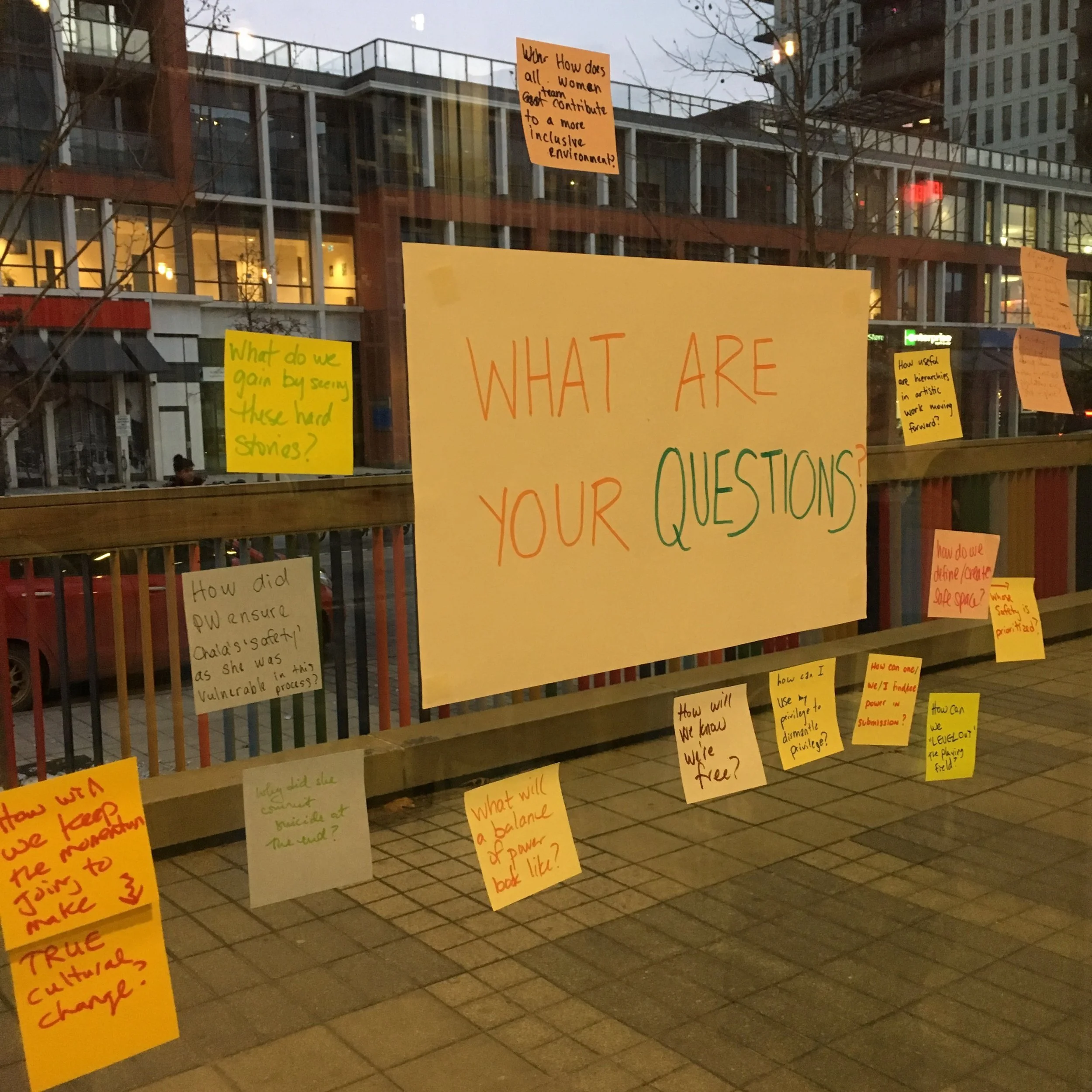
For the second half of the event, Generator’s APT Facilitator Sedina Fiati (pictured below) sat down with The Philosopher’s Wife team to talk about how they tackled these issues in the production. We heard from playwright, producer and actor Susanna Fournier, producer Alison Wong, and actor Chala Hunter. As a jumping-off point, we asked participants to share what they noticed about the production, and what their questions were (responses pictured below). You can watch the whole conversation on Periscope, or read some highlights below:
“It took me a long time to become the proud feminist killjoy that I now am.” -Susanna


On the Relationship with the Audience
Susanna “I think in terms of getting to a point in my practice as a playwright where I am now starting to really meet and develop audiences, for me I think the theatre contract is a stand in for a kind of social contract. So, I've invited you all to come into a space, and I’ve made something and brought other people in and I’m going to offer something, but I need you to come, and so, now we are in relationship with each other. I’ve asked you to come into relationship with me. And so I need to be aware of what my desire is, why have I asked you here, what do I think I have to offer you, what do I hope you might receive, and what am I hoping you might bring to this relationship that now we are in together.”
Alison “Introducing this work to an audience involved setting the stage, so to speak, for conversation. And really working with the intention that these plays are not meant to be let loose into the world and have them, necessarily, speak for themselves; the intention that we want to work in a way that allows the audience to come back to us, whether it is through conversation on the internet, whether it is through events like #UrgentExchange. Even the fact that it’s a trilogy, so knowing that we are building a relationship; the idea is that we want to build a relationship with our audience so that these ideas and the themes that are in the play continue to evolve and we continue to contemplate them each time we meet each other. And trying to, as much as we can with the resources we have available, to create avenues for that.”
On Theatre and Trauma
Susanna “I deal with a lot of difficult topics in my work, and I know that I am looking to create a kind of ritualized space; that potentially we can come together and grapple with some of these traumas in a way that creates even just a moment with which we can feel through them. Because I think if we are not willing to feel through them, they won’t pass through us. And so that is a really delicate thing, to go: I know I am purposely asking folks to come experience a wound, and I think if we can experience that together there is a possibility for changing a narrative around it, or allowing it to maybe leave our bodies, work through our body. I think theatre is a place for and of the body and I feel that I live in a very disembodied culture. And even sometimes in the act of theoretical talking about, of analysis around trauma, analysis around power, it’s like yes: in my head, and my body is not included. And what I find in theatre is when I am moved it’s because I am allowed to feel my way through the things I experience, not just intellectually, but in my heart, and my gut, and I guess that is the power of catharsis.”
On Power in Process
Susanna “I am learning a lot as a playwright and a producer. There is a huge amount of power you have as a playwright, in that I’m choosing content and I’m choosing whose story we are looking at and where should we look in a story in the same way the director can tell us where and who to look at. As a producer I feel that it is the most crucial realm of putting a different kind of politic in action, because I wield our culture’s powerful symbol, which is where does the money go. And you can create a process that reflects where you want to put that money. But you also choose who is on the team, how the team is going to gather, what are we going to talk about, what are we going to prioritize.”


Above: production photos from The Philosopher’s Wife. Cast: Chala Hunter, Aviva Armour-Ostroff, Susanna Fournier and Danny Ghantous. Photography: Haley Garnett and Bernie Fournier.
Chala “A question I have been asking myself in many rooms, as a performer, certainly, but just as a person on the street, or in my home, or in any community or room that I happen to be in, is about how I can embody a kind of equality or community or togetherness or how I can embody the way that I hope or wish power could function in our communities, in our society. And that’s a question; I don’t have the answer to that, but I’m asking it of myself in many different circumstances, and as I ask it, trying to catch myself when I am behaving in ways that I feel I have been conditioned to, out of fear, or learned power structures, or all sorts of things. And so I would say that within the rehearsal hall, especially having been a fairly involved part of the conversation around #MeToo or Not in Our Space, or many of these conversations around harassment and consent in the performing arts and in the world, I’ve been looking to embody in rooms, to be an ally. To show in my behaviour that I will ask questions, ask for consent, be respectful, but also kind of demand it for myself. And that means doing things that make me uncomfortable, like saying no, like asking questions when I don’t understand something but feel embarrassed to ask the question. Even standing next to someone that I feel might be vulnerable in a moment, and that’s an assumption, certainly sometimes, but I’m trying to trust my intuition in those moments and err on the side of being caring and hopeful, rather than this kind of silent ‘I’m going to stay away from a situation or moment that seems like it might be dangerous, or someone might be feeling a bit vulnerable, or they maybe they need some help. And I don’t mean that specifically in this process: I’m talking about in the last year of my life, and I operate in the same way in grocery stores now as well, which I find is necessary sometimes; crazy things happen everywhere.”
Sedina “Now I’m asking myself what kinds of spaces I want to create, and who do we need to be in the space for it to be affirmative and joyful, what do we need to say. …We really have to cultivate character in ourselves, as theatre artists, black performance artists. We are always like ‘In the room, in the room’ but if you are not that outside of the room, how will you be it, how will you suddenly summon up the courage, how will you suddenly summon up knowledge that you don’t have? It behooves us to keep having conversations like these.”
On Safety in Process
Susanna “We do need to always be taking the temperature in the room and go: How are we doing? Is this enthusiastically working? Or are we all like ‘Oh, knives in the air, elephants all over the place?’ And if that happens let’s talk then, before one of the elephants pierces another elephant. If we feel the temperature rising, we can always go ‘Are we ok? Is there something we need to discuss? Has something happened?’ Cause that might have happened two days ago. People’s reactions to things - I was chronically: something bad happens and three days later I’m upset. But I’ve learned to just kind of deal with it. We can’t expect everyone in the moment to react like, ‘Hi, I have the language and tools with which to do this.’ They may react three days later by having a small meltdown in a corner. I think it’s another reason why having producers in the room - or having outside eyes who are watching the process, just there for feedback - is really important. Because I’m still learning, and I still miss moments. There are still moments where I go, ‘I should have said something.’”
Chala “Asking questions is so important, just checking in with people, like kind of maybe more than seems reasonable, is important… There is so much talking that has to go down to make people feel safe.”

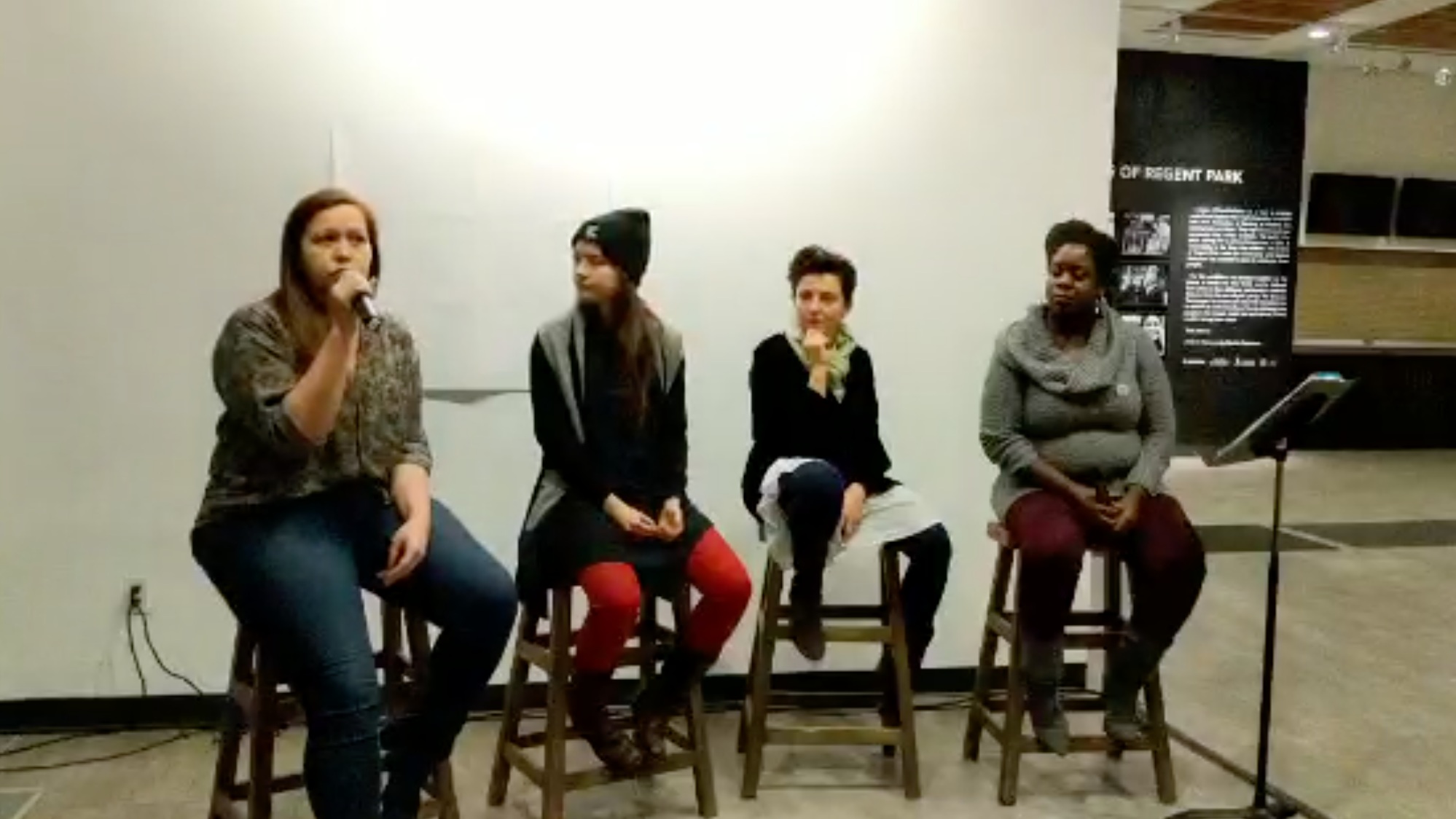

Photos: Speakers Meghan Speakman (left) and Andrea Zanin (right); PARADIGM productions in conversation with Sedina.
On Yes and No
Chala “I had an experience of realizing that I think of no as a rejection, or as like, ultimately negative; as a creative rejection, as a personal rejection, when really what I discovered through this process was that yes and no are both just pieces of information towards greater understanding and more complicity, and that is very fundamental for me.”
Sedina “Our theatre training has trained us out of ‘no.’ Yes and… but the spirit behind yes and is let’s collaborate - it isn’t do what you want. It isn’t yes to anything. It means a spirit of collaboration and that’s what we should be entering into. ‘No’ means, close this door but open a different door. Because that means we have to be creative in the way we do things…‘No’ can be so generous because you are helping the other person navigate, instead of letting them walk into a minefield.

Trailer Project by UnSpun Theatre and Ahuri Theatre
As indie theatre companies and creators, both UnSpun Theatre and Ahuri Theatre have made trailers for our own work in the past – whether for potential audiences or for potential producing partners. We also watch a lot of trailers, or scroll by them as they pop up on our social media feeds. We wondered: is there any magical formula that makes trailers effective? How much do audiences rely on trailers to determine what they’re going to see? What about potential partners?
As indie theatre companies and creators, both UnSpun Theatre and Ahuri Theatre have made trailers for our own work in the past – whether for potential audiences or for potential producing partners. We also watch a lot of trailers, or scroll by them as they pop up on our social media feeds. We wondered: is there any magical formula that makes trailers effective? How much do audiences rely on trailers to determine what they’re going to see? What about potential partners?
We decided to watch a ton of trailers from different performance practices (theatre, live art, dance, performance art) to see if we could come up with ‘rules’ for what works and what doesn’t. We then chose a number of trailers that employed a variety of techniques and held a screening night at the Generator offices. We then put out an online survey to garner feedback on a few trailers that had sparked interesting conversations from our screening night. We also spoke to some producers and producing companies about what they look for in a trailer or short video. We compiled the responses and looked for patterns. We’ve included the emergent patterns below.
Media moves quickly and these responses reflect a moment in time, and particular dominant styles of making trailers. Many respondents noted that we need to keep up with filmmaking trends if we’re going to use film as a marketing tool, and not rely on aesthetics or approaches that have worked so far.
Trailers for General Audiences
About our respondents:
100% of respondents attend live performance (generally at least 4x/year)
70% of respondents are art-practitioners
35% of respondents have made trailers in the past (mostly for the general public, some for potential partners)
Thoughts about making trailers:
“It’s our most effective marketing tool”
“It’s challenging to translate stage acting to film”
“The lack of resources is daunting”
A number of respondents noted that a show trailer they made helped secure a partner:
“Trailers raise the perceived value of a show and increase social media discussion”
Many respondents also noted the challenge in the timing of making a trailer: if you make a trailer early enough to share with potential audiences, you likely won’t have your design elements in place to film. But if you wait for the elements, you’ll miss the window of sharing the video with potential audiences.
68% of respondents watch trailers to determine if they will see a particular show (although, by the end of the survey, many later realized that they rely on trailers more than they had thought)
“I’m more influenced by graphic design and marketing”
“I’ll watch them if they happen to come up on social media”
“Trailers help me learn more about a company more than about a particular show”
67% of respondents said that a particular trailer had prompted them to see a show.
“If a trailer is everywhere I may get sucked in”
57% of respondents said that a particular trailer had made them avoid a show.
Respondents were turned off by: aesthetic, lack of diversity, preciousness, and quality of video
Creating for specific platforms:
Respondents noted that they often watch trailers differently across different platforms. Many do not watch Facebook videos with sound, so using sound as a main source of information or mood is not always useful on Facebook or other social media.
Respondents will usually seek out information about a company or show on their website or YouTube/Vimeo page. They expressed a willingness to watch longer videos on these sites, as opposed to social media sites.
There is a real line between sharing a trailer enough to illicit ‘buzz’ and overexposure.
We divided the trailers into two categories: Representational Trailers and Essence Trailers.
Representational trailers usually use footage and/or audio from the show and give a sense of what the show might be about. The features of Representational Trailers that respondents liked were that they get a sense of what the performance will actually look like and a sense of the aesthetic of the piece. It was agreed that these trailers have more of a chance to be done with poor quality footage and audio and often don’t translate well to film.
Example: UnSpun Theatre, All The Things I've Lost
Essence trailers might use footage that is completely separate from the show itself, and in some cases might be just a series of images and sound. They express a mood or try to pique curiosity. Respondents liked that these trailers don’t give too much away, communicate a feeling, and can be intriguing. These trailers can also alienate audience members or come off as dull, opaque or pretentious.
Audiences use these trailers in different ways: they go to representational trailers to get more details about a show, its style, the company, etc. They go to essence trailers to get excited about a show when they might have already heard about it.
Trailers for Presenters and Partners
We had just as much variety in the responses from presenters as we did from general audience viewers. Overall, it seems that presenters would really rather just watch your work live, but they mostly agreed that trailers can be a very good way for them to learn more about artists and companies whose work they don’t know well. They might also serve to get a presenter interested in work that they can then see live or learn more about from an archival video.
We spoke to presenters who produce touring work on large and small scales, as well as presenters who produce large national festivals.
Here is some of the range of responses we received:
One presenter said, “They’re useless.” They prefer to find new work “on the advice of a very trusted colleague who has seen the production and will vouch for it, by seeing the FULL live performance themselves, if not the full LIVE performance then a full length archival video.” They felt that “trailers are a possible marketing tool for public but they are not what presenters use at all.”
Another felt differently, responding “theatre trailers are very useful for presenters. When done well they provide compelling visuals, context and (hopefully) a few good reviews. (The) problem with trailers and all video is that if they aren't good, they could kill interest in the work (which may indeed be very good). Not all video production is created equal.”
One presenter and curator admitted that they hated having to watch trailers, but that it was a part of their work, and useful for learning about new companies to keep on their radar. They added that the trailer really has to accurately represent the piece if they aren’t able to see the actual show. The presenter said that they often use trailers when putting a season or festival together, as a way or presenting the work to the larger team and as a way of getting a sense of how different work might feel together.
One agent responded “I would say 120% you need a good 2-3 minute video, to sell your show to presenters (who then in turn use it to sell to their audiences) and to get pitch and showcase spots at conferences. I’m ALL for a good (and relatively short) sizzle reel!!”
The results – What to (maybe) do and what to (maybe) not do.
One caveat: there was no trailer that every respondent loved. Responses were extremely divergent. There was more of a consensus during the screening night and we suspect that the group dynamic and conversation helped shape responses. Some respondents loved trailers filled with artsy shots of fields and animals; others thought they were dull and hollow. As with anything, know your audience.
Keep it short. Especially if you’re sharing it on social media. And especially if your content is at all repetitive – in this case, most people won’t watch past 20 seconds of material that features repetitive content.
Tell a story (if you can). It doesn’t have to be a full narrative, and in fact, you’ll do best to focus on one or two elements of your show. It can also be an abstract narrative. But build to some sort of emotional peak.
Interviews must have content. Audiences are leery of interview snippets that feature artists talking about how good or important a show is. They are interested in hearing an interview if there is an interesting story, process, concept about the show.
Consider watching habits. Don’t rely on sound or music if you’re primarily sharing this content on Facebook. It needs to be compelling without sound. Consider subtitles.
High quality footage and audio is everything. You can have a great trailer, but poor quality footage turns people off and it results in your audience assuming that the lack of expertise they’ve seen might translate to the stage. If the sound is bad, they often think the sound in the show will be bad. Consider using mics for an archival run-through to get better sound. If there’s an audience not audibly laughing at a joke, it seems like the jokes aren’t hitting. On the other hand, audiences are forgiving when they see a dull trailer with really high production values.
The same goes for editing. Bad cuts can really stand out in a 45-second trailer.
Give us something, but don’t give everything away. Most viewers like to get some information about a show: Is this a dance piece or a theatre piece? What is the company making this piece? If your trailer is more abstract, audiences don’t mind as long as they’re not left feeling completely confused by the material. Give them something to hold on to.
Define yourself. Audiences responded to new, intriguing terms to define your work. Describing work as “a live film” or “an art party” piqued our respondents’ interests. Don’t be afraid to prominently feature your logo or a strong tagline.
Be graphic. Really cool graphic design elements wowed audiences.
Start strong. If your opening isn’t effective, much of your audience won’t keep watching.
Use choice pull quotes if you have them. Most respondents liked pull quotes and were influenced by them, as long as they came from a variety of sources. Trailers using quotes that came only from Twitter, for example, were frowned upon. Many people noticed this and responded negatively to it. It seemed like it was better to not include quotes than to only include quotes from social media.
Learn about film. Live performance generally doesn’t translate well to film, and the trailers that garnered the most positive feedback recognized this and used the features of film to their advantage. Some chose a representational style, but shot the performers at an interesting location or using close ups. Some were very clever about editing and sound, or using different camera angles.
“ Stage picture and screen picture are different – so just using stage blocking is not the best option.”
“Theatre is experienced live in one long “wide shot.” And I think what’s exciting to me about trailers is it’s a chance for us to get up close and intimate.”
Don’t make me feel like I’m watching a commercial. Even though you’re using this trailer to sell an experience, allow the trailer to stand on its own as a creative storytelling tool.
Do something different. Viewers were almost always interested in unusual approaches to sharing performance on film. Strange short films intrigued audiences and even though these films weren’t as connected to the performances themselves, respondents said they were interested in learning more about an artist or company based on the inventiveness of the material.
Examples
These are examples of trailers provided by UnSpun Theatre and Ahuri Theatre. Enjoy!
#UrgentExchange #WhoIsAMonster Video playlist
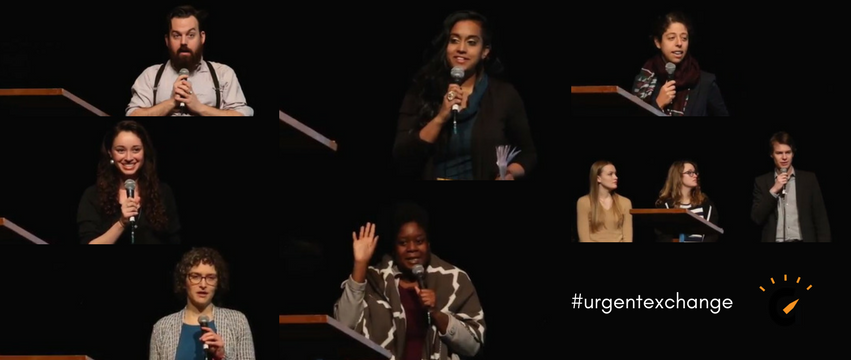
On Saturday, January 6, seven groups of presenters spoke about models for change, followed by on opportunity for audience members to learn more in break-out sessions.
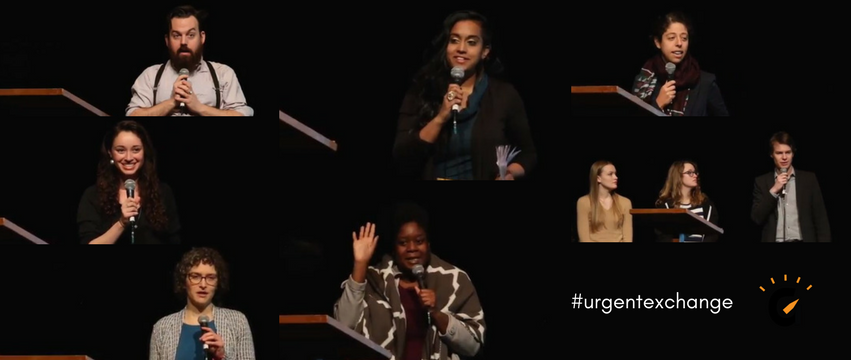
This #UrgentExchange was planned weeks before Kristin Booth, Trish Fagan, Diana Bentley and Hannah Miller came forward. When they did, it became an opportunity for the Toronto theatre community to come together, reel, and start talking about some concrete things we can do to create concrete change. A special thank you to Donna-Michelle St. Bernard and Jivesh Parasram, who moderated a community convening before the #UrgentExchange began.
On Saturday, January 6th, seven groups of presenters (pictured) spoke about models for change, followed by on opportunity for audience members to learn more in break-out sessions. We are so glad to be able to share these presentations with you in video form (shot and edited by Ryan Weatherby) and we hope they will serve to educate, inspire, and bring change.
On Twitter: What people were saying
On Periscope: Watch the recording
On Youtube: Watch the whole playlist, or click individual links below
Nikki Shaffeeullah - Container-Building: Facilitating Accountable Creative Spaces
Thalia Kane - Sharing the power, sharing the freedom.
Pippa Feinstein BA (Hons), JD. - Conflict resolution processes and strategies for healthy work environments
The JONNO team (Paul Van Dyck, Mirka Loiselle & Erica Anderson) - Violence in Theatre: Staging Triggering Material
Brook Thorndycraft - How to learn better ways of relating before the big damage happens
Sedina Fiati - Bystander Intervention
Some Specifics of Site Specific Theatre: A Generator Resident Company Community Project
A five part video series using case studies from Generator's Resident Companies Shakespeare in the Ruff, Outside the March and Litmus Theatre. This project was part is a Community Project as part of their residency.
Some Specifics of Site-Specific Theatre is a Video Series featuring case studies from Litmus Theatre, Outside the March and Shakespeare in the Ruff. This is a Community Project made collaboratively by Resident Companies during their 1st year at Generator.
About this series: Organized into 5 videos to represent a different phase of the creative production process, each company reflects on how they create theatre outside of traditional theatre venues, sharing their inspiration right through to lessons learned.
Part 1: INSPIRATION
Part 2: LOGISTICS
Part 3: THE SHOW
Part 4: AFTERMATH
Part 5: LESSONS LEARNED
Generator and ArtistProducerResource.com are supported by Canada Council for the Arts, Ontario Arts Council, Toronto Arts Council, Government of Canada and Business for the Arts. Videos edited by Dhulfiqar Gshayyish.
Part 1: INSPIRATION
Part 2: LOGISTICS
Part 3: THE SHOW
Part 4: AFTERMATH
Part 5: LESSONS LEARNED
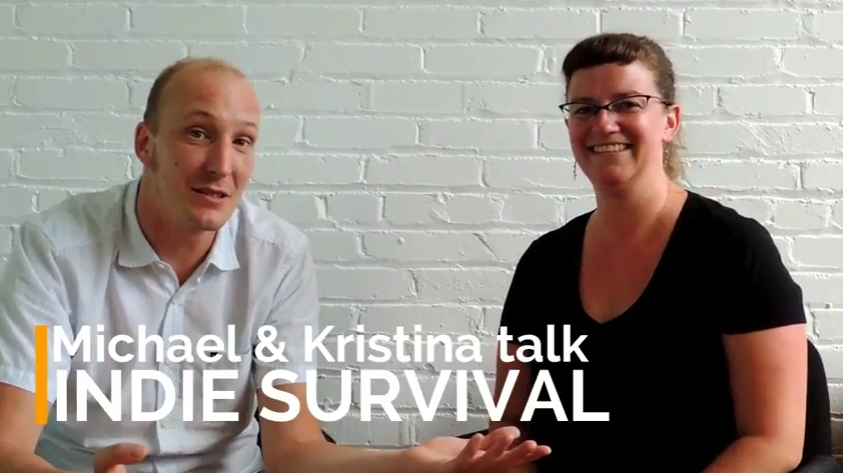
Michael and Kristina Talk Indie Survival
Back in August, Michael and Kristina sat down to talk Indie Survival, and our mutual interests in shared platform models. This December, we announced Kristina as our new Executive Director of Generator.
Back in August, Michael and Kristina sat down to talk Indie Survival, and our mutual interests in shared platform models. This December, we announced Kristina as our new Executive Director of Generator.
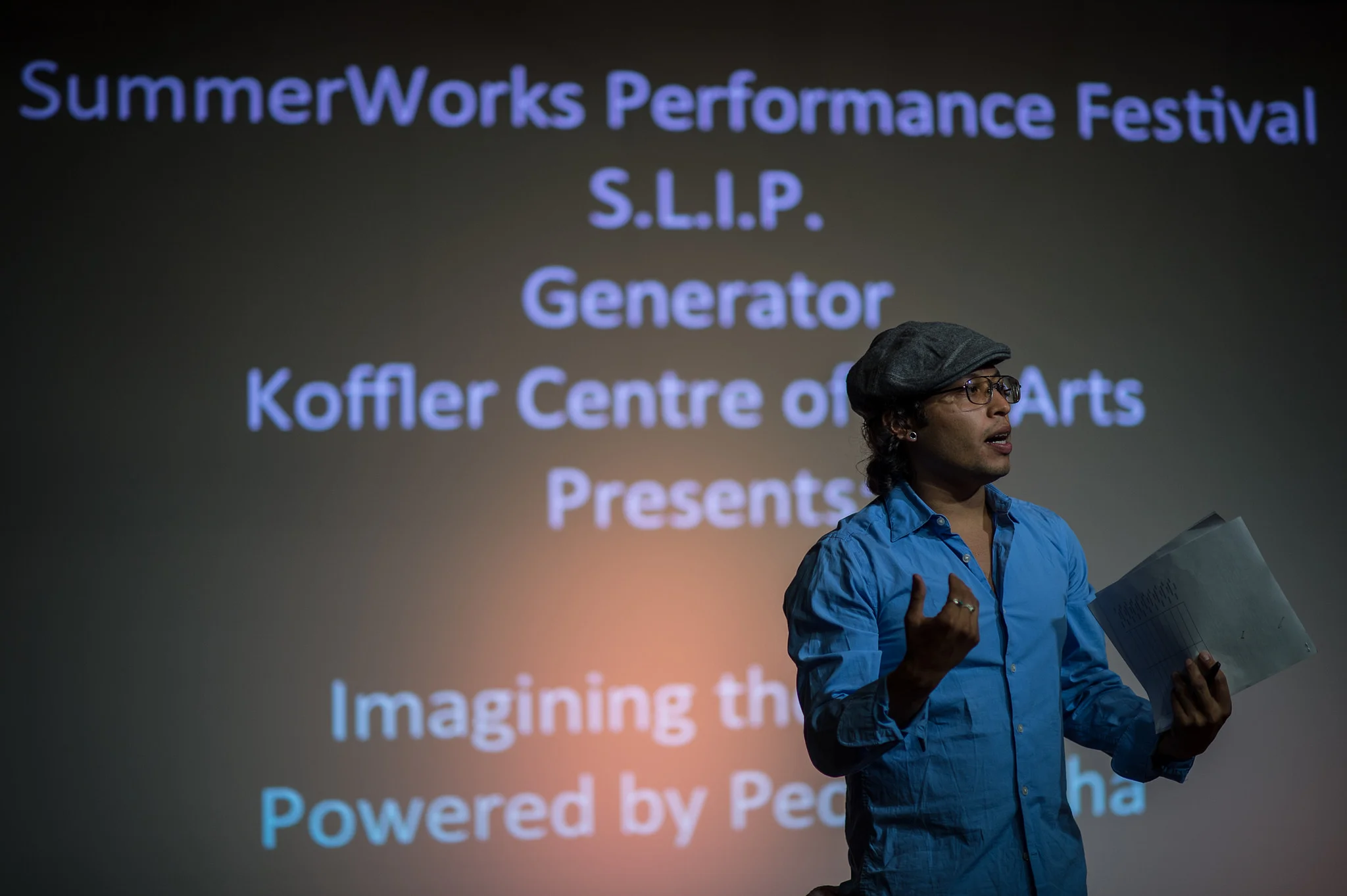
"Imagining the Future" - Pecha Kucha at SummerWorks 2016
Speakers had seven minutes each to give mini-presentations focusing on the question “How do you imagine arts and culture 20 years from now?” Featuring Dr. Mary Fogarty, Alex Johnson, Jane Kirby, Andy Moro, Christine Quintana, Joseph Recinos, Katie Sly, Donna Michelle St. Bernard, and Joshua Vittivelu.
Full recording of the curated event featuring artists, thinkers, makers, doers, activators, and leaders from Toronto and beyond. Following the fast-paced Pecha Kucha format, speakers had seven minutes each to give mini-presentations focusing on the question “How do you imagine arts and culture 20 years from now?”
FEATURING (alphabetically): Dr. Mary Fogarty, Alex Johnson, Jane Kirby, Andy Moro, Christine Quintana, Joseph Recinos, Katie Sly, Donna Michelle St. Bernard, and Joshua Vittivelu.
Presented by SummerWorks, Koffler Centre of the Arts and Generator.
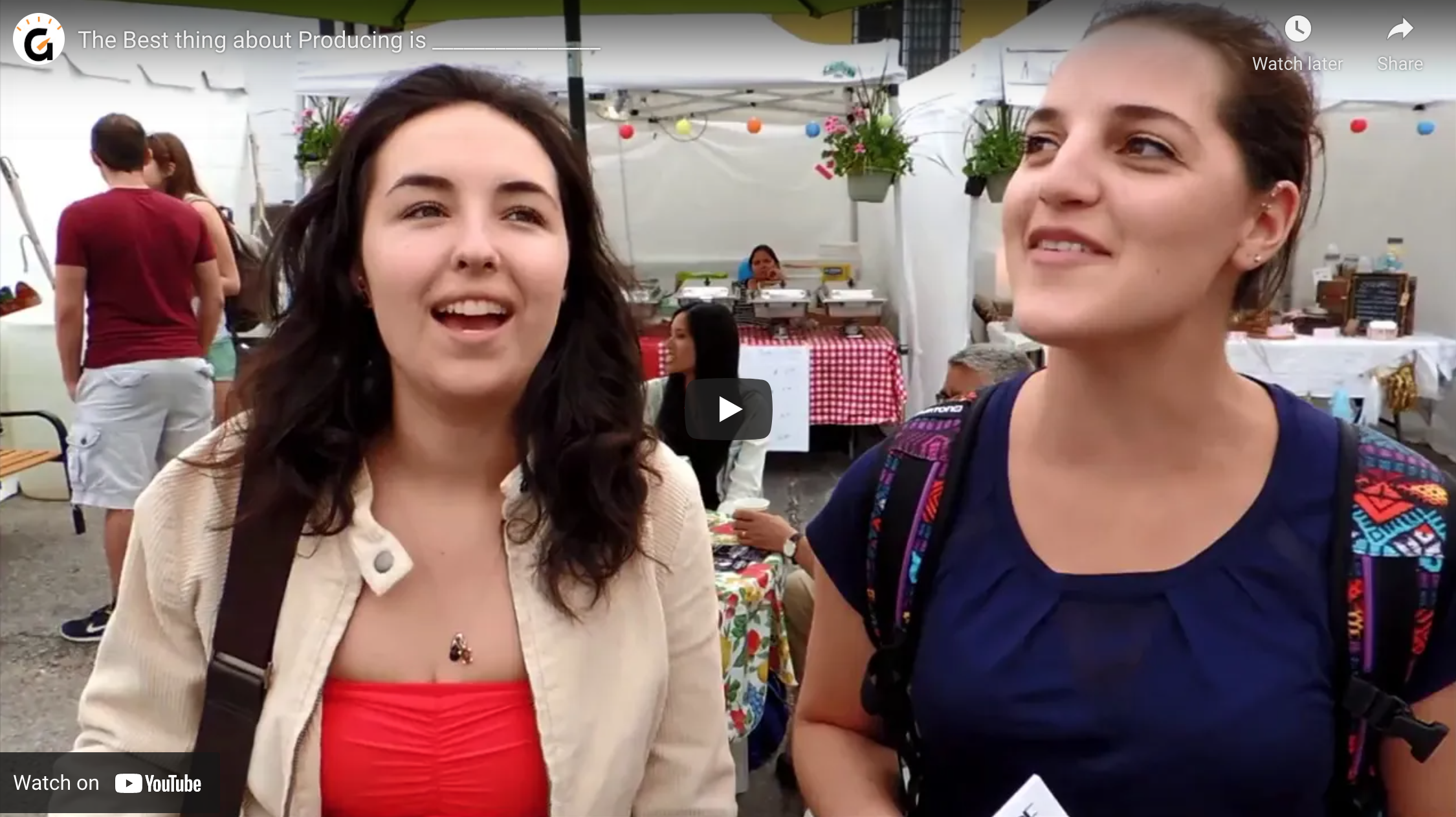
From the mouths of Fringe-ers: what's the best thing about producing?
We asked producers at the 2015 Toronto Fringe tent what they love about producing.