
Blog
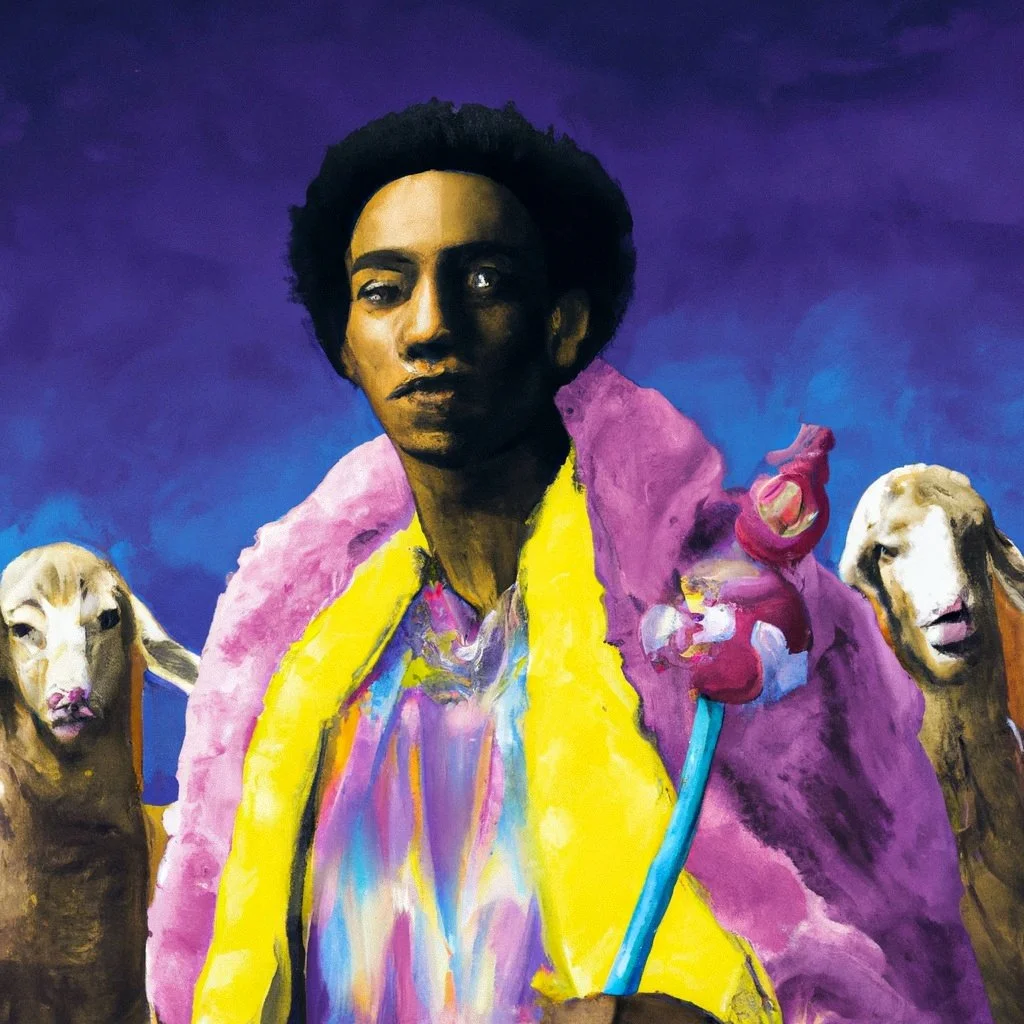
Paprika's 22/23 Hot Topics Series: "Theatre isn't made for me. And it shouldn't be.", or "Wolf Creating in Sheep's Clothing"
Cut to Feb. 22, 2023: I'm watching the Paprika Festival's latest Hot Topics session on "Responsible Storytelling". I'm speaking out loud as though I'm sitting in the live-streamed Zoom room with Santiago Guzman & Donna-Michelle St. Bernard, facilitated by Cheyanne Scott. The three brilliant artists can't hear me snapping or see me nodding, but I want them to know how much their words impact me.
This is the second blog in a series of Artist Responses to Paprika’s 22/23 Hot Topics series. In this post, actor and creator Paul Smith provides a personal response to the ‘Responsible Storytelling’ online conversation.
The more I see theatre and the more I create it, I've realized that most theatre isn't made for me. And it shouldn't be. Personally, I don’t believe that would be responsible. Theatre would suck more than it already does if it were only made for someone like me. But who am I? What is that responsibility, and who is that responsibility to? In the performing arts sector, I would say it’s to our community. But I question, when we think about community, is it the audience buying into our programming or the audience that has never felt welcomed to? However you define it, it is clear that there is some vague sense of duty we take on as storytellers, and if that is what we continue to call ourselves in grant applications and “about us” pages, then that inherent responsibility should be applied to all sides of production.
Cut to Feb. 22, 2023: I'm watching the Paprika Festival's latest Hot Topics session on "Responsible Storytelling". I'm speaking out loud as though I'm sitting in the live-streamed Zoom room with Santiago Guzman & Donna-Michelle St. Bernard, facilitated by Cheyanne Scott. The three brilliant artists can't hear me snapping or see me nodding, but I want them to know how much their words impact me. You can catch the recording of the discussion focused primarily on the creation-based practices of Guzman and St. Bernard here, but their paraphrased themes can be found along this response. On your way to the end, I’ve articulated myself through a list and some art.

“Wolf in Sheep’s Clothing”, AI-prompt-to-painting by Paul Smith inspired by Donna-Michelle St. Bernard likening a [mal/misintention] playwright who hides harm behind their story as a wolf in sheep’s clothing.
But first, a definition. At this moment, I understand community as an environment or population in which an understanding of care is intentionally shared, established, and respected. In my communities, you care for one another when no one else will. Love born out of survival. Despite its instinct to protect, love can cloud the impact of your care. In turn, when care is misplaced, healing can not happen until you understand the harm caused. If you create while denying healing, you only create space for harm. Responsibility in storytelling is then not only about accepting the big wins. It’s also accepting the losses (or learning moments), and facing the choice to own and learn from them instead of denying the reality of one's mishandling of responsibility—lest it spill over into the stories we share and how we share them.
Here are my takeaways:
“When you know all there is to know, your community will teach you all that you forgot.” The question of "responsible storytelling" is not only that of a playwright, dramaturg, performer, or director. It starts and ends with all of us, no matter your role on the performance, production, or administrative side. The message is important, but responsibility comes in how we tell it. Remembering that can allow for fruitful, authentic, and ongoing relationships that foster community as a base pillar of the art we create, but when it is jeopardized or trivialized, neither those making or consuming the art (nor the art itself) will experience their fullest potential.
“Give your community the power to try”. Your intention matters, but it also doesn’t. Your community will experience your story however they experience it, and no amount of care can stop that. However, that doesn’t mean you shouldn’t try. This notion of trying is what interests me so much, as the art of trying is expensive. Unfortunately, there’s not always enough to go around, and even when you're graced with it, how do you use it responsibly? I don’t know. I’ve stopped believing I have to be the one to figure that out.
That being said, I have some offers.
a. Talk-backs & Talk-forwards.
i. The arts’ way of describing what I grew up calling an Ask Me Anything (or AMA). Much like applause after a show, these question-and-answers before or after a show are moments that lower the wall that separates the artist(s) from the audience and equates us as people. I see them as a means of engaging in active discourse, as opposed to just stirring it up and vanishing at the end of a curtain call (if we are granted one). If you have a great facilitator who can host these kinds of discussions, talkbacks and talk-forwards can evolve from an expense to a tradition that makes space for education, meaningful connection, and care. In the last year, I’ve talked with audience members about why they’ve felt uncared for by a production, and often have to tell them “Sorry, I don’t work here”. There are many productions with many reasons why these events don’t happen, but I would have loved to see these paired with a production like Fairview (2023).
b. Check-ins, Check-outs, and the 24/48 Space
i. Sometimes, we bite our tongues for the sake of “the work”. Doing so will only continue to hurt us. So, if something affects you and you are still thinking about it 24 hours later, for whatever reason, know that you can and should address it in the next 48 hours. That space can be created as a result of checking in and out with your community at various checkpoints along the timeline of production, or the start and end of each day. If where you are doesn’t make you feel like that’s possible, maybe you have yet to find or foster community. In The First Stone (2022), similar conventions played a small and essential role in the production.
c. Community Engagement as Gesamtkunstwerk: The Contemporary “Total Work”
i. It is simply not enough for a company with the finances to do more than two shows a year to not engage their community outside of performance. If for whatever reason you choose not to hold a separate event or initiative, how can a community be integrated into the performance itself? I often think about Where the Blood Mixes (2022) or Dixon Road (2022). The former’s design integrated artwork from young students in their community, and the latter production also included reserved spaces for prayer where the show could also still be experienced.
d. Community Nights
i. An extension of the original Black Out Night concept as seen in Slave Play (2020), I see a future where Community Nights act to hold and support space for an affinity group or community that is used as a device for the themes behind the work they are being invited to witness. It’s not just for Blacks anymore (unless we say so)!
“You can’t create for your community responsibly until you stop being scared of them.” I finish the session realizing I still haven’t answered who I am, nor what my responsibility is. As a 24-year-old queer-Black emerging artist with a lot of interests and never enough time, identifying community is harder than defining it, because my community is large. I don’t think I’m equipped to responsibly care for all of them in the ways they need, and that scares me. But I intend to try and will listen as I do, because that is my responsibility as a storyteller.
Now, your turn. Who are you? Who is your community and how have you cared for them? How have you experienced responsible and irresponsible storytelling in your own community? Let me know when you know.
End of list.
Quotes from the Paprika live-event that I offer if you aren’t tired of reading:
I want to entertain but at the end of the day, I think about what is it that this story is going to do for my audience. I think a lot about theater as a way of engaging with our community, so I have a responsibility when I put a story on stage. And I think a lot about that: why am I telling this story to begin with. I think that that's my entry point.
-Santiago
Whatever you're writing, you're putting yourself into it and your perspective into it. Even when you are writing someone for a story that seems far from your lived experience, you are going to insert yourself—not necessarily have a specific avatar, but really all up and down in the cracks. So it's good to know that going in, to intentionally look for what you don't know what you can't know.
-DM


Paprika’s 22/23 Hot Topics Series: Artist Response - Michael Caldwell
At Generator, we’ve had a long and fruitful history in partnership with Paprika, as our missions, our programming, and our ways-of-working have consistently aligned to consider what support looks like for artists and producers in the early stages of their careers.
‘Care’ is a big topic, and it seems to be on everyone’s minds and in everyone’s hearts within our diverse communities of artistic practice, especially in the context of the current state of world affairs.
This is the first blog in a series of Artist Responses to Paprika’s 22/23 Hot Topics series. In this post, Generator’s Creative Director: Programming Michael Caldwell provides a personal response to the ‘With Care’ online conversation.
At Generator, we’ve had a long and fruitful history in partnership with Paprika, as our missions, our programming, and our ways-of-working have consistently aligned to consider what support looks like for artists and producers in the early stages of their careers.
‘Care’ is a big topic, and it seems to be on everyone’s minds and in everyone’s hearts within our diverse communities of artistic practice, especially in the context of the current state of world affairs.
I was unable to attend Paprika’s Hot Topic live session on November 30th, though I was able to view (and now respond to) the recorded version on their Facebook page.
The opening title card brought forward a question, as a prompt for response in the chat room, while we awaited the start of the session… what do you need to feel safe and comfortable in the creative process? Within my own work as a creator and as a facilitator, I’ve been moving further and further away from the idea of ‘comfort’ and leaning into working within discomfort, so my curiosity was already piqued with where this discussion might go…

A screenshot from the Paprika Hot Topic opening screen
This online session featured multi-hyphenate artists, Yolanda Bonnell and Katey Wattam in conversation with Paprika’s Community Programming Producer, Cheyenne Scott. In her welcome and introduction, Cheyenne spoke about her relationship to care, as a seed for this conversation, suggesting that it is easy (and I would personally say, ‘in fashion’) to speak about why care is important, but that it is vital and necessary to talk about how we can implement care into our processes. I was excited to hear this, and so curious about the tangibles that might come forward.
To begin, Cheyenne brought forward a series of story posts from Yolanda’s Instagram page, as source material for, and as a springboard into, the conversation. For me, the two sentences that really struck me -
“You have to actually WANT to do this work.”
“Care as a base shouldn’t be a radical act.”
Wow.
Much of the initial conversation really focused on the idea of unlearning what we’ve been taught. Yolanda cited the culture of always saying ‘yes’, working overtime and not sleeping, and suffering for our art, as outdated and harmful dogmas that require conscious unlearning. And within this, there is an inherent ableism; “because the system works for some, it must work for everyone”. This false assumption does not value everyone’s lived and living experience, and leads to a version of theatre in which only certain privileged individuals are able to practice.
Next, there was a conversation about rehearsal spaces and processes and how they can be caring ones. For me, many of the offerings were (and mostly have been, in the course of my work in Tkaronto) related to time; carving out more time before, during and after rehearsals for care. Yolanda brought forward a recent creative process in which they checked in with all of the artists, before rehearsals even began, to ask questions about the ways that they like to work, and how the room could feel safer and more supported. Katey spoke about a 2-3 day ‘getting to know you’ moment at the beginning of the rehearsal process, to co-create a contract of care for the space. Shorter work days or weeks, check-ins and check-outs, adjusting work hours, and daily rituals, were all mentioned as essential considerations…
Within this notion of added time (and labor) to our rehearsals, a more nuanced and supportive conversation is required with our granting bodies, our institutional spaces, and all those with real or perceived power, to truly support our individual efforts to prioritize care in our creative practices.
A wellness table was perhaps the most tangible offering from this session, and certainly something that I intend to bring forward in my own rehearsal processes. By carving out a space where folx can ask for what they want and need, the table begins to be populated with snacks, vitamins, blankets, mats, stickers, fidget toys, lotions… anything that enhances the overall well being of the individuals in the room. And as Yolanda shared, the wellness table is different for every project, as it changes with the different people in each room.

Screen shot: Cheyenne Scott (top left), Katey Wattam (top right), Yolanda Bonnell (bottom).
Katey spoke about learnings along her path towards a masters degree in social work, with a focus on Indigenous trauma. I was particularly taken by the idea of a window of tolerance, a range of capacity for an individual’s mind, body, and nervous system. When something triggers us, and we become disregulated in a space, how do we stay rooted and become grounded, and how do we relate with others to speak about disregulation, and move towards repair? Katey referred to this empowering work as ‘a cognitive life raft’ - tapping into the sensing, feeling, and thinking self to arrive at a common vocabulary, to create and share more tools for how to remain in the circle within conflict.
“It’s wild what our bodies go through!” says Yolanda, in reference to what we ask of ourselves in performance, and I absolutely agree. We so often ask ourselves to inhabit characters and imagine situations, to tell stories that are incredibly challenging and complex. Through the rehearsal process, Katey believes that it’s important for each individual’s window of tolerance to expand; to build up personal tolerance over time and increase the capacity for holding a specific story.
I truly believe that it is impossible to create a ‘safe space’ where everyone is safe, 100% of the time. When I step outside my door each morning, I encounter different people with different perspectives and I experience discomfort. There is an inherent risk within my engagement with the world around me. This is the same in any rehearsal room, especially when we move into new spaces with new people, all with their own histories and beliefs and opinions and ways-of-working. Cheyenne summarized it best when she said, “Be willing to adjust your plans and be willing to adapt and sacrifice!” There’s a poignant truth in this, even for those of us who are working within constructs of care. The work demands listening; it requires responsiveness and it may even require saving the rehearsal of that scene for tomorrow, while the room attends to community care today.
At the end of the session, Cheyenne brought forward one final question… “What is your last bit of advice, or tips and tricks, for engaging in this work?”
Yolanda: “Honour yourself as a human being that exists in this world, over anything else. You are part of a living, breathing ecosystem, and you deserve care and rest.”
Katey: “There’s no such thing as a ‘difficult’ person, only people with difficult behaviours, and those difficult behaviours point to a need that is not being met. Next time, consider what need is not being met, as this might become an opening for repair.”
Cheyenne: “Transparency. More consciousness and awareness about what people can expect; more communication and preparation. Prepare the expectations in advance. And if you are not receiving the information, know that you can ask for what you want and ask for what you need.”
A truly thoughtful and affecting ending to a very whole session about care.

Paprika Festival is a youth-led professional performing arts organization, which runs year-round professional training and mentorship programs that culminate in a performing arts festival of new work by young artists.
Paprika’s Hot Topics series is presented with support from Why Not Theatre.
