
An Exploration of Access to Opportunities as a Musical Theatre Performer
Written By: Will Parry
Throughout my life I have always wanted to do theatre, despite it not necessarily being a traditional pathway of many of those around me growing up. Friends. Family. People I saw day-to-day. This led to a lot of people feeling a sense of confusion around my career and asking me the ever-dreaded question: “So, what’s next for you?” A seemingly innocent and caring inquiry that myself and almost all of my theatre colleagues are exhausted of hearing… especially performers. Because “what’s next” is so often out of our control.
Theatre at its core is a collaborative art form, meaning it takes multiple people to make it happen. Almost like a team. A team that has to be built for each project. A like-minded group of individuals with complimentary skill sets. Sounds puzzle piece-y, eh? That’s because it is. A very complicated set of puzzles where each individual project has very specific composition needs, where producers and directors are the puzzle-makers, and performers are mere pieces, waiting to see if they get chosen. This means you won’t be the right fit every time, no matter how hard you try. Whether or not a performer gets cast comes down to not only skillset, but many, many other things. This leads to many performers feeling a lack of agency and control in their career. I, along with my swath of Type A performer peers, feel complicated about this. So for my sector research project as part of Generator Performance’s Artist-Producer Lab, I wanted to explore this idea of what it means to have agency in your career and how we as performers can feel a semblance of that, and discuss some of the uncontrollable things that are in our way.
Over the course of a week, I surveyed a wide variety of musical theatre performers based in (or who primarily work in) Toronto. The respondents range in age from 18 all the way to their 70s, and are at various stages of their career, from freshly graduated from theatre school all the way to nearing retirement. It’s important to note as well, while a lot of these folks work primarily in union (Canadian Actors’ Equity Association) spaces as actors, industry realities require them to engage professionally in at least one or two other performing arts disciplines (writing, producing, etc.), in order to stay financially afloat in our current #RecessionCore times. These are my discoveries from their responses. Thank you to all of those who took their time and energy to fill out this survey.
When asked what ways performers were finding work (note: multi-select answer), respondents stated…
95% said Auditions
84% said Working Relationships
61% said Based on Witnessing Prior Work (i.e. seeing you in shows, etc.)
59% said Personal Relationships
with the remainder finding work through interviews, educational/development programs, cold submissions, agent efforts, and self-producing.
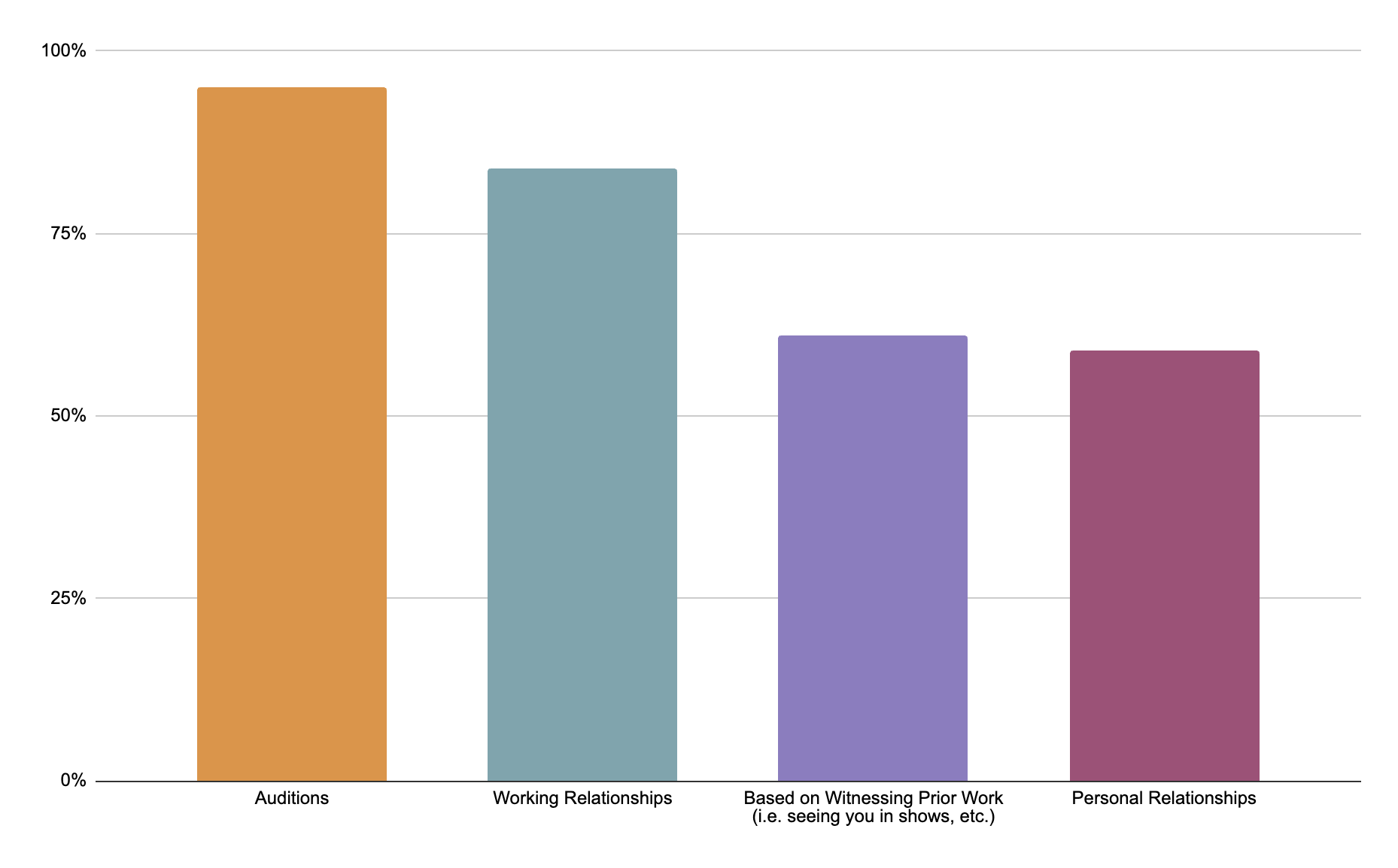
These results reflected what I had assumed prior to the survey: although opportunities primarily come from auditioning, there are a lot of opportunities that come simply from “who you know”. This is likely due to a variety of reasons but it comes down to companies saving time and money by bypassing the audition process and instead offering roles to those they already know and trust. After all, if someone can complete a task once, they’re capable of doing it again,especially if you know what they’re capable of from your own firsthand experience. It makes sense. This set of responses seemed understandable enough, but I wanted to continue investigating past this layer. Let’s continue onto our next set of findings.
When asked what barriers performers felt were most in their way (note: another multi-select), respondents stated…
52% said Lack of Roles/Opportunities within their Playable Demographic
50% said Knowledge of Opportunities
30% said Racism
27% said Interpersonal Conflicts with Engagers (i.e. “this director doesn’t like me”)
27% said Lack of Time Due to Demands of Non-Theatre Employment
25% said Geographic Barriers
Others reported feeling a variety of barriers, most namely: feeling unsafe around particular engagers, fatphobia, nepotism, ageism, and familial obligations.
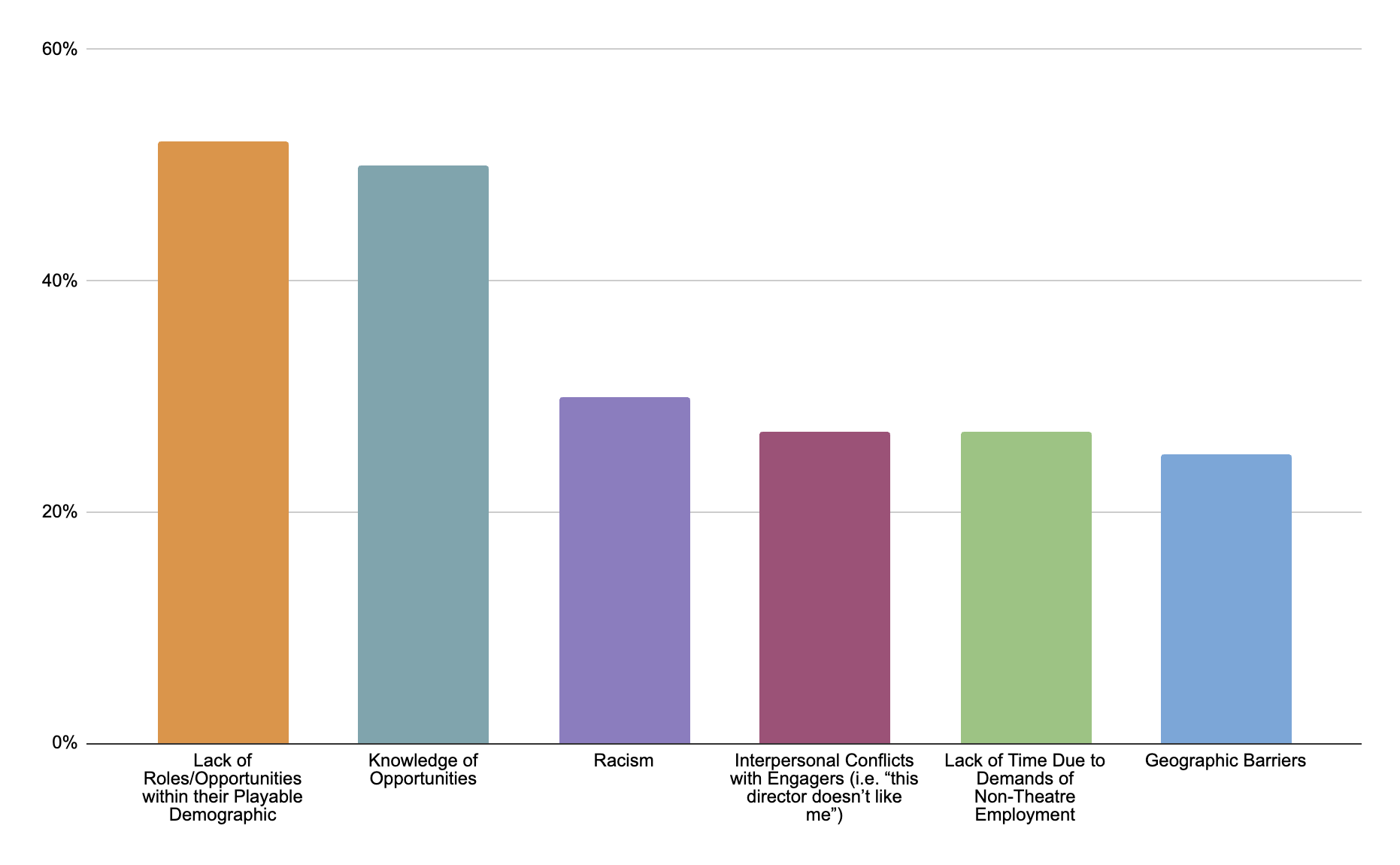
In addition to these barriers, which I listed as options on the survey, some respondents wrote in additional comments: some reflected that their careers felt stifled by companies hiring the same actors over and over; lack of access to development programs (for those who did not attend post-secondary training and/or who began working in theatre later in life); lack of flexibility within contract dates; and the specific shows being programmed. The most written-in response was: leaders of theatre companies are simply hiring their friends.
Through these findings, an underlying theme I found was this idea of gatekept opportunities. Whether it be from the door being completely closed or by a lack of opportunity, OR, more concerningly, the door being intentionally closed to only those already inside. The unfortunate truth is, the musical theatre cannon has not quite caught up to the rest of the world. It’s notoriously quite behind even outside the traditional “golden age musicals”. Casting decisions privilege more “conventional” body types, identities, etc, and those of specific vocal ranges and acting types. All of this has created employment barriers for many respondents. The more concerning takeaway is that respondents perceive most companies to be giving opportunities through internal social circles, which prevents emerging artists, and established artists who are not in the right social circles, from having equitable access to employment. This is inequitable from a labour justice perspective, and lacks sustainability for our industry. The best way for performers to improve their craft and grow their abilities is through practical opportunities; how can we expect folks to get “better” otherwise? In short, it’s not sustainable.
Since this is a larger industry issue, systemic change is needed… but systemic change often starts with small changes made by individuals. In this case, those individuals with the most obvious power to make impactful changes are engagers such as producers, directors, etc. I wanted to instead explore: What are ways that we as performers, and industry as a whole, can build more agency into the performer pathway?
When asked to imagine a more accessible landscape for the musical theatre performer landscape, respondents offered:
Expanding the cannon to include shows with more intersections and identities
Resources to allow theatre companies to view more auditions
More unvetted open calls (audition opportunities where anyone can show up and audition without prior invite, appointment or representation)
Prioritization of emerging artists in audition calls
More publicly accessible audition postings (rather than word of mouth/luck)
Publicly sharing pay rates in audition calls
Expanding “emerging artists” programs to any age (i.e. not conflating “young” with “early career”)
Offer compensation for time in professional development programs
Companies offering workshops solely focused on craft rather than project-focused work
More opportunities for non-locals
Transparency around hiring intentions (i.e. don't hold auditions nationally if you are already committed to only hiring performers who are local to your company)
Hire more diversely
More development opportunities to bridge the gap from post-secondary to professional practice
Transparency on job requirements (i.e. backflips, specific vocal requirements, etc.)
Transparency on what roles are already cast
Semi-professional opportunities for young-in-craft artists to hone craft
Professional hub where theatre seasons are shared before announced to public and already cast
Longer time slots for auditions (to allow for conversation)
Remove opportunities from behind paywalls
More workshop oriented auditions
However, we can’t necessarily make all these seemingly tangible changes overnight, and I wanted to focus on ways performers could improve conditions for themselves, without (or before) the participation of industry leaders So, I asked them: what are moments when performers have felt the most agency within their careers, and how did they create those? Here are some of the tangible steps they took to feel more agency:
Creating their own work
Advocating for themselves and those around them
Declining opportunities that don’t align with them
Reaching out directly to creatives (i.e. to pursue collaboration)
Expanding networks and building community
Exploring other creative avenues (i.e. drag, writing, producing)
Taking classes
Attending theatre
Winning grants
Booking meetings with their agents
In conclusion, the industry has lots of barriers right now when it comes to performers having access to employment opportunities… like a lot of barriers. But even amidst those, there are still ways we as performers can navigate the industry even before changes that engagers and theatre companies can implement in order to support us. With all the above in mind, hold people accountable and be the change you want to see in the industry. Woohoo!