
Dasha Plett
Research Question
What barriers do transfeminine people face as aspiring, current, or former workers in Canada's performing arts sector, and how are we responding to those challenges?
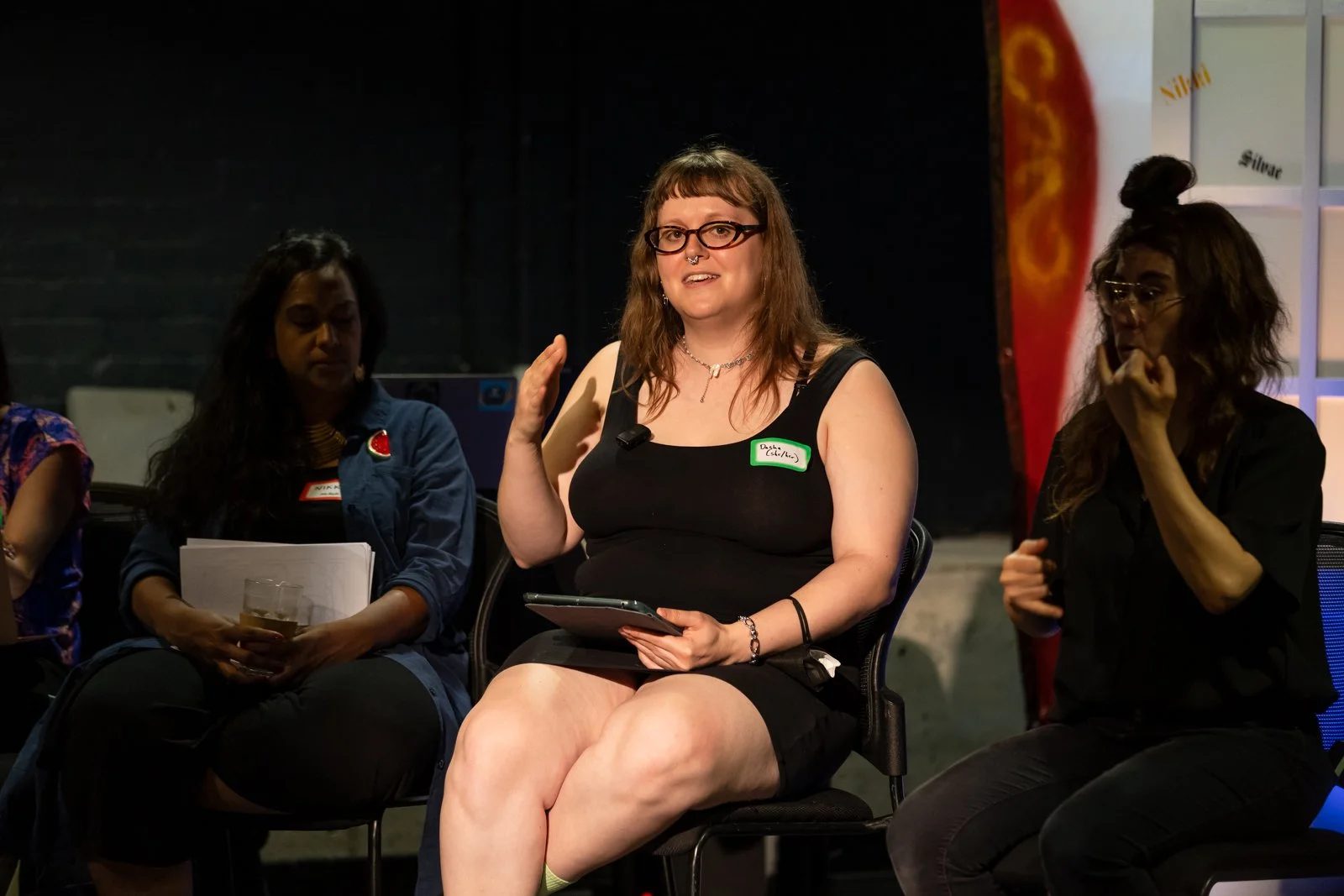
Photo by Marlowe Porter from the Thought Network Symposium

Photo of Glory! We Quit Theatre
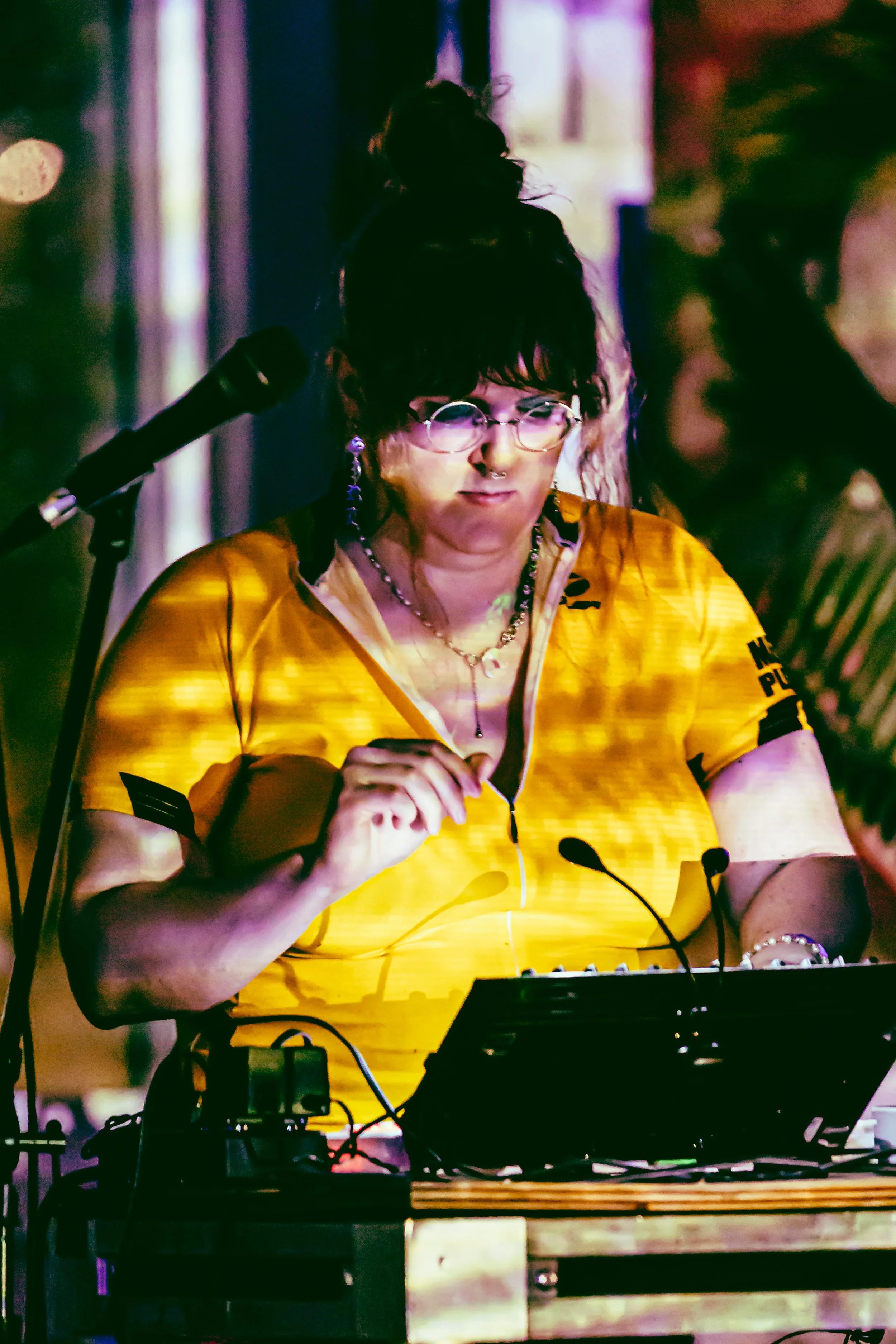
Dasha Plett (she/her) is a Winnipeg-based artist working with performance, sound, and video. Alongside her own projects and work as a freelance composer/sound desgner one half of We Quit Theatre, a nationally touring performance project with Gislina Patterson. Despite living in Manitoba, she was dubbed one of “10 Toronto theatre artists to watch” by Next Magazine in 2024. She is a proud member of IATSE ADC659, and a professional audio describer. Visit Dasha online at www.princessdasha.com.
2025-26 Winnipeg Theatre Gender Statistics
THE 2025-26 WINNIPEG THEATRE GENDER STATISTICS WORKBOOK CAN BE FOUND HERE
Introduction
The goal of this project is to gather and map statistical data about cisgender and gender diverse (i.e. non-cisgender) theatre workers employed as creative team members or performers during Winnipeg’s 2025-26 theatrical season, with special attention given to trans women/fem representation within the industry. I want this project to contribute to a better understanding of the experiences and structural barriers experienced by current, former, and aspiring trans women/fem theatre cultural workers. While Winnipeg-based in its scope, I hope this project’s approach and findings can also provoke thought and inquiry about other Canadian cities and regions.
The project surveys 39 shows presented by 10 (out of 11) Winnipeg theatre companies who receive Manitoba Arts Council (MAC) Operate funding, including sick+twisted (s+t), One Trunk Theatre, Manitoba Theatre for Young People (MTYP), Theatre Projects Manitoba (TPM), Shakespeare in the Ruins (SIR), Theatre Cercle Molière (TCM), Royal Manitoba Theatre Centre (RMTC), Prairie Theatre Exchange (PTE), Dry Cold Productions, and Winnipeg Jewish Theatre (WJT). Currently absent is Rainbow Stage, which receives operating funding but has not responded to my request for copies of their season programs. MAC’s Operate grant program awarded $8,360,000 in 2025, more than double the total awarded by all other programs ($3,574,105), and so is a useful vector for thinking about how our local arts community is materially structured.
This project has been supported by Generator, a Toronto-based organization supporting the development of artist-producers and advancing independent research into the Canadian performing arts. It also benefited immensely from a conversation with my friend and colleague Cat C. Haines about trans misogyny and artistic communities.
Who I am
I’ve been working as a theatre professional for about a decade, and for about 8 of those 10 years, I’ve been doing something with my gender that I’ve given different names at different times, but always has included some form of consciously embracing and practicing femininity. Today, I’d describe myself as a 32-year-old white trans woman, whose employment within her local theatre ecology is mostly as a sound designer / composer. I’ve worked with most local regional and indie companies examined in this study (excepting WJT and Dry Cold Productions) in some capacity or other over the years, and I sometimes work nationally and internationally, with my designs travelling as far away as Norway, and closer to home, receiving multiple Dora award nominations in Ontario. Alongside my work as a designer, I am half of We Quit Theatre, a transgender artist duo comprised of myself and Gislina Patterson. We tour our work regularly across the country, and sometimes self-produce productions in Winnipeg. I am also a member of IATSE Local 659 Associated Designers of Canada and a trained audio describer.
Project background
Something that I’ve noticed throughout my career is that Canada’s theatre industry tends to flatten complex demographics into simple shorthand: categories of race, gender, and disability become umbrellas that obscure the complex variety of experiences within those groups, often erasing forms of privilege or professional advantage certain subsets of these groups might have. Over the last five or six years, I have noticed a heightened attention to who is represented on and behind stage in our industry. “Visibility” has become an important political and economic goal, a thing that audiences, critics, and artists wanted, deserved, and (at least sometimes) demanded. At the same time, as Olúfẹ́mi O. Táíwò so elegantly lays out in his short and essential book, Elite Capture, representation often becomes a game of institutions seeking out the individuals within underrepresented communities whose identity and/or politics are most legible and/or pliable.
I have been curious about how trans women fit into this picture. In my experience, it’s been quite common for me to work alongside non-binary and transmasc artists (alongside other gender diverse artists), but I can only think of one project locally that I’ve worked on where I knew there was another trans woman/fem also employed as a performer or creative team member. I wanted to better understand how trans misogyny has affected me as a theatre worker, if my experiences were merely anecdotal or part of broader systems of oppression at play in theatre. In her indispensable book, A Short History of Trans Misogyny, Jules Gill-Peterson writes that “‘trans misogyny’” refers to the targeted devaluation of both trans femininity and people perceived to be trans feminine. [...] While it can manifest as a system of beliefs, trans misogyny also structures the material world through disparate life outcomes and a suite of characteristically punitive regimes. As an exercise of interpersonal or state violence, trans misogyny [...] trans-feminizes its targets without their assent, usually by sexualizing their presumptive femininity as if it were an expression of male aggression. This process of misrecognition and projection construes its targets as inherently threatening.” While I have benefited enormously from theoretical interrogations of trans misogyny, I have noticed a dearth of statistical information pertaining to trans women/fems in creative fields, and this project is an attempt to provide some data to think through my experiences and those of my sisters, and to offer a hopefully illuminating tool for others who want to think alongside me.
How to use the workbook
The workbook document is an online Excel spreadsheet split into 3 tabs that can be navigated at the lower left-hand side of the screen:
1: Industry and per company data: provides two sortable tables mapping totals and percentages of cis, gender diverse, and trans woman/fem theatre workers employed during Winnipeg’s 2025-26 season. This tab also provides this information for each company surveyed.
2: Per show breakdown: sortable table breaking down cisgender, gender diverse, and trans woman/fem employment for every show surveyed.
3: Industry graphs: a graphical representation of cisgender, gender diverse, and trans woman/fem employment for creative teams, performers, and the two combined.
As you browse the data, I’d encourage you to use the various sorting options for each table, as they can reveal a lot about how a given company or production is approaching gender, as well as interesting information about creative team vs performer representation. The hope is that this data can be helpful to other trans women/fems navigating the theatre industry in Winnipeg and beyond, as well as for allies and other gender diverse theatre workers who want to advocate for an industry that de-centers cis-ness and remain aware of the many complex divisions and power imbalances that can be flattened by common demographic language like “gender diverse.”
Gender is difficult to quantify, and even using broad categories, any attempt to do so should be undertaken with care. This survey draws on publicly available information about theatre workers employed on the shows surveyed, as well as community knowledge acquired from a decade of working professionally in Winnipeg theatre. Like all surveys, this one has made certain assumptions and omissions which I discuss in greater detail later in this document.
Noteworthy findings
- Out of 535 roles surveyed for the Winnipeg 2025-26 theatrical season, trans women/fems worked on four occasions. One of those was an out of town artist traveling with a touring show at the Royal Manitoba Theatre Centre, and to the best of my knowledge was not specifically sought out by the theatre. Two of those were myself.
- Trans women/fems made up just 0.75% of all industry hires.
- 42 gender diverse hires were made during the 25-26 season, accounting for 7.9% of all industry hires. Considering that gender diverse individuals accounted for just 0.3% of the total population according to 2021 Canadian census data, Winnipeg theatre gender diverse hires were comparatively high. According to this same data, trans women account for about 0.1% of the total Canadian population; again, trans woman/fem employment in Winnipeg theatre’s 25-26 season was much higher than this. Nevertheless, it is important to note that trans women/fems account for only 9.5% of gender diverse hires, despite accounting for 27.7% of gender diverse Canadians. In other words, while nearly a third of all gender diverse Canadians are trans women/fems, only a tenth of all gender diverse 25-26 Winnipeg theatre hires were trans women/fems.
- Two of the trans women/fems hired worked on a single show, Neither Here Nor There, developed and presented by s+t. The show was conceived as a collaboration between blind and trans artists, and used the Tiresias myth as its source material. This kind of project is extremely rare in Winnipeg, and while there have been a couple of shows over the last five years written by trans artists (Elio Zarillo’s two shows that were produced at PTE come to mind, both of which I worked on, and both of which only had one trans woman/fem on the team—myself), these shows are very rare. Compared to recent seasons, I’d speculate that the 2025-26 season was actually a very good one for trans women.
- 46% of shows were entirely cisgender.
- 8% of shows had at least one trans woman/fem working on them. s+t consistently ranked highest in terms of rates of employment of both gender diverse theatre workers and trans women/fems and produced the only show to hire a trans woman as a performer. It’s worth noting that sick+twisted only started receiving operating funding in the last couple of years and does not have a permanent office/rehearsal/performance space, in contrast to the majority of theatres surveyed.
- Of the 10 companies surveyed, only s+t (9% of all hires), PTE (1.4% of all hires), and the RMTC (0.5% of all hires) employed trans women/fems.
- In terms of overall gender diverse employment, 32% of s+t’s, 14% of MTYP’s, and 11% of TPM’s total hires were gender diverse. While 8% of RMTC’s and 25% of PTE’s gender diverse hires were trans women/fems, these relatively high rates are due to a comparatively low rate of gender diverse employment overall, RMTC coming in at 6% and PTE at 5% (this places them ahead of only Dry Cold Productions at 4.8% and WJT at 0%--though it should be noted that WJT is a theatre I’ve never worked at and the one I feel most likely to have miscounted somebody).
On methodology and reflections
This study has a number of limitations that I’d like to go through in detail. While potentially tedious, I believe that these notes are crucial for contextualizing this study, and are at least as valuable in thinking about gender in our local and national theatre industry context as the numbers themselves.
This study limits its scope to Winnipeg-based arts institutions who received Operate funding through the Manitoba Arts Council. Winnipeg has a number of theatre companies making indie or Fringe Festival work who do not receive operating funding, including my own, and so are excluded from this study. MTYP’s presentation of the South Korean production Doodle Pop included very little biographical information about the artists, and the language barrier made further research impossible given the limited resources available to undertake this study. TCM’s production of 45, de la Taupinière included almost no information about the process or artists (most of whom I believe were children) who helped develop it. For these reasons, both shows are not included in the survey.
This study looks specifically at two categories of theatre workers: performers (on-stage actors and other performers) and creative teams (playwrights, directors, SM and backstage teams, designers, choreographers, intimacy coordinators, etc.). What “counts” as a performer or creative team member is something that theatres might define differently (i.e. are pit band members credited as performers or creative team? Do they have program bios at all? What about touring shows that provide show credits only for touring personnel? etc.). In general, if a theatre worker was featured in a program (i.e. they had a bio, or, if the company didn’t provide bios, were on a definitive list of theatre workers contracted to work on that production), they are in this study. This study excludes office staff, technicians, carpentry staff, arts administrators, and other support personnel. This was both to make the scope of data manageable given the resources available to me to work on this project, and because public-facing data (like bios, personal websites, and interviews) are far more widely available for performers and creative team than other theatre workers. In rare cases where an individual worked in multiple departments (say, a touring show where the director was also a performer), they are counted towards the category that seemed to me represented their primary role on the production.
Within the on-stage and back-stage categories, theatre workers have been counted in one of three demographics: cisgender, gender diverse, and trans women/fem. The approach of this study is inspired in part by Calgary’s Chromatic Theatre’s YEG Theatre Stats project, an annual survey of Calgary theatre shows and companies that calculates the percentage of employed BIPOC artists based on “perceived and indicated race.” Determining information about someone’s identity without asking them is always a fraught endeavour. Gender is extremely complex, and for many of us, circumstantial. Gender identification can shift over time, sometimes day-to-day, change in different professional or personal settings, or be culturally specific in ways that are flattened by colonial, imperialist, or neoliberal gender schematics. In mainstream neoliberal discourse in the theatre and elsewhere, visibility is often held aloft as a political end in-and-of-itself. But for many trans people, this visibility can be a deadly trap, exposing us to violence that we seek to minimize through non-disclosure of our gendered complexity. Nevertheless, the purpose of this study is ultimately to survey institutional hiring practices; while it is possible, even probable, that there are local gender diverse artists who choose not to be out at work for any number of reasons, and that this in no way invalidates their identity or experience, this also means that a theatre should not be congratulated for hiring them. In spite of these various complexities, this study has looked at public-facing information about theatre workers, including professional bios, personal and professional social media and websites, interviews, and public Winnipeg arts community knowledge to make an educated assessment as to what category an artist might identify with or be identified as.
Some specific notes:
- If a theatre worker used a single pronoun (i.e. “she/her” or “he/him”) in a current bio and prior knowledge of the artist alongside a cursory look at other public-facing media about them didn’t indicate a gender identification other than cisgender, they were put in the cisgender category. In <5 cases, I was unable to find any information about the artist beyond their name and role, and chose to mark them as cisgender. While visibility is a complex experience for many people regarding their gender, in my experience of the local industry, if someone is consciously not cisgender that information is usually publicly noted somewhere. Additionally, the vast majority of Canadian society is cisgender, and so I felt comfortable with the margin of error incurred in making this choice.
- If a theatre worker uses multiple pronouns (say, “she/they” or “he/they”) and there was no indication they were a trans woman/trans fem, they were put in the gender diverse category. While I suspect not everyone who uses “they” or other neo-pronouns alongside a pronoun that aligns with their (assumed) assigned-at-birth-gender would identify as non-binary or gender diverse (perhaps they use additional pronouns to indicate subtle gendered nuance), publicly using additional pronouns puts you at odds, even in small ways, with the cisgender fabric of the world we live in, and so I felt comfortable counting folks in this position towards the gender diverse category.
- If a theatre worker used she/her pronouns and self-described as a trans woman, she was put in the trans woman/fem category. If a theatre worker used they/them pronouns but publicly and professionally embraces personal practices that are frequently trans-feminized, jettisoned from the perceived safety of cisgender society, and consistently marked as feminine, I also put them into the trans woman/fem category. Wearing a dress, using a feminine name, doing complex makeup outside of a drag context, and any number of other personal and/or cultural practices aligned with femininity in a world that assigns you male, regardless of what those practices personally mean to you, can result in a violent trans-feminizing that shifts how you are treated, personally and professionally, and render you vulnerable to trans misogyny. Thinking about trans-femininity in this way draws on Jules Gilles-Peterson’s A Short History of Trans Misogyny, which I’d highly recommend for anyone whose interest is piqued by this survey.
- Very few self-identifying Two-Spirit artists worked in the surveyed theatres during the 2025-26 season. I only counted two, just 0.37% of all artists surveyed, and one of those artists was part of an out-of-town touring production. “Two-Spirit” is a pan-Indigenous umbrella term used to describe a wide variety of what could be articulated as sexual, gender, community, or spiritual Indigenous identities. I think often of how Joshua Whitehead, an Oji-Cree/nehiyaw, Two-Spirit/Indigiqueer member of Peguis First Nation (Treaty 1), and a former classmate, writes about Two-Spirit identity as an experience that exists in complex relationship to settler-colonial understandings of gender and sexuality, including transgender identity. I’m specifically reminded of his extraordinary response to being nominated for a 2018 Lambda Literary Award in the Trans Poetry category and would like to quote it at length:
I recognize the difficulty of categorizing Two-Spirit (2SQ) within Western conceptualizations of sex, sexuality, and gender. I cling to Two-Spirit because it became an honour song that sung me back into myself as an Indigenous person, a nehiyaw (Cree), an Oji-Cree. [....] To be Two-Spirit/Indigiqueer, for me, is a celebration of the fluidity of gender, sex, sexuality, and identities, one that is firmly grounded within nehiyawewin (the Cree language) and nehiyaw world-views. [....] My gender, sexuality, and my identities supersede Western categorizations of LGBTQ+ because Two-Spirit is a home-calling, it is a home-coming. I note that it may be easy from an outside vantage point to read Two-Spirit as a conflation of feminine and masculine spirits and to easily, although wrongfully, categorize it as trans. [....] ‘[Q]ueerness’ is not a word we know, we know relationships and accountability and are birthed into our communities knowing our role and how it is we must contribute. [....] It is my hope that we can begin to have these much needed conversations about the state of 2SQness within, beside, and sometimes beyond, settler queerness, a story of emergence that has many times misguided, misrepresented, and failed 2SQ Indigenous folx at many turns throughout history.
While I am incredibly grateful for the Two-Spirit trans women in my life and communities, and as Jules Gilles-Peterson describes inA Short History of Trans Misogyny, the erasure of Two-Spirit people and identities irregardless of their relation or lack thereof to transness is foundational to the history of trans misogyny itself. It behooves a project like this one to heed Whitehead’s insistence that transness and Two-Spirit experience are not the same, and that attempts to directly conflate the two–in the context of a literary award or a study on trans representation in theatre–ultimately reinscribe violent settler-colonial histories. The illusion of cis-ness as a stable and enforceable category, of “men” and “women” as real and identical categories across time and geography, are violent and fundamentally colonial ideologies that have led to the criminalization, disenfranchisement, murder, and genocide of those deemed gendered others. Gender will always be attenuated by dynamics of colonization, race, disability, and class, and it is incumbent on all theatre workers who desire a freer and fairer theatre to be thinking about these dynamics with the kind of depth, nuance, and sensitivity that artists and thinkers like Whitehead approach the world. In the two cases where theatre workers in this study identified as Two-Spirit, I have opted to put them in the gender diverse category. Neither artist self-described as a trans woman/fem nor, in my limited view, publicly expresses their gender in ways that I believed could be accurately or productively described in those terms. While not the focus of this study, and not something I feel positioned to speak to in depth, I do think that this relative absence of Two-Spirit theatre workers in publicly funded theatre institutions should be taken as a profound indictment of Winnipeg’s cultural institutions, and a failure on their part to think about the complex relationships between gender, sexuality, and the Reconciliation many of them advertise as a part of their mandates.
- This brings up a crucial point and invitation. Part of Chromatic Theatre’s YEG Theatre Stats project that I particularly like is their following proviso: “Stats are imperfect, challenging, and only a small piece of the puzzle. We hope these statistics continue to inspire conversation in our community, and as always if you catch any mistakes, reach out and we will correct them in a jiffy.” This makes the responsibility for thinking about who is being hired in this industry a collective one, and a project like this one a work-in-progress that, while impossible to perfect, nevertheless can be valuable in understanding our individual experiences within this industry, advocating for ourselves and our colleagues, and attempting to transform the industry as a whole. I would like to extend the same invitation as Chromatic Theatre, and earnestly and humbly invite anyone who has questions or suspects an error has been made to contact me and I would be happy to chat or make a correction as quickly as possible. Where I’ve made an incorrect deduction or assumption, I’d plea for forgiveness; while Winnipeg has a comparatively small performing arts scene and that has assisted me in feeling a measure of confidence in how I’ve undertaken this study as I’m often looking at people I’ve directly worked with, spoken to, or am otherwise familiar with, I don’t know everyone, and I’d love this study to be an opportunity to further solidarity between local cultural workers and get to know each other better. All inquiries regarding this project can be sent to wpgtheatregenderstats@gmail.com.
Conclusion
My intention for this statistical data and writing is to better understand the experiences of trans women/fem artists working in Winnipeg theatre and beyond, both as cultural workers and as members of useful but sometimes obfuscating categories like “gender diverse.” Across all of Winnipeg theatre (i.e. including indie theatre, Fringe productions, various technical, administrative, and other support staff), I am aware of six trans women/fems. While many of us live at a variety of identity intersections, we are all, as far as I know, white. I’m struck by both the sparseness and homogeneity of our numbers, and have been thinking a lot about what it says about Winnipeg’s theatre community’s trans misogyny and racism.
I’m not a drag performer, and rarely attend drag events; nevertheless, I follow a lot of local drag performers online, and know that Winnipeg has a small but vibrant drag community, operating almost entirely without operating funding from our local arts councils. Occasionally, drag queens are hired by local arts institutions for one-off performances; notably MTYP has supported drag queen story hour events which faced significant blowback from local far-right protestors in recent years, and—while not a theatre organization—Synonym Arts Consultation (who do receive local operating funding) often plans events that feature drag performers. But beyond this, drag mostly falls outside of the arts council ecosystems. A local trans woman and drag performer, Zova Da Silva, made an Instagram post a couple weeks prior to me writing this, in which she named nine Winnipeg-based trans women and fems who are drag performers, a majority of whom were IBPOC, with multiple Two-Spirit artists represented. This celebration and breadth of local talent and lived experience feels impossible to imagine in Winnipeg’s current theatre landscape, and points to the profound failure of the local industry to nurture and uplift trans women and fems in our community, despite significant resources in terms of civic, provincial, and federal funding, space, administration, and infrastructure. Theatre requires massive numbers of artists to take place; why is it so difficult for trans women to find a place in this industry, particularly if we also are experiencing racism?
This study does not attempt to answer this question, but I hope that it can, if nothing else, allow aspiring friends of the dolls to move through this industry with less naivety, and a greater awareness of whose absence is, perhaps, required to maintain the illusion of the neoliberal theatre. I know multiple trans women in the industry nationally who’ve functionally “quit” theatre in the last couple years. When I presented some preliminary research related to this study at the Generator Thought Network Symposium in Toronto in June 2026, many colleagues working across the country spoke to me afterwards about how the lack and mistreatment of trans women/fems in this industry that I was discussing was reflected in their own artistic communities. I feel extremely fortunate to have a sense of what I’ll be working on for the next 8-12 months, but cobbling together work has been a struggle, and I currently have not been offered contracts at any of the theatres surveyed as a performer or member of a creative team. My belief is that the dearth of trans women in our local industry is reflective of a national problem.
For fellow girlies reading this, I am so proud of you, and I hope there is clarity and perhaps some comfort in the numbers. We so rarely get to experience trans fem consensus reality, and that can take a profound toll.
For everyone else: the tides of fascism, including rampant militarism, imperialism, climate change, xenophobia, cissexuality are growing, even in a country like Canada which preens itself on its supposed political differences from the United States. There’s no time to lose, and I urge all of us to become involved in organizing a theatre and a society where the dolls can work, love, and thrive.
With this being said, I’d like to underscore that any current aspiration for industry change requires a profound reckoning with how our theatres are funded, and move beyond representation as the be-all-and-end-all of political progress. To take one specific local example: Winnipeg’s theatre community receives funding from a variety of sources, including wealthy donors. Gail Asper, a prominent local philanthropist whose various personal and family foundations are proud funders of many of the theatres surveyed here, recently chose to retract promised funding to the Canadian Museum for Human Rights (CMHR) in light of a recent exhibit on Palestinian displacement. To me, this action highlights what I believe is a prickly reality of our industry: that private donor funding is conditional upon those receiving it maintaining specific political allegiances and omissions. While the CMHR is currently standing by their curatorial decisions, it’s not difficult to imagine the ways these sorts of open threats to an institution's operating budget might dramatically shape programming and hiring decisions.
Perhaps more than any other doubt I have about this survey, I am dogged by the question: in an industry that is often used to art-wash abhorrent ideologies and the opportunism of individuals, charitable bodies, and companies alike, should we desire representation for the girls at all?
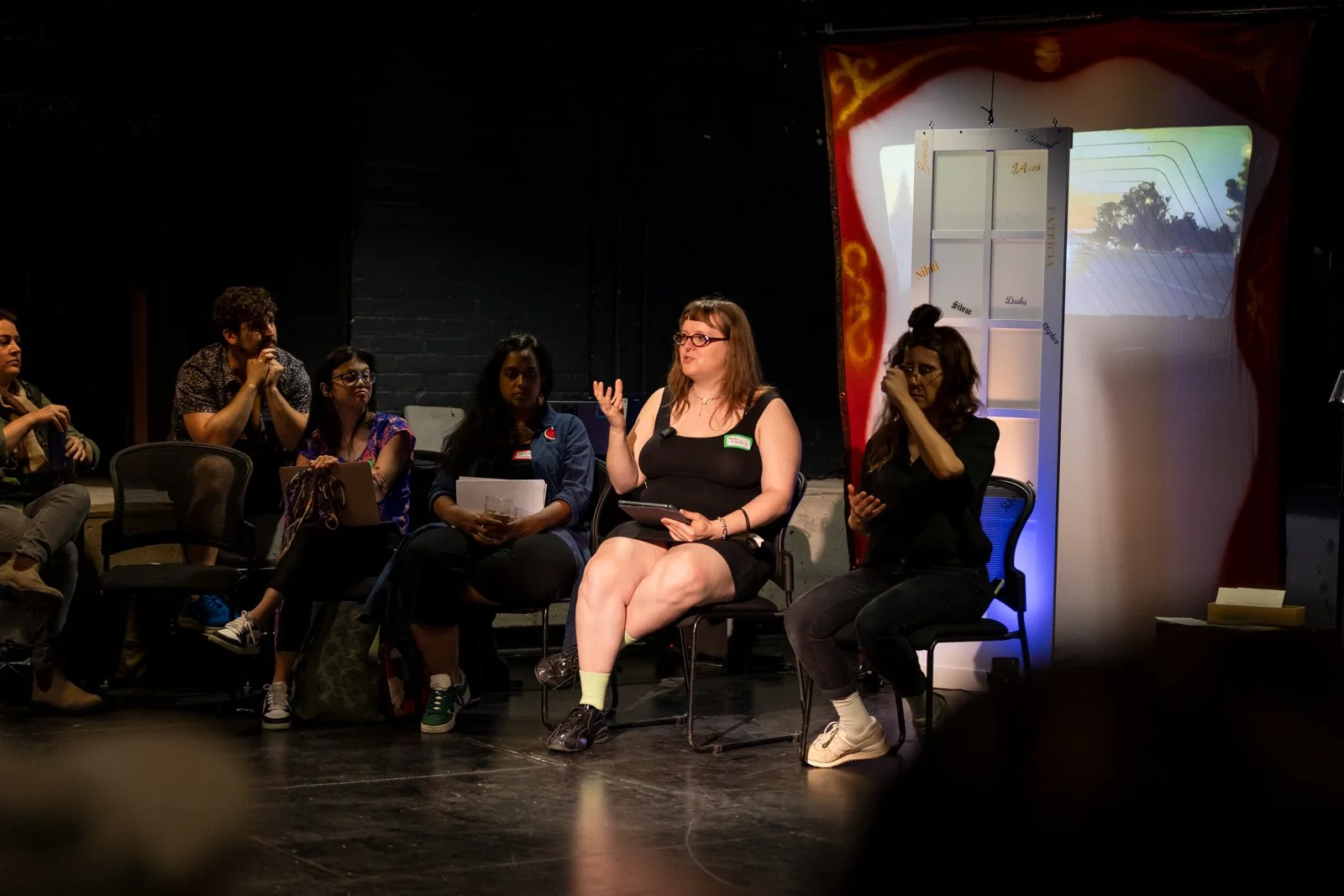

Photo of Dasha Plett in Final Destination Girl by Pablo Riquelme