
Updates
News about our organization and information related to our programs.

Meet the Strategic Advisors!
We are thrilled to be working with this incredible group of Strategic Advisors, who have just begun their focus on four primary strategic areas: leadership transition, governance model, taxonomy review of ArtistProducerResource.com, and expanding our networks.
We’re thrilled to be working with this incredible group of Strategic Advisors! We're working with a few of these wonderful folks for the first time, and we're continuing relationships with many. We are so grateful to each of them for the generosity of heart and mind they are bringing to Generator in this transition period.
As Generator looks to the next chapter of our work building the capacity and resilience of the independent performance sector, we are engaging the Strategic Advisors as a paid advisory body. Through our open call for applications in March/April, we sought experienced and active producers and community members, with close ties to Toronto’s performing arts scene. (You can view the call for applications here. Thank you so much to all those who applied!)
The Strategic Advisors will help inform Generator’s next transformation. This transformation will include a leadership transition, governance review, and ongoing development of online community resources. The Strategic Advisors have just embarked on their work, with those strategic areas as a focus.







The Strategic Advisors Welcome Meal at the end of April! The advisory was joined by board members ted witzel, Claire Burns, and Quinn Harris, and staff members Kristina Lemieux, Annie Clarke, and Keshia Palm.
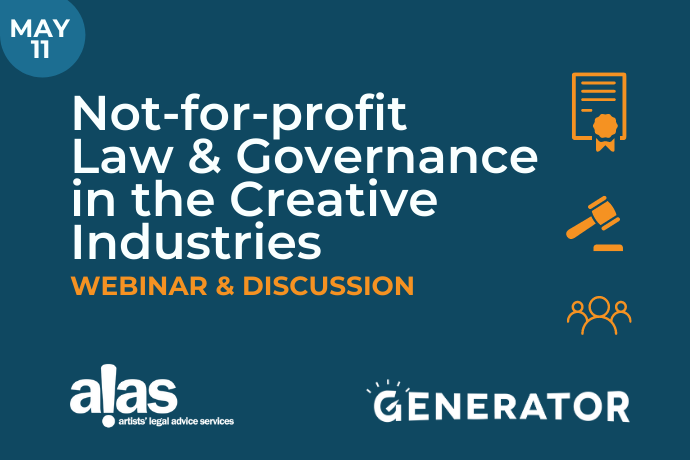
Webinar & Discussion: Not-for-profit Law & Governance in the Creative Industries
Generator is teaming up with Artists’ Legal Advice Services (ALAS) for a workshop on not-for-profit law and governance in the creative industries. Registration required for this free webinar and discussion: May 11, 1-2:30pm ET.
Generator is teaming up with Artists’ Legal Advice Services (ALAS) for a session on not-for-profit law and governance in the creative industries.
We’re in a time of unprecedented momentum for reimagining systems of board governance in the performing arts sector — join us for this free webinar and discussion to understand legal requirements and explore what’s possible.
This session will be held via Zoom Webinar, beginning with a presentation and ending with a question and answer period.
Tuesday, May 11, 2021, 1-2:30pm ET
Pre-registration required (closed as the event is now over)
Live captioning will be provided. If you have any access needs or questions, please contact info@generatorto.com.
Moderator: Catherine Lovrics (Barrister & Solicitor / Canadian Trademark Agent)
Panelists: Terry Carter, Carol Hansell, and Jane Marsland

About the Panelists
Terry Carter
Terrance S. Carter, B.A., LL.B, TEP, Trademark Agent – Managing Partner of Carters, Mr. Carter practices in the area of charity and not-for-profit law, and is counsel to Fasken on charitable matters. Mr. Carter is a co-author of Corporate and Practice Manual for Charitable and Not-for-Profit Corporations (Thomson Reuters), a co-editor of Charities Legislation and Commentary (LexisNexis, 2020), and co-author of Branding and Copyright for Charities and Non-Profit Organizations (2019 LexisNexis). He is recognized as a leading expert by Lexpert, The Best Lawyers in Canada and Chambers and Partners. Mr. Carter is a member of CRA Advisory Committee on the Charitable Sector, and is a Past Chair of the Canadian Bar Association and Ontario Bar Association Charities and Not-for-Profit Law Sections.
Carol Hansell
Carol Hansell is the Senior Partner of Hansell LLP, a member of the Hansell McLaughlin Advisory Group. Over her more than 30 years in practice, she has led major transactions for public and private corporations and governments. She now leads an independent firm dedicated to advising boards, management teams, institutional shareholders and regulators in connection with legal and governance challenges. She is regularly engaged in connection with special committee mandates, board investigations, governance design and reviews and shareholder engagement matters. Carol is also a principal with Hansell McLaughlin Advisory Inc., which, together with Hansell LLP, delivers integrated legal, governance, government relations and communications advice. Carol has served on boards of organizations across a variety of sectors – public companies, Crown corporations, financial institutions, healthcare, not-for-profit and arts organizations. She is a Fellow of the Institute of Corporate Directors and the American College of Governance Counsel and the recipient of a number of awards and recognitions.
Jane Marsland
Jane Marsland has been an articulate advocate for the arts for many years and has served on a wide range of boards, advisory groups and committees. Jane was co-founder and director of ARTS 4 CHANGE, a three-year program designed to create positive change for and by arts professionals in Toronto, as well as co-founder and Director of the Creative Trust: Working Capital for the Arts. Ms. Marsland has managed arts organizations since 1970 and was General Manager of the Danny Grossman Dance Company from 1982 to 1999.
Since 1999, Jane has been working as a free-lance arts consultant and has worked with more than 100 arts organizations. Recently, Jane worked with the Toronto Alliance for the Performing Arts and ARTS Action Research on a two-year community initiative, Theatres Leading Change Toronto involving 18 small and mid-sized theatre and dance organizations. Theatres Leading Change was designed to illuminate and better understand change: on an individual learning level; on a community co-learning level; and as a function of broad-based change that may hold within the possibility of paradigm change in the field.
She has been the recipient of two arts community awards: a “Harold” in 2001 and the Sandra Tulloch Award for Innovation in the Arts in 2002. In 1995, she received the first M. Joan Chalmers Award for Arts Administration for outstanding leadership in the arts. In 2011, she was the winner of the Toronto Arts Foundation’s Rita Davies and Margo Bindhardt Cultural Leadership Award. In 2012, Jane was awarded the first Metcalf Foundation Innovation Fellowship in the Arts to examine Shared Platforms and Charitable Venture Organizations and their applicability to the arts sector in Ontario. Jane was honoured as the recipient of the Silver Ticket at the Dora Mavor Moore Awards in 2017.

Artists’ Legal Advice Services
ALAS’s mission is to empower Ontario’s creative community by providing access to summary legal advice, information and education. Learn more about their work here.
Generator has been writing about boards on our Learnings + Explorations blog this year — find posts here.
2019/20 Annual Report
Generator has published our 2019/20 Annual Report! Our 2019/20 Fiscal Year was September 1, 2019-August 31, 2020.


Generator has published our 2019/20 Annual Report! Our 2019/20 Fiscal Year was September 1, 2019-August 31, 2020. Here are some highlights:
We moved our office from CSI Bathurst to Trinity St. Paul’s Centre for Faith, Justice and the Arts…and then shut our doors when Covid-19 hit in March 2020
Our financial blog posts offered guidance to artists in a rapidly changing economic landscape as pandemic lockdowns began, and were viewed 4200+ times in the first four weeks
Five incredible Artist Producers graduated from our training program, successfully navigating a transition to digital learning and digital practicums in the spring
Even in a year that saw producing grind to a (temporary) halt, 2019/20 was our biggest ever for ArtistProducerResource.com—more than 8,100 users visited the site, a 35% increase over 2018/19
We completed our Transform Dance project, looking at Transformative Justice approaches to workplace harassment in the Toronto dance community—our final project report was shared in March 2021
We began accountability work with consultant Zainab Amadahy, who produced an Equity and Justice and Organizational Review that was published in March 2021
To learn more about our programming plans as we began our 2020/21 year in September, read our Fall Organizational Update here.
Thank you for being a part of our 2019/20 year.
Generator Board Statement on Public Report: Equity & Justice Organizational Review
We're sharing the Public Report of our Equity and Justice Organizational Review, together with a statement from our Board of Directors, a workplan, and notes about the process.
Statement
After Generator released its BLM solidarity statements in the summer of 2020 we received significant criticisms surrounding our working culture and learning environment, including our flagship program, Artist Producer Training (APT). As a result of folks coming forward with critical feedback, Generator leadership hired facilitator Zainab Amadahy to conduct an internal review. The abridged Report shared today reflects the recommendations of that review and the process in which the review was undertaken and approached.
At this time, Generator’s governance and leadership is largely white. The Board is made up of white people and our Lead Producer is white. We are a PWI (Predominantly White Institution). As a service organization that prioritizes supporting artists from equity-seeking groups, we have failed to ensure power dynamics are not skewed along racial lines. Our white governance and leadership are working to understand and address the lived and living experiences of the individuals we aspire to support, particularly artists who identify as racialized, while also creating a long term plan to introduce a broader spectrum of voices into our leadership and governance.
The report created by Zainab outlines this discrepancy between intention and impact. We have read it, are absorbing the concerns of those who participated in the process and are committed to creating an organization that measures our “successes” (however fraught that term may be) in terms of racial equity.
We recognize some members of our Generator community encountered harm while engaging with us. We have heard feedback around equity, paternalism, passive-aggressive communication, lack of clear policies, rigidity and lack of racial representation among our facilitators and leadership. We apologize for the distress and pain our members experienced.
All of us became members of Generator’s board because we believe in the game-changing impact that Generator’s programs can have on individual artists and the Toronto performance sector as a whole. Zainab’s investigation, while framed and targeted to solicit critiques and concerns, also affirmed the essential value of the organization and the Artist Producer Training Program. By Zainab’s account, many participants noted the important professional development APT offered and how it has benefitted their practices.
Under Kristina’s leadership, Generator made a clear commitment to supporting artists from equity-seeking groups, and investing in their capacities to create platforms for their work. We have not always met their needs or supported them on their own terms, and we’ve hurt some of the artists we care about as a result. We are grateful to the interviewees for their honest feedback, and to Zainab for her thorough and candid work in investigating the feedback we received, speaking hard truths with compassion, and for helping us to learn where we must foundationally shift our practices to dismantle White Supremacy Culture within the organization.
We, as a board, are committed to repairing the relationship between the organization and the community. We understand that repair and reconciliation does not follow a linear path, but rather is a circle, a web, a thick braid, which we will attempt to weave laterally, with increased community involvement over the next two years. In the following pages, we have shared our plans for the short, medium, and long terms.
Our first step in this process is to invite other folks to become involved in shaping the next chapter of Generator’s future. We are excited about the energy and ideas that additional voices can bring as we look toward a leadership transition and Generator’s next iteration. In the next few weeks, we will be putting out calls for people to get involved in both volunteer and professional capacities in the coming year, as members of a strategic advisory, by joining us on the board, or by becoming a knowledge contributor for ArtistProducerResource.com.
We encourage you to email feedback or questions to board@generatorto.com, please introduce yourselves. We would love to start a conversation.
We have our sleeves rolled up.
Thank you for your time and consideration.
In solidarity
the Generator Board of Directors
Claire Burns, James Foy, Quinn Harris, Kristina Lemieux, Brendan McMurtry-Howlett, ted witzel
Workplan
Our goal is to rebuild/build trust between:
the organization
ie. the board, the staff, the leadership
AND
our community
ie. program participants, resident companies, community members and past Generator Generations.
Trust first and foremost between the individuals who make up the community and the organization. How do we rebuild trust? We know it will not be easy and will be a continuous process. We do not know the exact pathway but have been set up remarkably well through Zainab’s recommendations.
We are committed to transparency in this process. As Zainab writes, “Decisions can’t be made anonymously or behind closed doors”. The work plan is a work-in-progress developed to put the recommendations into action. The work plan is subject to change based on input from the Strategic Advisors, and we will update our community regularly on our progress. If you are interested in receiving updates or feeding into this process, either as a community member, by joining Generator’s board, or becoming a Strategic Advisor, please subscribe to our mailing list to hear about these opportunities.
SHORT TERM (March-July 2021)
a) Revising organizational values statement to ensure core priority of racial justice
b) Develop Board Work Plan and Matrix for skills development re. dismantling white supremacy
c) Call for professional paid, community Strategic Advisors to support the implementation of recommendations from this report
d) Call for Board Members with goal of racial parity or 50% BIPOC folks in leadership and governance positions
e) Creation of leadership transition plan with an emphasis on models with decentralized and/or shared organizational power structure
MID TERM (July-December 2021)
a) Building a work plan for authentic relationship building between Generator and BIPOC communities
b) Review of Accountability Process including the creation of a Grievance process with clear complaint mechanisms and alignment with goals of social and racial justice
c) Program and Curriculum review including methods for approving facilitators and confirming their commitment to racial justice, ensuring the self-determination of participants, holding folks accountable to their community agreements, and ensuring curriculum is assessed through an equity/social justice lens.
d) December 2021- Board Review- Board reviews its own performance guided by internal/external stakeholders
LONG TERM (January-June 2022 + beyond)
a) Comprehensive strategic review and planning process facilitated by an external consultant
b) 2022- Staff Performance reviews
c) Ongoing recruitment of Board Members with goal of racial parity or 50% BIPOC folks in leadership and governance positions
d) Continue to publicly share our learnings and goals as we identify next steps beyond this work plan
Process
In the spirit of Generator’s mandate as an educational service organization we’ve outlined the process leading up to the release date of this Report and Statement.
Organizational Statements
BLM Solidarity Statement (June 5)
Organizational Update (October 7)
Process Working with External Reviewer
Process of working with Zainab can be found in the Appendix of the Public Report
Consent to share the Public draft of the report was confirmed by Zainab and Participants in late February 2021
Process of Creating this Statement
I’m one person drafting this letter. My name is Claire (she/her). After I drafted this the other board members – Quinn (she/her), James (he/him), ted (he/him), Brendan (he/him) and Lead Producer, Kristina (she/her) – read this, contributed their ideas and suggested edits. Some but not all edits are incorporated in this final doc. We also shared the doc with the Lead Producer who had time to review it before forwarding it to Communications staff, Annie Clarke, to disseminate.
View this statement as a PDF signed by Generator’s board here.
Transform Dance: Final Report
Transform Dance was a pilot project designed to support three Transformative Justice processes for individuals or groups of individuals who had experienced workplace harassment within the Toronto dance community. We wrapped up work on the project in August 2020, and have published a final written report as well as a three-episode podcast to share our learnings.

After sharing a draft version of our Transform Dance report in June 2020 and wrapping up work on the project in August, we are now releasing our final report, prepared by Project Coordinator Meg Saxby.
Transform Dance was a pilot project about finding ways into healing and transformation—both at the individual and at the collective level—within the dance sector in Toronto. In particular, we were interested in addressing harassment (sexual, gender-based and otherwise) and transforming the culture of the dance sector.
Transform Dance was designed to support three Transformative Justice (TJ) processes for individuals or groups of individuals who had experienced workplace harassment within the Toronto dance community.
In the end, the project supported two processes around past harms, as well as a third process that took the form of a multi-part workshop series, designed to build the capacities of men who are emerging and established leaders within the dance community.
Transformative Justice is a non-punitive approach to justice and healing that grows out of the experience, wisdom and practice of communities of colour who seek to resolve harm without resorting to policing structures and the judicial/legal system.
TJ processes seek to create opportunities for people who have been harmed to heal, for those who do harm to learn, change, and grow, and for repair and transformation of the relationship to occur if/when possible and desired. For an introduction to Transformative Justice, read our 2019 blog post here.
We believe this report shows that the TJ approach has considerable merit as a means of providing healing and transformation for the dance sector as a whole, as well as other parts of our culture.
Our report highlights learnings from the Transform Dance project and makes some recommendations for how this work could grow and serve the arts sector. We are optimistic and hopeful that all participants in the arts sector, including funders, governments, arts organizations, and artists themselves will see the value in this approach and continue to invest in it.
The Transform Dance Podcast
Transform Dance was about learning, experimenting, and trying new things. As Transformative Justice is a community-based framework that centres accessibility, we thought documenting our experiences as a conversation would be a valuable way to reflect the project, and to deliver our insights in an accessible way.

We made a podcast where you can hear different people who were connected with the project talk about their experiences.
You can listen to the podcast on Spotify, Stitcher, or Apple Podcasts, or find the transcripts here: Episode 1—Our Advisory Board; Episode 2—Conversation with a Participant; Episode 3—Facilitator Roundtable. The Transform Dance podcast was produced by Katie Jensen of VocalFry.
Report Contents
Introduction
Appropriation and Accountability Statement
The Framework: Transformative Justice
The Problems: What Were We Trying to Address?
The Process: What Steps Did We Take?
The Cases: What Processes Emerged?
The Money: What Did It Cost?
Ideas for the Future: Where Could We Go Next?
Closing the Circle: Thoughts on Accountability for the Future
More Insights: the Transform Dance Podcast
Thank You
Appendices
Acknowledgments
The Transform Dance project came out of a summer 2018 conversation discussing what service organizations could do for harassment in dance in the wake of #MeToo. This project was supported through Toronto Arts Council Strategic Funding (Open Door), and was also supported through Generator’s core funding from Toronto Arts Council, Ontario Arts Council, and Canada Council for the Arts.
Resources
We also invite you to visit resources on the Harassment and Mental Health pages on ArtistProducerResource.com.